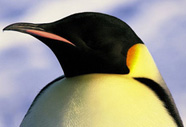
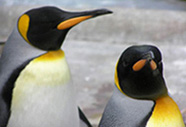
Emperor Penguins are social animals, both foraging and nesting in groups. They are very attentive and act day and night. On land they alternate between walking with a wobbling gait and sliding over the ice on their bellies, propelled by their feet and their flipper-like wings. During the beginning of the Antarctic winter, in March and April, all mature Emperors travel to colonial nesting areas, often walking from 30-70 miles from the edge of the pack ice.
ŸŸŸ
Normally, they are very territorial and will not approach each other easily, but this behavior is one of the ways that emperor penguins manage to survive successfully in the depths of the Antarctic winter. The usually come and interact with each other in response to the cold, where they huddle together for insulation. They stand in compact huddles ranging in size between ten and many hundreds of birds, each leaning forward on a neighbor. Those on the outside tend to face inward and push slowly forward. This produces a slow churning action, giving each bird a turn on the inside. However, studies have shown that by huddling together, emperor penguins use about half the energy that they would otherwise and would starve to death over the winter rather than come through and raise chicks as well.
ŸŸŸ
From January to March, Emperor Penguins disperse into the oceans, traveling and foraging in groups. They can dive from 490-820 feet into the Southern Ocean . In fact, the deepest diving record for the Emperor is 1870 feet. The longest they can hold their breath when underwater is 20 minutes. When swimming, they can speed up to 6 mph but only up to 12 mph in short bursts. Their normal resting heart-beat is about 60-70 bpm. This goes up to 180-200 bpm before a dive as they load up with oxygen, then as they hit the water, the rate drops to 100 bpm. It then immediately slows down to only 20 bpm during most of the dive so they use the stored oxygen in blood and muscles to the maximum effect. On returning to the surface again, the heart rate goes back up to 200 bpm, probably to pay back the "oxygen debt" they have incurred during the dive. Emperor penguins are able to tolerate low levels of oxygen during dives and experience pressures so great that no human can endure. |