
saMsAra
Inspiration
koshas
Universe
Three Views
of the World
Two Guys
karma
saMsAra
Activity and
Experience
Personal Growth
Relationships
Personality Problems
Thoughts on Death
Rebirth
yoga
naiSkarmya
tantra
ishvara(I) ,
devas &
devis
bhakti
Nights of
brahmA
Questions &
Answers
Reference Links
Visitor Survey
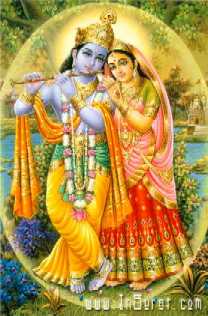
Shri Krishna and Radha


mAm ev'aiSyasi, satyaM te pratijAne, priyo'si me.
Bear me in mind, love me, worship me, bow to me.
You will come to me, I am telling you this truth, for you are dear to me.
Over the years, I have noticed that most people who are new to the concept of karma, have real difficulty grasping it. At the same time, I have always wondered why something so straightforward, and virtually self-evident, needs an explanation. I hope this discussion will be helpful to those who are new to this ancient concept.
To understand karma, one must realize that it is not a religious notion. Many followers of different religions have told me that after death, I will go to hell unless I belonged to their religion, the only true religion in the world. In religions, everything is so black and white. If you belong to a right religion, you go to heaven; else you go to hell and are eternally tortured in most inhumane ways imagineable, by their all-merciful God.
Compared to such religious notions, karma is definitely not straightforward, contrary to my earlier assertion. But it is precisely because so many people are thoroughly steeped in religious way of thinking that karma becomes hard to understand. I think once people disabuse themselves of the erroneous idea that we live a formulaic existence in which A leads to B, X leads to Y and so on, karma will not be so hard to understand.
We should be thankful that life is complex. That is what makes it interesting.
I will start with the quote from bRhadAraNyaka upaniSad: "according as one acts, according as one conducts himself, so does he become. The doer of good becomes good. The doer of evil becomes evil. One becomes virtuous by virtuous action, bad by bad action." Indeed our actions and our conduct, make us what we are.
What is the basis of such an assertion? The Upanishad did not quote any "authority figure" whose word we have to accept without questioning. What then is karma all about? How did this notion come about? Does it really make sense? Here is a brief overview.
People who contemplated mysteries of life and creation, eons ago, were struck by the order underlying a seemingly chaotic existence. They expressed their confidence in this order by the term Rta, which simply stands for "course of things". Science recognizes order in the universe also. In fact, science can be defined as a study of the order in the universe. But Rta is a more overarching concept than the concept of order in science, which is merely order in the physical or material creation.
For the Vedic thinkers, order extended beyond the physical world into our daily existence. Just as day and night are due to order in the physical universe, so are the events in our lives governed by order in our inner universe.
The order of both the external world and the inner world are both maintained by one principal, dharma or the law, that which upholds the order. Things behave the way do because of something that inheres in them; something that, for the physical world, can be described as characteristic property of things. Same is true for us. dharma then is simply the "manner of being". Just like the concept of Rta led to the concept of dharma, the latter led to the concept of karma.
Here is some of what logically follows from the concepts of Rta, dharma and karma:
There is inherent nature to everything in creation. Thus we cannot impose our will on the universe. The only way to "have our way" in the world is through understanding of how the world operates and make sure that "our way" meshes with the natural order. We simply cannot and should not "dream up" our way but rather "find our way" in the scheme of things. Both dharma and karma imply that a right path already exists. All we need to do is to figure it out and tread it. This, of course, leads to the meandering paths we take through all our series of lives - rebirths or reincarnations.
All actions produce consequences. Our actions, i.e. our karma (from kR, to do or to act) result in consequences for us and us alone. This is the basic statement of the law of karma. We experience those consequences unfailingly. All our experiences make an imprint on us. This imprint or impression, or saMskAra, is one immediate way our actions change or form us. The way we react to events is conditioned by these imprints. Some experiences are pleasurable and hence desirable. They generate intentions or vAsanAs in us. Others are painful. They generate aversion and hate. This is another effect of actions and experiences. Indeed, most of the time, we are constantly performing karma or actions, and generating more samskAras (Impressions) and vAsanAs (Intentions). The impressions and intentions we carry contribute to our personalities. They determine how we act and react.
Our actions don't go unnoticed in the universe. They remain our burden till we do something about them. Sum total of a person's karma is his cumulative karma or sanchita karma. Since we are conditioned by our karma, samskAras, and vAsanAs in a fundamental way, we can say that they make up or constitute a person's karmic state at any given time. Thus we can denote a person's karmic state as (Impressions, Intentions, Karma)t where t denotes a point in time and karma is understood as sanchita karma or cumlative karma. Our karmic state changes under the force of our actions and our experiences. This also is a basic statement of the law of karma. Thus we can express the law of karma in terms of karmic state of a person as follows:
(Impressions, Intentions, Karma)1 + Actions + Experiences ===>
(Impressions, Intentions, Karma)2
In this simple equation, 1 and 2 denote karmic state of a person before and after action and experience. The above applies in the subtle and causal bodies of the universe. In the physical plane, the law takes the more familiar form:
(Impressions, Intentions, Karma)1 + Actions ===> Consequences
Science limits itself to a portion of this law:
Actions =====> Consequences
But we all know that our actions result from our karmic state.
We can use these equations to analyze how actions and experiences change a person or his karmic state.
Finally, since a person's total personality is determined by his karmic state, the plots presented in Two Guys, e.g., XBC for X and YBC for Y, also map the karmic state of a person at a given time. Indeed, our karma determines our personality profiles.
We can learn the following from the above equation. A person performs actions impelled by his Intentions and Impressions. Those actions and his experiences change him and leave him with a new set of Impressions and Intentions, besides changing his sanchita karma. This cycle can go on endlessly until something is done to stop it. This is the cycle or the wheel of saMsAra.
Previous Next