           |
Lightsaber Combat For safety the student should be issued a training saber, it handles and functions in all ways as any other saber with the exception that the power has been turned down leaving it capable of producing nothing more than a rather nasty shock if it strikes anything. The five aspects that the student needs to develop are:
1. Awareness
The three rings of Defense The middle ring also involved four guard positions: high, low, left and right. Whereas in the outer ring the blade tended to be held at a diagonal, in the middle ring up and down were parallel to the ground at head and knee height, while left and right were perpendicular to it. The idea with the middle ring was to pick up quicker blows and stop them before they could intersect with the body. Luke also noted that the middle ring was effective against picking off blaster bolts. The inner ring involved parries instead of blocks and was proof against lunging attacks. For this third line of defence, the lightsaber was kept in close, with the hilt covering the navel. By angling the blade, attacks could be shunted aside, and a riposte to the opponent's chest or stomach became a very real possibility. The inner ring was the last line of defence, dangerous to be defending from, and dangerous to be attacking from.
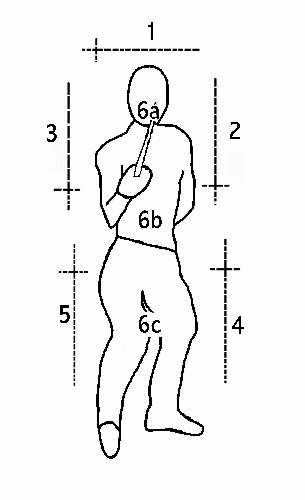
Attacks 2 -- This is a cut parallel to the ground at your opponent's left shoulder. 3 -- This is a cut parallel to the ground at your opponent's right shoulder. 4 -- This is cut to the opponent's left leg. While swinging parallel to the ground is not practical with this move, it should still be done along clean lines, with your weapon pointed down at approximately a 45� angle, maintaining this angle as much as possible throughout the swing. 5 -- This is a cut to the opponent's right leg. See 4 for attack lines. 6 -- This is a thrust to the opponent's torso. Thrust can be divided into three parts: 6a (thrust to the head), 6b (thrust to the torso) and 6c (thrust to the legs). If it makes it easier for you, simply make 6 = 6, 7, and 8.
Force
How to parry these? 1 -- Bring your lightsaber well above the level of your head, having it run parallel to the ground and perpendicular to the swing of the attacker. 2 -- Bring your lightsaber to the left side of your body, with the lightsaber a comfortable distance away from you body (but don't overstretch it). The lightsaber should be perpendicular to the ground and completely vertical (pommel down, point up). Try to place it so that the center of the blade is at the level of your shoulder, so that you will have the maximum chance of safely intercepting the attacker's blade. 3 -- Bring your lightsaber to the right side of your body, using the techniques discussed in 2. 4 -- Bring your lightsaber to the left side of your body, placing the blade down at approximately a 45� angle. As in two above make this parry comfortably away from your body, but do not overextend. Have the lightsaber in your hand, pointing straight out. Then point the lightsaber down to the ground. Finally, rotate your arm at the elbow to the left and bring your whole arm across your body until the lightsaber is in a good parry position. This sometimes both looks and feels more fluid than a regularly executed 4 parry. 5 -- Bring your lightsaber to the right side of your body, placing the blade down at approximately a 45� angle, again making this parry comfortably away from your body. 6 -- Here comes the difficult one: parrying a thrust. As opposed to the other five, which is merely positioning a block, the parry of a thrust involves a movement, some of which can be very interesting. Remember, though, that safety is a primary concern with thrust, because they can be very dangerous to both attack from and defend from. With a lightsaber thrust, which should usually be the standard torso-as-target variety, a good swinging contact with the attacking lightsaber to knock it out of its line of attack and AWAY from you is usually the best and most effective thing. The direction of this parrying swing is really dependant on the situation at hand: what would be the most natural, what attack from who occurs next, etc. The tricky part comes with blocking thrust, as there are more of them and they often come towards more than one target (6a, 6b, 6c). The whack-away method is also effective here, bound by the directional conditions previously stated for lightsaber. However, with the lightsaber, there are more varieties available, which for our purposes I'll call spin parries (simply because that's what I call them). I'm sure you've all seen this move or several like it on the Holonet: the attacker thrust, and rather than just bashing his lightsaber away, the defender 'takes it on his blade', 'spins' his own around it, and flicks it way. This can be as simple as a single spin-and-flick, or can be a series of circular (meaning spinning the lightsaber in a full circle, i.e. a prolonged spin) parry whose purpose is to disarm the attacker. If you practice this basic move once or twice, you will see what it is I mean. These are very effective, and many interesting moves can spring from them.
Deflecting shots with a blade A Krath "feels" for the impending attack upon themselves and through the Force position their blade as to intercept it preventing themselves from being hurt. The shot will then deflect at a random angle, but would not hit the Krath. A Krath can also feel for the location of where they must place their blade as to ensure the blast is directed to a particular location. Directing the shot takes immense concentration, even Krath Priests will often randomly deflect the shots choosing to target only a few of them. The object of the exercise here is not to kill the remote, but to defend yourself from its shots. Use your lightsaber to block the stingshots. Once you can do this with one remote, we�ll work with more. And once you can defend yourself against a handful, we will work on redirecting the bolts at various targets. While the remote, being lifeless, did not have a direct connection to the Force, it existed within the universe bound together by the Force. I made myself disfocus my attention on it directly and instead gain an impression of where it fit within the immediate area. I opened myself to the Force, allowing it to seep in and extend my sensory perception. There, there, I aw the remote moving through the Force, leaving little oscillations in it like a moth moving through smoke. By spotting the disturbances it created, I was able to pick it up and track it. Likewise, within it, the transference of energy created even smaller vibrations within the Force. I sensed the microtemors of energy gathering to fire a stinger. I pinpointed where that reservoir of energy existed and began to bring my lightsaber up and around. As the stinger diode spat scarlet fire, I swept my lightsaber in an arc that picked off the dart heading for my stomach.
Composed partially from materials I would like to send out a special thank you to him for almost all of my Online Materials  |