 |
|
|
|
|
|
|
|
|
|
|
|
|
|
|
|
|
|
|
|
|
|
|
|
|
|
|
|
|
|
|
|
|
|
|
|
|
|
|
|
|
|
|
|
|
|
|
|
|
|
|
|
|
|
|
|
|
|
|
|
|
|
|
|
|
 |
|
|
|
|
 |
|
|
|
|
|
|
 |
|
|
|
 |
|
 |
|
|
|
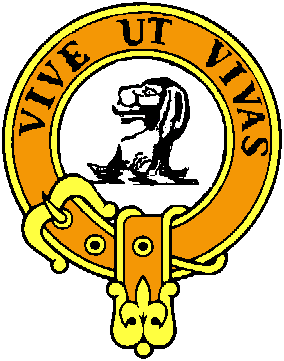
Motto:
"Vive Ut Vivas" - "Live, So That You May Live" |
|
|
|
|
|
|
|
Arms:
Three black Talbot's (a species of hound) heads on a silver background |
|
|
|
|
|
|
|
Badge:
A Talbot's (a species of hound) head |
|
|
|
|
|
|
|
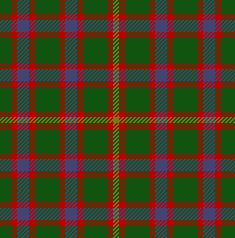
Tartans:
Clan Hall (right) |
|
|
|
|
|
|
|
|
|
Septs:
Halle; Haule; Haul; Hal; De Aula; Hale; Haw; Collingwood; Crispin; Fritz William; MacHall |
|
|
|
|
|
|
|
"The history of Scotland, shrouded by the mists of time, indicates that the name "Hall", is a Norman surname. In Latin documents, the surname "Hall", is usually rendered, 'De Aula'."
"Professional historians used such ancient manuscripts as the Domesday Book (compiled in 1086 by william the Conqueror), the Ragman Rolls, the Wace Poem, the Honour Roll of the Battle Abbey, the cruia Regis, Pipe Rolls, the Falaise Roll, tax records, baptismals, family genealogies, and local parish and church records to establish that the first record of the name "Hall", was found in Lincolnshire {England} where they were granted lands after the Norman Conquest in 1066." |
|
|
|
"The Normans were commonly thought to be of French origin but, they were of viking origin. The Vickings landed in the Orkneys and Northern Scotland about the year 870 AD, under their king, Stirgud the Stout. Later, under their Jarl, Thorfinn Rollo they invaded France about 940 AD. The French king, Charles the Simple, after Duke Rollo laid siege to Paris, finally conceded defeat and granted northern France to Rollo. Duke William who invaded England in 1066, was descended from the first Duke Rollo of Normandy. After distributing the estates of the vanquished Saxons, many nobles were dissatisfied with their lot. They rebelled, so Duke William then took an army north, and wasted the northern countries. Many Norman nobles fled north and were granted lands over the border in 1070 by King Malcolm Canmore of Scotland." |
|
|
|
"Upon entering England with the Norman Conquest, the Hall's were acutally "FitzWilliam's", they being settled in Greatford Hall in Lincolnshire, and being directly descended from Wentworth, Earl FitzWilliam. The younger son of this noble house, Arthur FitzWilliam, was called "Hall", to distinguish him from his senior brother. Hence Arthur Hall would be the first on record about the year 1090 AD. The line continued in Lincolnshire, and intermarried with Crispins, and the Earls of Chester. In Cheshire {England}, the Hall's were a cadet branch of the Kingsley Hall's of that county. By 1340 AD, the name had moved northward at the invitation of Earl David of Huntingdon, later to become King David of Lesmahagow." |
|
|
|
|
|
|
|
"The Hall's were one of the sixty major riding families of the Anglo-Scottish border and were involved in reiving as other border clans were. During one of the "Day of Truce" occasions, a Robert Spragon "fyled" a compliant against two Halls that had rustled 120 sheep. The traditional homes of the Hall's were at Redesdale in England; East Teviotdale, and Liddesdale in Scotland. Some notables in the Scottish East March were: John Hall of Newbigging; Geroge Hall; Andrew Hall of Sykes, and Thom Hall of Fowlscheils. Other Hall's lived in Synstrother; Glenryg, in the barony of Lesmahagow; Garvald; Irvide; Glasgow; Sancharmvr; Preswick and Perth." |
|
|
|
|
|
|
|
Information on this page provided by: |
|
|
|
www.ancestry.com |
|
www.tartans.com |
|
|
|
|
& |
|
|
|
|
|
|
|
|
|
|
|
|
|
"The author and historian, George MacDonald fraser, describes the activites of the Ha'ls for the next three or four centuries as 'A large, widley-spread clan, at one time the most powerful in Redesdale {England}, the Halls were well-hated and feared on both sides [of the border].' The Hall's were considered to be a clan 'to whom no quater (mercy) should be given'. Fraser listed the nortious Hall's as Eddie Hall, 'the famous theif', and George of Bordupp, who served with Phillip in the Low Countires (Belgium and Holland). George of Bordupp is mentioned in 1597 by Ralph Mansfielf, the Keeper of Redesdale, when he was accused of enlisting help from 'a notrorious thief and murderer' in his Border Netherlands' and was being allowed to settle in Redesdale." |
|
|
|
|
|
|
|
 |
|
|
Gathering Family Data Still In Progress |
|
|
|
|
|
 |
|
|
|
|
|
 |
|
|
|
|
|
|
|
|
|
 |
|
|
|
|
|
|
 |
|
|
|
|
|
|
|
|
|
|
|
|
|
|
|
|
|
{Photo Album} |
|
{Halloween} |
|
{Thanksgiving} |
|
{Christmas} |
|
{Fantasy} |
|
|
|
|