
Population:
Area:
Head of State:
Official Language:
Major Languages:
Per Capita GNP:
My Site:
2.5 million (2.2 persons per sq mi)
1,030,700 sq mi
Col. Maaouya Sid'Ahmed Ould Taya
Arabic
French, Hassaniya, Pulaar, Wolof, Soninke
US $500/year
Kaedi, on the border with Senegal
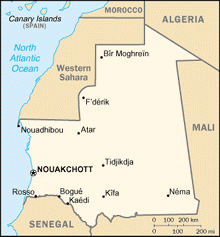
The Islamic Republic of Mauritania is a former French colony which gained its independence in 1960. From that time until 1978, the country was governed by a civilian regime led by Moktar Ould Daddah. A bloodless coup occurred in 1978 after fighting in the disputed territory of the Western Sahara proved to be an unpopular decision among Mauritania's citizens. A series of subsequent coups eventually resulted in the current president, Col. Maaouya Sid'Ahmed Ould Taya, rising to power in 1984.
Although slavery was finally abolished in 1980, pockets of indentured servitude still exist. As a result, on-going conflict among the country's two major ethnic groups drew worldwide criticism from human rights organizations in the 1990s (and still continues today). To stem the tide of this criticism, the government ratified a new constitution and legalized opposition parties. In early 1992, the first presidential elections were held, resulting in Ould Taya's re-election with 63% of the vote. Despite his overwhelming margin of victory, the international community viewed the elections as fraudulent. Opposition parties boycotted the two subsequent elections, resulting in Ould Taya's party (the PRDS) maintaining its hold on the presidency as well as a majority of seats in both houses of the legislature.
Geography and Climate
Mauritania is about twice the size of France, with 75% of the country in the Sahara Desert. As such, rainfall in the desert region is usually less than 100mm (4in) a year. In the south, rainfall increases to about 600mm (24in), most of which occurs in the rainy season of July-Sept. Daytime temperatures reach 85 degrees in the winter and well over 110 degrees in the summer.
Sandstorms, recurring droughts, explosive population growth, and desertification pose the greatest threats to the environment. As a result, in less than two decades, the population has shifted from being 70% nomadic herdsmen to 70% sedentary farmers.