|
|
 |
| Albanian Independence until the Breaking of Yugoslavia Albania decided on declaring its independence from a 500-year reign of the Ottoman Empire. This happened on November 28 1912. The state included Kosovo and the other parts it requested where, the majority of the populace was made of Albanian ethnicity. European powers ruled on giving these Albanian territories to Yugoslavia and Greece, stripping Albania of more than a third of its population. The amputation of Kosovo from Albania caused much anger among all Albanians, but it was mostly felt from the Kosovar Albanians. It caused severe economic problems to the Northern Albanian regions and Kosovo. The new division cut ancient trade routes and it deprived rural traditional markets. Those who attempted to cross borders were either beaten severely or killed. Gavrilo Princip, a Serbian citizen, assassinated Archduke Ferdinand, the heir to the Austro-Hungarian throne. This cause a chain effect that lead into World War I. The outcome of the war was bad for everyone. It heightened the conflicts between Serbs and Albanians. A decade after the war, Yugoslavia was formed. It included Bosnia-Herzegovina, Croatia, Macedonia, Montenegro, Serbia and Slovenia as republics, and Kosovo and Vojvodina as autonomous zones. Albanians in Kosovo were treated poorly in the Yugoslavian state. Their lands were seized, and people were told to leave their homes. There was both physical and mental abuse. The state policy towards the Albanian population was to teach them Serbian language education system. Albanians were denied the right of Albanian language for official matter or any other form of cultural activity. After it educated an opposition elite, this policy was abandoned. Serbs, then, made Albanians go to Muslim primary and secondary schools. This was to keep the Albanians ignorant. This calculation was also wrong. World War II knocked on the door. Yugoslavia and Albania were conquered by the Germany Nazis and the Italian Fascists. The Slavs were seen as an inferior race and were treated worse. Josip Broz Tito, one of the resistance leaders of the fascist occupation managed to win support of the allies and the Yugoslavian people. At the end of the war, Tito ruled a reunited Yugoslavia. He was a communist, and this made it possible for a more equal rights era. Minorities and Slavs were to have equal rights and to be respected by other groups and vice-versa. Kosovo still was an autonomous zone in Serbia. After severed Yugoslavian-Albanian relationship, Albanian rights were not guaranteeing enough in Kosovo. Therefore, Tito asked for changes in the Constitution to help the Albanians. With Marshal Tito in power, Yugoslavia was the strongest Balkan state; second in Eastern Europe next to Soviet Union. On may 4 1980, just before Tito's eightieth birthday, Josip Broz Tito died, and took with him the self-management, brotherhood, and unity of Yugoslavia. Disorientation dominated, especially in Kosovo. Ethnic Albanians had now lost their protector. This leads to recent history and the separation of Yugoslavia. |
 |
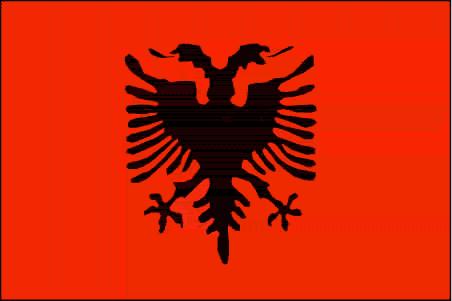 |
| The Albanian flag which is the symbol of Albania's independence. This flag is also the flag of Kosovo(albanian). |