
Jutte-jutsu ~ pronged truncheon art (page 1)
According to Edomachikata Juttejutsu headmaster and historical period researcher Y. Nawa, the jutte (十手、十梃、術手)or jutte(十手、実手)refers to the steel hooked truncheon weapon used in juttejutsu, an historical Japanese arresting art. While the history of the jutte can be traced back to the Muromachi period (some researchers draw a relation between the jutte and the kabuto-wari兜割 or“helmet splitter”) in Japan, the jutte saw most of its application throughout the Edo period by feudal police (yoriki与力, doshin同心) amidst rising crime due to social change.
Jutte were carried as a symbol of authority by police and a limited range of officials, as well as used primarily to disarm and restrain violent individuals for arrest once polearms such as the kumade熊手(rake)、sasumata刺叉(trident)、sode-garami袖絡(sleeve entangler)、and hashigo梯子(ladders used in groups) were used to subdue the criminal. The shaft of the jutte was used to shield and deflect a sword, as well as for striking and grappling purposes, while the hook was used to secure the sword and opponent.
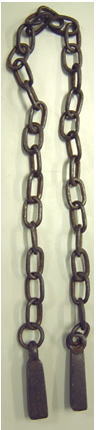
Physically, the jutte is a iron truncheon around 25 - 90cm long with a hook (kagi 鉤) attached. I enclose an image from the Nawa Collection, which incidentally can be viewed at the Criminal Museum of Meiji University, for your reference.
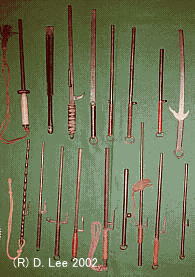
The photograph to left displays a number of Jutte (pronged iron truncheon) along with Kabuto-Wari (helmet-splitter) and Tessen (iron-fan).
Physical properties of the weapon could differ according to rank, system
practiced and individual preference.
Next page..