
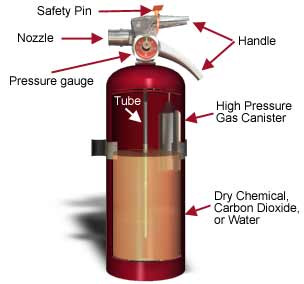
Fire extinguishers are metal canisters containing either water, carbon dioxide, halon or a dry chemical. In a typical household fire extinguisher, there is a plastic siphon tube connected to the top of the canister and leading down to the bottom of the supply of fire-suppressant. Access from the siphon to the nozzle is cut off by a spring-mounted valve. Located in the upper part of the canister is another, smaller cylinder holding a compressed gas, such as carbon dioxide. There is a release valve to prevent the compressed gas from being prematurely let go.
When the operating lever is pressed, it pushes down on an actuating rod, which releases the spring-mounted valve, allowing access from the the siphon tube to the nozzle. The actuating rod, which has a sharp point on the end, also penetrates the release valve of the gas cylinder. This releases the compressed gas, applying pressure on the water or other fire-suppressant substance. The only place for the substance to go is up the siphon tube and out the nozzle. The compressed gas expells the substance with a great deal of force.
In 1819, the British Captain George William Manby invented the first modern version of the fire extinguisher. It was a copper vessel that contained 13.6 liters of potassium bicarbonate under compressed air pressure.
In the late 1800's, the Soda-Acid extinguisher was invented. This type was very similar to a modern fire extinguisher - it was a cylinder containing a fire-suppressant substance (a water and sodium bicarbonate combination), and inside the main cylinder there was a smaller cylinder containing concentrated sulphuric acid. When the smaller cylinder was ruptured, the acid would mix with the bicarbonate solution, expelling carbon dioxide. The carbon dioxide would pressurize the water and force it out of the extinguisher through the nozzle.
In 1912, the carbon tetrachloride (CTC) extinguisher was invented. The canister was made of brass or chrome, and it was operated by a hand pump. This kind of extinguisher was safe to use on flammable liquid and electrical fires. Until the 1970's, they were very popular for use on automobile fires. The CTC worked by putting out the flames through a chemical reaction. However, the vapor and combustion by-products of the CTC were toxic, and some people actually died from using this kind of extinguisher in an insufficiently ventilated area.
How Stuff Works
Chemistry is Everywhere
Wikipedia