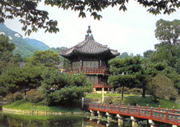
About Korea
The History
The people of the Neolithic Age who migrated into the korean peninsula around 4000B.C. were the ancestors of the Koreans. The Ancient Choson (Korea) period was divided into the Tangun(2333-1100 B.C.), the Kija(1100-194 B.C.), and Wiman(194-108 B.C.) periods, which collapsed when China invaded Korea in 108 B.C.. And then three kingdoms formed, the Koguryo, the Peakche, and the Silla. With the help of China , Silla defeated Paekche and Koguryo and unified Korea. By the 8th century the capital city of Kyongju grew with a population of 1 million. After a 100 years of unity and due to the power struggle of aristocrats, Silla fell in the hands of Koryo in 935. The Koryo period was from 918-1392. With the invasion of outsiders, such as the red turbans and the japanese pirates and the assasination of a highly respected scholar named Chong Mong-ju, Koryo dynastys' 475 years of rulage finally collapsed. A new dynasty was again founded and Korea was renamed Choson or the Land of Morning Calm and a completely new capital city (Soul, or Seoul in Korean) was built. And within this kingdom with the ruling of King Sejong the Han'gul (korean letters) was created.
The Korean people encountered new challenges in the 19th century as the world was shrinking and Western powers were encroaching Asia. Since Korea had no relations with the West, Western nations called Korea a "hermit kingdom". But Korea could not remain a secluded nation, and eventually the pressure that was brought upon Korea by Japan and the Western powers led to the opening of Korea, establishing modern relationships with them toward the end of the 19th century. With this, Korea encountered a variety of problems as the need for her to become modern and preserve her sovereignty and territorial integrity grew. In 1902,as Japan and Russia were on war , a large number of japanese troops invaded Korea and Manchuria. Korea was again occupied by Japanese troops, and was forced to sign many agreements with the Japanese.With these agreements, the Japanese established their control over Korea securing many privileges. When the Japanese emperor accepted on August 15 , 1945 the Potsdam Ultimatum of the Allies, Japanese colonial rule in Korea ended, bringing the liberation which the Koreans has awaited for 36 years. The Cairo Agreement of the US, Great Britain and China made public on December 1, 1943, stated that "in due course Korea shall become free and independent." However, Korea was to be partitioned and occupied by US and Soviet troops, and their failure in Korea led to the emergence of two states of Korea.
Early Sunday, on June 25,1950, North Korean troops opened fire and launched a well planned war against South Korea, thus the beginning of the Korean War. Realizing the grave danger to the existence of the Republic of Korea, Pres. Truman requested the assistance of UN members for South Korea. UN condemned North Korea as an aggressor and asked the member nations to provide military and other assistance to the South. On Sept. 28 Seoul was recovered . In 1951 talks for a truce began but progressed slowly and with the death of Stalin in early 1953 North Koreans were anxious to end the war. As a result, the Korean Armistice was signed on July 27, 1953, and the four-mile-wide demilitarized zone (DMZ) was established across the peninsula along the battle fronts. With this, the truce village of P'anmunjom was put on the Korean map.