
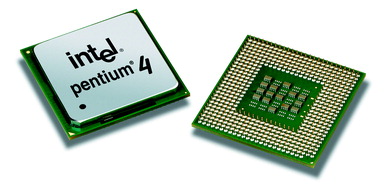
The CPU
The CPU when first turned on, runs on a basic set of instructions contained in the mainboards BIOS which usually will tell the CPU to search for and load an Operating System (such as Windows) often stored on a Hard Drive. It loads your OS and other software into the System Memory where it can access it very quickly so it can then manipulate and process your data, and control the various parts of the computer system.
The technology needed to run a modern computer system is of a very high order, but I believe that the above paragraph is a fairly accurate overview.
CPUs are made by two major companies with few exceptions, Intel and AMD. Each has their own characteristic strengths and weaknesses, making one better suited for a particular task than another.
I will try to list a few here:
Intel:
Generally better suited to business applications, with focus on stability and ability to operate more applications at once. Intel's Hyperthreading is a Technology which allows a single CPU core to act like two seperate ones much of the time, which is helpful for running multiple apps at once. Intel CPUs are rated in the MEGAHERTZ or GIGAHERTZ of the CPU clock, which is not necessarily an indication of speed.
Celeron: Stripped down version of the Pentium series, offers a low cost option.
Pentium4: The current premium desktop processor by Intel.
Pentium M/Centrino: Intels Laptop CPU. Specially designed for low power use, is actually very efficient and cool running. Comparable to P4s of much higher speeds.
AMD:
Designed for high performance, AMDs traditionally excel at Games and other processor intensive software. They are usually a better value, that is more speed for less money. AMD usually uses a more efficient design, so the rating is a higher number than the actual clock speed. The rating is intended to give an idea of comparable speed.
Sempron: AMD's budget entry. Is often considered superior to the Celeron.
Athlon: AMD's premium 32 bit processor.
Athlon64 : AMD's all-new 64 bit processor.


