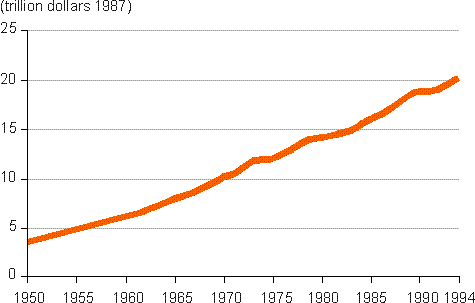
World-wide, rapid and profound changes are occurring in many social, institutional, and economic systems. Continued impoverishment of large parts of the global population, increased disparities both within and among nations, and rapid globalization-particularly through developments in information technology, transport, and trade regimes-are observed. In many countries, there are trends towards decentralization of environment responsibilities from national to subnational authorities, an increasing role for the transnational corporations in environmental stewardship and policy development, and a move towards integrated environmental policies and management practices. Increased willingness by Governments to co-operate on a global basis is witnessed by the multitude of world summits in the last decade. The question arises, however, as to how this willingness is translated into concrete and effective actions. There is greater recognition and popular insistence that the wealth of nations and the well-being of individuals lie not just in economic capital, but in social and natural capital as well.
Against this background of change, many fundamental global environmental trends are emerging from the diverse regional accounts of priority environmental concerns-global and regional, current and future-summarized in this report:
The use of renewable resources-land, forest, fresh water, coastal areas, fisheries, and urban air-is beyond their natural regeneration capacity and therefore is unsustainable.
Greenhouse gases are still being emitted at levels higher than the stabilization target internationally agreed upon under the United Nations Framework Convention on Climate Change.
The use of renewable resources-land, forest, fresh water, coastal areas, fisheries, and urban air-is beyond their natural regeneration capacity and therefore is unsustainable
Greenhouse gases are still being emitted at levels higher than the stabilization target internationally agreed upon under the United Nations Framework Convention on Climate Change.
Natural areas and the biodiversity they contain are diminishing due to the expansion of agricultural land and human settlements
The increasing, pervasive use and spread of chemicals to fuel economic development is causing major health risks, environmental contamination, and disposal problems
Global developments in the energy sector are unsustainable
Rapid, unplanned urbanization, particularly in coastal areas, is putting major stress on adjacent ecosystems.
The complex and often little understood interactions among global biogeochemical cycles are leading to widespread acidification, climate variability, changes in the hydrological cycles, and the loss of biodiversity, biomass, and bioproductivity.
There are also widespread social trends, intrinsically linked to the environment, that have negative feedback effects on environmental trends, notably:
an increase in inequality, both among and within nations, in a world that is generally healthier and wealthier (See Figure 5.);
a continuation, at least in the near future, of hunger and poverty despite the fact that globally enough food is available; and
greater human health risks resulting from continued resource degradation and chemical pollution.
If one were to distill four key priority areas that emerge from the GEO-1 Report for immediate, enhanced, and concerted action by the international community, energy, environmentally sound technologies, fresh water, and benchmark data are obvious choices. Many other urgent action areas are apparent in the report as well. But these four, although touching on different levels at which action should be taken, address key areas needing attention if the world is to reverse the negative environmental trends highlighted in the GEO Report. Economic cost-benefit analyses will need to be conducted in conjunction with concerted international action in these areas.
[Executive
Summary] [Global Overview] [Overview
of Regional Status and Trends] [Overview
of Regional Policy Responses] [Looking
to the Future] [The Way Ahead] [Energy
efficiency and renewable energy resources]
[Appropriate
and environmentally sound technologies world-wide] [Benchmark
data and integrated assessments]