Benchmark data and integrated
assessments
Assessments are required continually
to guide rational and effective decision-making for environmental policy
formulation, implementation, and evaluation at local, national, regional,
and global levels. To improve the global capability for keeping the environment
under continuous review, urgent action is required in the following fields:
investment in new and better data
collection, in the harmonization of national datasets, and in the acquisition
of global datasets;
increased understanding of the linkages
among different environmental issues as well as of the interactions between
environment and development;
enhanced capabilities for integrated
assessment and forecasting and the analysis of the environmental impact
of alternative policy options;
better translation of scientific
results into a format readily usable by policy-makers and the general public;
and
the development of cost-effective,
meaningful, and useful methods for monitoring environmental trends and
policy impacts at local, national, regional, and global levels.
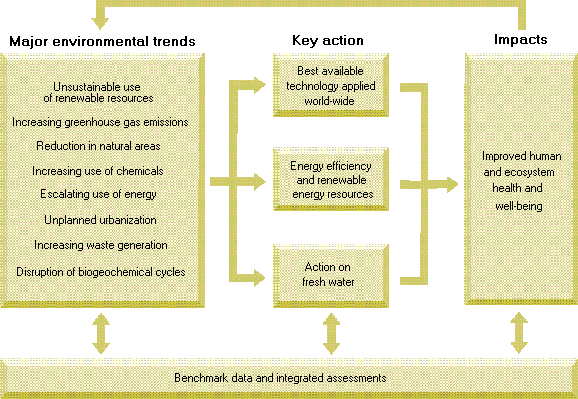
Figure 6 illustrates the relationships
among key actions, major environmental trends, and the ensuing overall
improvements in environment and human health and well-being. To achieve
advances in one or all of these key areas for action, a change in the "hearts
and minds" of everyone will be required, along with a world-wide transition
towards equity and resource efficiency. The necessary financial resources
will have to be made available at national and international levels. Estimates
have indicated that if 2-3 per cent of gross domestic product (GDP) could
be devoted to environmental education, protection, and restoration, great
strides could be made in halting the progress of major negative environmental
trends. Implementing the pledges made at Rio to increase development aid
to the equivalent of 0.7 per cent of industrial countries' GDP and to provide
new additional funding is the prerequisite for initiating action to reverse
global environmental degradation.
Figure 6. The
action cycle
[Executive
Summary] [Global Overview] [Overview
of Regional Status and Trends] [Overview
of Regional Policy Responses] [Looking
to the Future] [The Way Ahead] [Energy
efficiency and renewable energy resources]
[Appropriate
and environmentally sound technologies world-wide] [Benchmark data
and integrated assessments]
[Home]
Liscened to
Jay and Vijay.