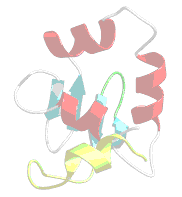
Among the side-effects of Trichosanthin observed during clinical trials, the most dangerous complication anaphylactic shock- a sudden, severe life-threatening allergic reaction that can kill within minutes. This reaction was experienced by between 10 to 20 percent of people using the drug. It is critical, therefore, to modify the molecular structure of the drug in order to decrease its side effects. For this purpose, we have designed and constructed a Trichosanthin Mutant (or Modified Trichosanthin, MTCS) with protein engineering technologies. While retaining all the pharmacological activities, its side-effects are greatly reduced comparing with trichosanthin. The results of our experiments proved its high efficacy and low toxicity for treating cancer, AIDS and other viral infections.
MTCS is one of the biggest medical projects of the Chinese Academy of Sciences. Its research has undergone a period of over 20 years:
1981-1985 Chinese Academy of Sciences Basic Research Priority Project
1986-1995 "863" National High-Tech Research and Development Project
1996-1998 National Natural Science Research Funds Project
1998-1999 Shanghai Biotech & Medicine Development Funds Project
1996-2000 National Top Priority New Medicine Research and Development Project
1997-2000 Chinese Academy of Sciences Applied Research Priority Project
2000-Present Shanghai Biotech & Medicine Development Funds Project
CURRENT STAGE OF DEVELOPMENT:
US, China and PCT Patents have been applied for this product and its technologies. Clinical trials for AIDS treatment in China.
Pre-clinical laboratory works for cancer treatment were mostly completed. The process of industrial production was refined. Currently applying for cancer treatment clinical trial permit in China.
MAJOR FUNCTIONAL FEATURES:
MTCS is a powerful inhibitant to a broad variety of human cancer cells. Study results indicate that MTCS induces the programmed cell death, or apoptosis, of cancer cells. To leukemia cells for example, MTS is several hundred times more potent than drugs commonly used in chemotherapy. In three xenograft animal models implanted with human cancer cells, MTCS exhibited exceptional inhibitory effects of cancers, resulting in disappearance of diseases and full recovery of animals.
MTCS inhibits HIV replication in both acutely infected T-lymphoblastoid cells and in chronically infected macrophages. Conventional anti-HIV drugs block fresh infections by free virus but they cannot get rid of enough of the infected cells. MTCS, however, attacks the virus by eliminating the virus-infected cells, and in other words, it has a unique mechanism of action complementary to other drugs and may fill the gap in the treatment of AIDS.
MTCS is found capable of inhibiting viruses other than HIV, e.g., japanese encephalitis virus, coxsackievirus, measles virus, adenovirus, Herpes simplex virus, vesicular stomatitis virus, hepatitis B virus, etc.
Extremely low toxicity. Study results indicated the presence of MTCS specific binding receptors on the membrane of cells sensitive to MTCS, e.g., cancer cells and HIV-infected cells. These receptors mediate the endocytosis of MTCS into sensitive cells, which then exerts its toxic effects. No such receptor is present on normal body cells. That is why no obvious detrimental effects on normal body cells can be observed even at a dosage several hundred times higher than that used in treatments, making the drug extremely low in toxicity and side-effects.