 |
|
|
|
|
|
|
|
|
|
|
|
|
|
|
|
|
|
|
|
Trichosanthin |
|
|
|
|
|
|
 |
|
|
|
 |
|
|
|
|
|
|
|
|
|
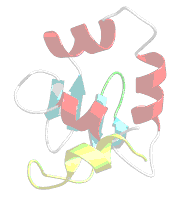
Trichosanthin(Compound Q, GLQ233), a 27 kDa sized single chain ribosome-inactivating protein with 247 amino acid residues, possesses multiple pharmacological properties. |
|
|
|
|
|
|
|
|
|
|
|
|
|
|
|
Trichosanthin was isolated from the root tuber of a Chinese medicinal herb Trichosanthes kirilowii Maximowicz and was identified as the active component of Tian Hua Fen, a Chinese medicine described as early as the 16th century as a treatment for various kinds of ulcer. Since the discovery of its specific injurious effects on human placental trophoblasts in the 1970's, trichosanthin has been used clinically in China to induce abortion and to treat diseases of trophoblastic origin such as hydatiform mole, invasive mole and choriocarcinoma. Soon after the laboratory finding in 1989 by McGrath et al. that trichosanthin appeared to inhibit the HIV-1 replication in both acutely infected T-lymphoblastoid cells and in chronically infected macrophages, and selectively killed HIV-infected cells while leaving uninfected cells unharmed, clinical trials of trichosanthin as a potential treatment for HIV were carried out in USA. Trichosanthin attacks the life cycle of the virus at an entirely different point from AZT and related drugs, and in other words, it has a unique mechanism of action complementary to other drugs. Present clinical reports showed that trichosanthin has some curing effects on AIDS patients and suggested it to be a possible treatment that may fill the gap in the treatment of HIV disease. |
|
|
|
|
|
Trichosanthin Available for Lab or Clinic Use |
|
|
|
|
|
|
|
 |
|
|
|
|
|
|
|
|
|
|
|
|
|
|
Side effects of Trichosanthin observed during clinical trials included allergic reactions, neurotoxic effect and flu-like syndrome, etc. Among them, the most dangerous complication seen with the drug is anaphylactic shock- a sudden, severe life-threatening allergic reaction that can kill within minutes. This reaction was experienced by between 10 to 20 percent of people using the drug. Therefore, it is critical to modify the molecular structure of the drug in order to decrease its side effects. |
|
|
|
|
|
|
|
|
|
Based on our study of the structure-function relationships of trichosanthin and the knowledge of its gene sequence, primary structure, three-dimensional structure, and crystallographic structure of trichosanthin complex with its analog substrate, we have developed a Modified Trichosanthin, reducing the side-effects of trichosanthin while retaining its pharmacological activities. |
|
|
 |
|
|
|
|
Back to our home |
|
|
|
|
|
|
|
|
|
|
|
|
|
|
|