|
|
SPIDERS |
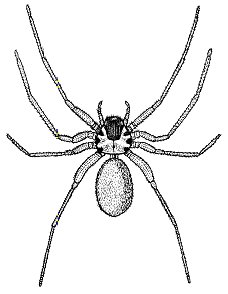
Many people confuse spiders with insects. The easy way to recognize the spider from an insect is that spider has 4 pairs of legs and an insect has 3 pairs. There is also one major difference. The insects have compound eyes whereas the spider has singular eyes with lenses. Unlike insects, spiders do not have antennas.
�
�
Digestion:
Spiders have no jaws to chew their food, so they digest it externally.They pump liquid from their digestive tract onto their prey.
- �
�
- �Reproduction:
The ovary of the female spider produces the eggs. After a female mates with a male, the sperm cells are held in a small chamber called the seminal receptacle.
�
- �Nervous System:
A spider does not have an ear. Mammals hear with help of hairs that are located in the ear where pressure waves in the air are converted to electric signals. Thesignals are then sent to the brain and interpreted as sound. A spider hears with very tiny hairs on her legs (thrichobotria). She is very capable of localizing the origiof a sound by interpreting the movement of the air produced by that sound.
- �
Blood Circulation:
- �
The spiders have circulating blood in their body. The colorless blood calledhemolymphe transports nutrients, hormones, oxygen and cells. The blood also serves another purpose. It is used locally to raise the blood pressure during moulting (sheddingof old skin) and stretching the legs.
- �
Go to these web sites for more information:
Spiders of Australia
- http://www.xs4all.nl/~ednieuw/australian/Spidaus.html
- �
Araneae, Spiders of North-West Europe
- �http://www.xs4all.nl/~ednieuw/Spiders/spidhome.htm
- �
- �