Echinoderms
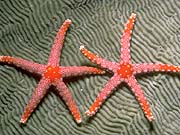
Echinoderms: The most common Echinoderms are the star fish.
Characteristics:
-Most echinoderms exhibit pentamerous radial symmetry. Animals with this type of symmetry can be divided into five equal parts from a central axis.
Two features are unique to echinoderms:
One is their system of Tube feet, a series of suction disks used in locomotion and getting food. Tube feet are powered by a unique system of water-pumping tubes.The other is their endoskeleton, or internal skeleton. The endoskeleton protects and supports the organism's soft tissues. It also provides a place to which muscles can attach. The endoskeleton is made of calcium compounds that form plates just below the epidermis. A number of spiny projections extend from these plates through the epidermis. Different spines are modified for different functions in the various classes of echinoderms.
The name echinoderm means " spiny skin."
�
Development:
-During development, echinoderms go through a bipinnaria larva stage. The bipinnaria is a bilaterally symmetrical. This suggests that echinoderms evolved from an ancestor with bilateral symmetry. The bipinnaria larva differs structurally from the trochophore larva of mollusks.
�
Digestion:
-Most starfish are carnivores. Food is taken into the mouth, located on the starfish's lower surface. From the mouth, food goes through the esophagus to the stomach, where digestion takes place. Many starfish can push the stomach outside of their body to surround a food organism. Digestive enzymes are produced by digestive glands in each arm. Undigested wastes are eliminated through the anus on the starfish's upper surface. �
�
Reproduction:
-Reproduction in starfish is usually sexual. Males and females generally shed egg and sperm cells into the water. Starfish also have remarkable powers of regeneration. If a starfish is broken into pieces, many of the pieces will regenerate. For example, a severed arm will regenerate the entire animal as long as the arm has part of the central disk attached to it. A few species of starfish reproduce asexually by shedding arms.
�
Examples of some Star Fish!�
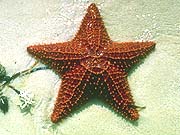
Cushion Star
 |
� |
�
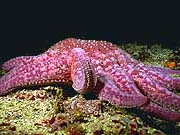
Sunflower Starfish
|
24 arms, it can reach a diameter of over 2 feet! 3.)The color of this starfish bottoms from Alaska to southern California. |
 1.)The
sunflower star is among the larger of the starfish
species. 2.)With its
1.)The
sunflower star is among the larger of the starfish
species. 2.)With its�
Pacific Starfish
� |
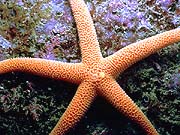 |
�Short Spined Starfish
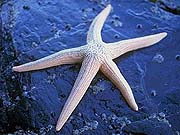 |
1.)The short spined starfish is a coldwater species found in the northern waters from the Arctic to Cape Hatteras. |
�
Orange Starfish