
|
| AKC STANDARD |
| General Appearance |
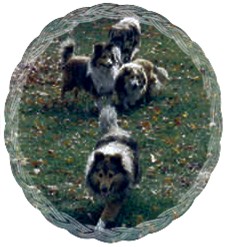
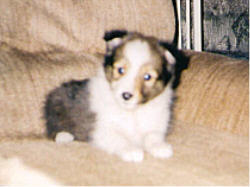
| Preamble- The Shetland Sheepdog, like the Collie traces to the Border Collie of Scotland, which, transported to the Shetland Islands and crossed with small, intelligent longhaired breeds, was reduced to miniature proportions. Subsequently crosses were made from time to time with Collies. This breed now bears the same relationship in size and general appearance to the Rough Collie as the Shetland Pony does to some of the larger breeds of horses. Although the resemblance between the Shetland Sheepdog and the Rough Collie is marked, there are differences which may be noted. The Shetland Sheepdog is a small, alert, rough-coated, longhaired working dog. He must be sound, agile and sturdy. The outline should be so symmetrical that no part appears out of proportion to the whole. Dogs should appear masculine; bitches feminine. Size, Proportion, Substance The Shetland Sheepdog should stand between 13 and 16 inches at the shoulder. Note: Height is determined by a line perpendicular to the ground from the top of the shoulder blades, the dog standing naturally with forelegs parallel to line of measurement. Head The head should be refined and its shape, when viewed from top or side, should be a long, blunt wedge tapering slightly from ears to nose. Expression- Contours and chiseling of the head, the shape, set and use of ears, the placement, shape and color of the eyes combine to produce expression. Normally expression should be alert, gentle, intelligent and questioning. Toward strangers the eyes should show watchfulness and reserve, but no fear. Eyes- medium size with dark, almond-shaped rims, set somewhat oblizuely in skull. Color must be dark, with blue or merle eyes permissible in blue merles only. Ears- small and flexible, placed high, carried three-fourths erect, with tips breaking forward. When in repose the ears fold lengthwise and are thrown back into the frill. Skull and Muzzle- Top of skull should be flat, showing no prominence at nuchal crest (the top of the occiput). Cheeks shouild be flat and should merge smoothly in a well-rounded muzzle. Skull and muzzle should be of equal length, balance point being in the corner of eye. In profile the top line of skull should parallel the top line of muzzle, being on a higher plane due to the presence of a slight but definite stop. Jaws clean and powerful. The deep, well-developed underjaw, rounded at chin, should extend to base of nostril. Nose must be black,. Lips tight. Upper and lower lips must meet and fit smoothly together all the way around. Teeth level and evenly spaced. Scissors bite. Neck, Topline, Body Neck should be muscular, arched, and of sufficient length to carry the head proudly. Chest should be deep, the brisket reaching to point of elbow. The ribs should be well sprung, but flattened at their lower half to allow free play of the foreleg and shoulder. Abdomen moderately tucked up. The tail should be sufficiently long so that when it is laid along the back edge of the hind legs the last vertebra will reach the hock joing. Carriage of tail at rest is straight dow or in a slight upward curve. When the dog is alert the tail is normally lifted, but should not be curved forward over the back. Forequarters From the withers, the shoulder blades should slope at a 45-degree angle forward and downward to the shoulder joints. At the withers they are separated only by the vertebrae, but they must slope outward sufficiently to accommodate the desired spring of rib. The upper arm should join the shoulder blade at as nearly as possible a right angle. Elbow joint should be equidistant from the ground and from the withers. Forelegs straight viewed from all angles, muscular and clean, and of strong bone. Pasterns very strong, sinewy and flexible. Dewclaws may be removed. Feet should be oval and compact with the toes well arched and fitting tightly together. Pads deep and tough, nails hard and strong. Hindquarters The thigh should be broad and muscular. The thighbone should be set into the pelvis at a right angle corresponding to the angle of the shoulder blade and upper arm. Stifle bones join the thighbone and should be distinctly angled at the stifle joing. The overall length of the stifle should at least equal the length of the thighbone, and preferably should slightly exceed it. Hock joint should be clean-cut, angular, sinewy, with good bone and strong ligamentation. The hock (metatarsus) should be short and straight viewed from all angles. Dewclaws should be removed. Coat The coat should be double, the outer coat consisting of long, straight, harsh hair; the undercoat short, furry, and so dense as to give the entire coat its "standoff" quality.The hair on the face tips of ears and feet should be smooth. Mane and frill should be abundant, and particularly inpressive in males. The forelegs well feather, the hind legs heavily so but smooth below the hock joint. Hair on tail profuse. Color Black, blue merle, sable (ranging from gloden through mahogany); marked with varying amounts of white and/or tan. Gait The trotting gait of the Shetland Sheepdog should denote effortless speed and smoothness. There should be no jerkiness, nor stiff, stilted, up-and-down movement. The drive should be from the rear, true and straight, dependent upon correct angulation, musculation, and ligamentation of the entire hindquarter, thus allowing dog to reach well under his body with his hind foot. and propel himself forward. React of stride of the forleg is depentent upon correct angulation, musculation and ligamentation of the forequarters, together with correct width of chest and construction of rib cage. The foot should lifted only enough to clear the ground as the leg swings forward. Viewed from the front , both forelegs and hindlegs should move forward almost perpendicular to ground at the walk, slanting a little inwards at a slow trot, until at a swift show parallel lines of footprints actually touching a center line at their inner edge. There should be no crossing of the feet more throwing of the weight from side to side. Temperament The Shetland Sheepdog is intensely loyal, affectionate, and responsive to his owner. However, he may be reserved toward strangers but not to the point of showing fear, cringing in the ring. |
| For More details on AKC standard Please see there web page. |
 |
 |
 |
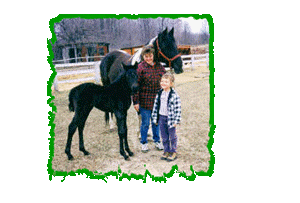 |
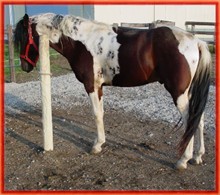
| Below is "Beauty" a (black/white with her solid black foal) "Reina" Missiouri Fox Trotter To learn more about Beauty and MFT horse's click here! |
 |
 |
 |
| HOME / BREEDINGSTOCK / PUPPY PAGE / INFO / MFT MARES / SHELTIE EYE PROBLEMS / PHOTO GALLERY / LINKS |