| A3 | 220.0 Hz |
| A#3 | 233.1 Hz |
| B3 | 246.9 Hz |
| C4 | 261.6 Hz |
| C#4 | 277.2 Hz |
| D4 | 293.7 Hz |
| D#4 | 311.1 Hz |
| E4 | 329.6 Hz |
| F4 | 349.2 Hz |
| F#4 | 370.0 Hz |
| G4 | 392.0 Hz |
| G#4 | 415.3 Hz |
| A4 | 440.0 Hz |
What are sharps and flats?
The # sign by a note is used to tell that the note is "sharp" (a half step up from the pitch; A natural to B natural is a whole step, but A natural to A# is a half step). Notes can also be "flat" (a half step down from the pitch) and have a b sign by them. A# is the same pitch as Bb.What do the sharps and flats in the key signature mean?As noted below the table above, B# is C and E# is F. Therefore, Cb is B and Fb is E.
The sign for sharp is:
![]()
The sign for flat is:![]()
In music, to the left of the time signature a KEY SIGNATURE is written. At the beginning of a piece it will be either empty or contain sharps or flats (but not both). Later on in a piece, if the key signature changes, sharp signs or flat signs that are no longer there are usually replaced with natural signs
to emphasize that they are gone, but only right where the change is; all the lines after that will simply show the new key signature minus the natural signs.
The sharps and flats are written on the line corresponding to the note that they make sharp or flat. These lines change depending on which "clef" the music is written in (you may have heard of treble or bass clef before). The sharps and flats always follow the same pattern:
If sharps and flats are two versions of the same thing, why have both?
# of Sharps Notes that are Sharp # of Flats Notes that are Flat 1 F# 1 Bb 2 F#, C# 2 Bb, Eb 3 F#, C#, G# 3 Bb, E,b Ab 4 F#, C#, G#, D# 4 Bb, Eb, Ab, Db 5 F#, C#, G#, D#, A# 5 Bb, Eb, Ab, Db, Gb 6 F#, C#, G#, D#, A#, E# 6 Bb, Eb, Ab, Db, Gb, Cb 7 F#, C#, G#, D#, A#, E#, B# 7 Bb, Eb, Ab, Db, Gb, Cb, Fb Do you see a pattern? The first sharp is the last flat and vise versa.
Another interesting point is that having seven sharps is the same as having five flats and vise versa once again.
A key of six flats is the same as a key of six sharps.
Take a look at those key signatures I listed before. How could you have only a Gb (F#) and all other notes natural using only flats? How could you have only an A# (Bb) and all other notes natural using only sharps?Why is a collection of sharps or flats called a key signature?
The sharps and flats in a key signature show what key the piece is in. Music with no sharps or flats is in the key of C. One sharp changes the key to G. One flat changes it to F.What makes no sharps the key of C and one flat the key of F?The key of a piece with any number of sharps is a half step up from the last sharp listed.
So, if there are three sharps (G# being the third), the piece is in the key of A.The key of a piece with any number of flats is the second-to-last flat.
If there are five flats (Db being second-to-last), the piece is in the key of Db.
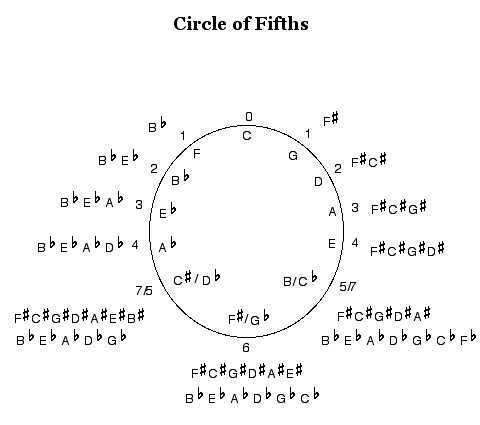
The order of the sharps and flats listed in the table above is not random. The distance between F and C is the same as the distance between C and G or E and B. This distance is known as a fifth. A pure fifth is two notes whose frequencies are a 3:2 ratio, but the ratio of log2/log3 is more pleasing to the ear.

This picture has the keys written on the inside, the number of sharps or flats (or sharps/flats) directly outside, and the names of the sharps and/or flats near that. Notice that the names of the keys themselves are all fifths apart.Fibonacci Sequence and Music