All of these numbers are in the Fibonacci sequence!
| Fibonacci Numbers |
| 1 |
| 0+1=1 |
| 1+1=2 |
| 1+2=3 |
| 2+3=5 |
| 3+5=8 |
| 5+8=13 |
| 8+13=21 |
| 13+21=34 |
| 21+34=55 |
| Continues... |
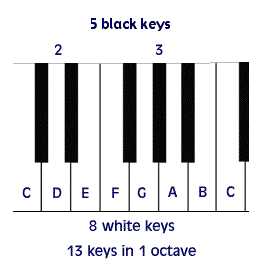
One interesting connection between this sequence and music is a piano keyboard.
All of these numbers are in the Fibonacci
sequence!
Another application of Fibonacci numbers to music
has to do with what is called the golden proportion.
Divide any Fibonacci number by the one adjacent
to it in the sequence...
| 1/1 | 1.000000000 |
| 1/2 | 0.500000000 |
| 2/3 | 0.666666666 |
| 3/5 | 0.600000000 |
| 5/8 | 0.625000000 |
| 8/13 | 0.615384615 |
| 13/21 | 0.619047619 |
| 21/34 | 0.617647058 |
| 34/55 | 0.618181818 |
| 55/89 | 0.617977528 |
| 89/144 | 0.618055555 |
| 144/233 | 0.618025751 |
The ratios eventually become about equal to 0.618--the
golden
proportion.
Where does the golden proportion
figure into music?
For example, take a look at where the "motto"
in Beethoven's Fifth Symphony is positioned:

The motto itself is 5
measures long. In the first movement, there are 372
measures of the portion of the motto that I will refer to as "X"
There are 228 measure of "Y."
X (372) + the number
of measures in the motto (5) = 377
Y (228) + the number
of measures in the motto (5) = 233
Y/X (233/377)=0.618025751
It's the golden proportion!
Also, in Tallis' 40-voice motet, Spem in Alium, there is a bar of absolute silence at the point of the golden proportion, following which all forty voices come in together!
So even the Fibonacci Sequence is used in music.