Take
Me On A
Tour
Analogy of a Cell
An internet activity
for 9th Grade Science
Designed by
Kenny Krestian
[email protected]
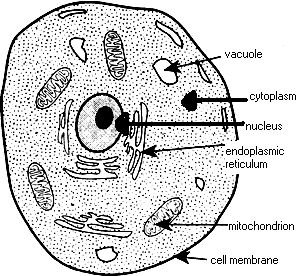
Introduction | Task
| Process | Resources|
Evaluation
|
Conclusion | Credits
|
Teacher Page
Introduction
What if there were no roads in
Spokane? How would your life be different?
Spokane, Washington is made up
of various components, each with a unique job that helps the town run smoothly.
For example, the post office, telephone, and cable company work to keep
us connected with the "outside world". The mayor of Spokane was elected
to make decisions and allocates funds for the community. The grocery
store supplies us with the products we need. The dam captures and
releases energy from the water that supplies electricity to our homes.
And thankfully, there are roads in Spokane that allow the transportation
of people and materials from place to place.
A Cell is the basic building block
for life. A cell can be compared to a town. Like Spokane, a
cell is composed of specialized parts that function to transport materials
within the cell, capture and release energy for cells to use, build proteins,
dispose of waste, exchange information, and even allow movement.
Students will use an understanding
of cell organelles and function to develop an analogy between a cell and
a facility, in the form of a brochure.
HOME NEXT
The Task
 You are in charge of the public relations
for a new facility being built near Spokane. The owner of the facility
has hired you to create a brochure, taking potential visitors on
a tour of the facilities.
You are in charge of the public relations
for a new facility being built near Spokane. The owner of the facility
has hired you to create a brochure, taking potential visitors on
a tour of the facilities.
Some possible facilities
are:
-
A new amusement park
-
A new airport
-
A new mall
-
A new hospital
-
A new factory
-
A new school
-
A new arcade
You will compare the parts of the facility with the
various parts of the cell. This is called an analogy. An analogy
is stating that one thing is like another.
-
For example:
-
A cell is like a town. (In this example the town is
the "facility")
Like a cell, most facilities have various parts.
-
For example:
-
Some of the parts of the town that might be used are
the mayor, the post office, the bank, the school, the church, the park,
the river, the roads, the homes, etc.
The various parts of the cell, called organelles,
will be compared with parts of the facility that you choose.
-
For example:
-
The mayor of the town is like the nucleus of a cell.
They both function in control and maintenance.
Your brochure will take
a tour through the facility that you are promoting. The brochure
will explain the function of each of the parts, or components, of that
facility, and explain how those parts are like the various parts of the
cell.
For more information on getting
started click below on next.
HOME PREVIOUS
NEXT
The Process
To accomplish the task, you
will need to complete the following:
-
On your own, using the resource page, research the
function of eight (8) organelles.
-
Decide on a facility to base your analogy upon.
-
Using your eight (8) selected organelles you will
develop an analogy that compares the specific organelle with a specific
component of your facility. (Refer to the task page for an example!)
-
You will create a brochure that will
"take a tour" through your facility. The brochure will explain the
function of each ogranelle, how it is like the component
of the facility, and include a picture for each organelle or its comparative
component.
-
Each student will then present his/her
brochure to the class.
HOME PREVIOUS
NEXT
Resources

Use any or all
of these web sites to find your information on cell organelles and their
functions.
Cells Alive
use plant and animal cell link in left column.
Science
Line
Cell
Biology Web Page
Cell Structures and Functions
Animal Cell Map
Plant Cell Map
Cellular Organization
Animal Cell Organelles
Typical Plant Cell
Parts of the Cell
HOME PREVIOUS
NEXT
Evaluation

Below describes the process
in which you will be evaluated for your cell brochure.
| |
Beginning
3
|
Developing
6
|
Accomplished
9
|
Exemplary
10
|
Score
|
|
Research
|
Student has
more than 3 missing details.
|
Student has
2-3 missing details.
|
Student is only
missing one small detail.
|
Student has
no missing details.
|
|
|
Cell Functions
|
Student has
more than 3 incorrect cell functions.
|
Student has
2-3 incorrect cell functions.
|
Student has
one incorrect cell function.
|
Student has
all correct cell functions.
|
|
|
Correct Organelle
Analogy
|
Student has
more than 3 incorrect cell analogies.
|
Student has
2-3 incorrect cell analogies.
|
Student has
one incorrect cell analogy.
|
Student has
all correct cell analogies.
|
|
|
Correct Pictures
|
Student has
more than 3 incorrect pictures.
|
Student has
2-3 incorrect pictures.
|
Student has
one incorrect picture.
|
Student has
all correct pictures.
|
|
|
Overall Creativity
and Neatness
|
Student creativity
and neatness is beginning.
|
Student creativity
and neatness is developing.
|
Student creativity
and neatness is accomplished.
|
Student creativity
and neatness is exemplary.
|
|
HOME PREVIOUS
NEXT
Conclusion
 After exploring your "facility" you
should have a good idea of how a cell functions. With this understanding
you should be able to comprehend that every living organism is composed
of billions of cells that run as smoothly as your facility. I hope
that you will take your new understanding of cells and continue to compare
cells to everyday components.
After exploring your "facility" you
should have a good idea of how a cell functions. With this understanding
you should be able to comprehend that every living organism is composed
of billions of cells that run as smoothly as your facility. I hope
that you will take your new understanding of cells and continue to compare
cells to everyday components.
HOME PREVIOUS
NEXT
Credits &
References
Thank you to:
WebQuest for the Template
The
WebQuest Page
Microsoft Clip Art for most of the pictures.
Cell picture in the introduction is from:
http://regentsprep.org/Regents/biology/units/organization/cell.gif
The following web sites for their information!!!!
Cells alive web site:
Cells Alive
Science Line:
Science
Line
University of Texas Medical branch:
Cell
Biology Web Page
Thames Valley District School Board:
Cell
Structures and Functions
San Diego City Schools Technology Challenge Grants:
Animal
Cell Map
Plant
Cell Map
Estrella Mountain Community College:
Cellular
Organization
Canadian Museum of Nature:
Animal
Cell Organelles
Ross Koning's personal web site at Eastern Connecticut
State University:
Typical
Plant Cell
and
University of Minnesota, Computational Biology
Centers:
Parts
of the Cell

HOME PREVIOUS
|
