Star Hopping :
Why hopping ? the reason are: It is easiest method to find the target.
The celestial coordinates are not required. Fast & direct to know & master
the night sky. Many astronomers discover comets by This method.
Hopping tip:
Basic requirement:
(1)Sky atlas (2)FOV circle (3)Observing plan, check on planisphere or planetarium programs
for targets that can be observed on specific date & time, the nearest bright
stars, constellation, Transit time (to minimize horizon sky glow), Moon phase..
Starting point:
(1) Center at bright stars, use naked eye help to aim the main telescope like
a gun. adjust RA/DEC until target star is in finder scope
(2) confirm with sky atlas, use FOV circle sheet place on sky atlas and
compare with finder scope, observe for fainter marking stars around the bright
star, rotate sky atlas to match the actual one in finder scope. Then ready to hop.
Direction:
The idea of directions are easily confused. After lost in space so many times, I give-up
to identify them, except the west for reference (obviously stars drift to the west)
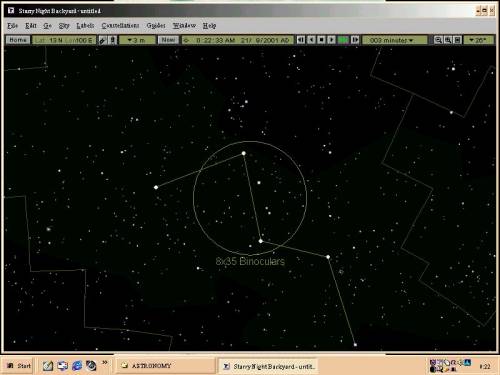
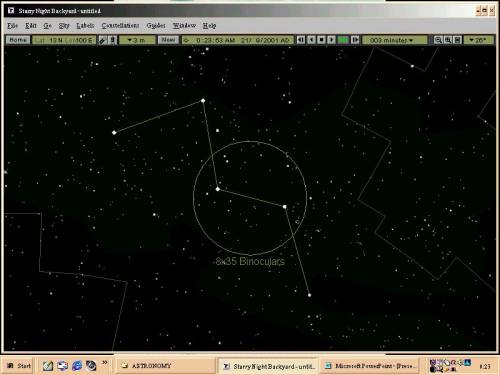
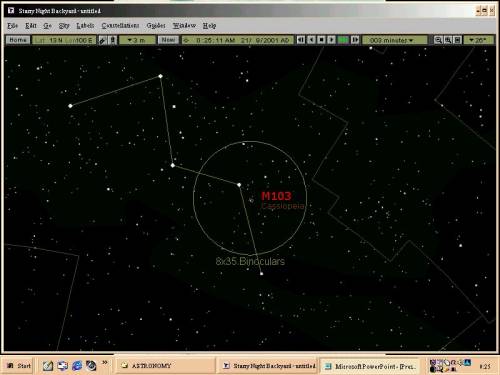
Example: the hopping to M103 in Cassiopeia
Start from one leg of 'w' of cassiopeia
comprise of star Schedar, Eta , Upsilon 1 & 2 and Gamma cassiopeiae
from top to bottom respectively. Try to find the pattern among them, at first
time the orientation may be difference depend on time (rotation of earth),
type of finder scope. Normal finder scope gives invert image, Right angle
finder scope gives mirror image. Rotate the sky atlas to get the same orientation.
Level 1 : Locate near bright star and can be seen in finder scope
Level 2 : Locate near bright star but can't be seen in finder scope
Level 3 : Far away from bright star but can be seen in finder scope
Level 4 : Far away from bright star and can't be seen in finder scope