
IN COMMEMORATION OF THE MURDER OF THE [RUSSIAN] ROYAL FAMILY
(A Sermon by
Metropolitan Philaret [Voznesenskii])
Once upon a time, not so very long ago, tomorrow's date of July 17, according to the so-called new-style, used to be a day of grief, a day of mourning, because on that day the Russian people and the Russian émigré community would recall the frightfully evil act of the Royal Family being most-brually and wickedly put to death in the cellar of the Ipatiev house. It used to be a day of mourning, but it is not so, now! For now the Royal Family is glorified as a family of holy martyrs. Never forget that when the Church glorifies someone who is holy she is not turning that person into a saint, she is only publicly affirming that God has already glorified such and such an individual, or such and such a group of people.
There is, in the Lives of the Saints, a notable example of when a certain person, occupying an extremely lofty position, being renowned and wealthy, departed into a monastery, embraced the monastic life, and began to live in like manner as the other podvizhniks [ascetics] -- in fasting, prayer and self-deprivation. Around him, others dwelt, many of them enduring stricter podvigs [feats of asceticism] than he. Nevertheless, the people began going to him, drawing upon his inspired spiritual conversations and instruction, and the Lord glorified him, specifically, with the gifts of clairvoyance and miracle-working. One of the monks even asked the starets [elder]:
"Why is this so? The one under discussion certainly is a podvizhnik, to be sure, but he is not prominent among the others; on the contrary, there are others who lead a stricter life, but they are not adorned with such spiritual gifts as miracle-working or clairvoyance. Why has the Lord specificially marked him out in such a way?"
And the starets replied:
"This is why:
all the others, when they embraced the monastic life, embarked upon their
podvig, but, essentially, wrought but little change upon that life
which they had previously been surrounded by, only themselves becoming monks.
Therefore, their manner of life became different from what it had been in
the world. They had not given up anything in particular; they lived humbly,
unpretentiously, just like all the others. This man had been extremely renowned,
rich, and formerly at the very pinnacle of life; he performed the podvig of
renouncing the world to a much greater extent than those others, around him.
He renounced his lofty position; he renounced his honours; he renounced
everything, and therefore he is now thus decorated by the Lord, inasmuch as
his podvig of
renouncing the world [that he was a part of] is so much greater and more profound,
than is that of the others."
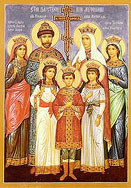
When one speaks of the glorification of the Royal Family, it should never be forgotten from what heights THESE PEOPLE fell!� Into the bottomless pit of frightful torments� For we know from their biographies just WHAT they were forced to suffer!� Initially, when this evil act took place, their holy names had filth poured out upon them in abundance -- O, but what was not asserted about the Royal Family!� But all of this, like dried-out husks, has now fallen away -- and before the world, truly, there stands a purely Christian family, radiant, gleaming with virtues, and, in particular, of course, one that had manifested itself in a Christian manner during those years of humiliation and grief, which had befallen their lot. From what a lofty height did they fall! Or their enemies had cast them down.
We know that, in the course of their lives, they experienced frightful defamation, slander, abuse and woes; yet, at the same time, they shone forth with astounding humility, compassion, complete forgiveness and good wishes. We know that it was for this reason that their wicked enemies, who controlled and governed everything, constantly replaced their guards. They would set over them the coarsest, the most, depraved -- it would seem, the most morally dissolute -- of guards. These, initially, would mock the defenseless prisoners; but, later, the latter's humility, their amiability, their astonishing kindness would act upon the guards in such a way that they would gradually soften [in their attitudes toward the Royal prisoners] and become friends, rather than foes. Therefore, I repeat, their evil enemies constantly kept changing the guards, because the virtues of the prisoners would entirely soften the callousness of their foes.
They bore this
podvig to the end -- in the
spirit of amiability and in the spirit of Christian love; and, finally, they
were most-wickedly put to death. The Russian Church [Abroad] has worthily
glorified them as martyrs, because, being slain, they ended [their lives]
as martyrs, and showed themselves to be true Christians, throughout the entire
duration of their lives. The Church now glorifies them -- whereas previously
we had prayed for the repose [of their souls], now we must pray to them, that
they might, through their compelling prayers before the Throne of God, the
Lord of Glory, intercede for that unfortunate land [of Russia] which they
so loved, and that the Lord might have mercy upon it and set it free from
the frightful material and spiritual yoke [which bestrides it].
Amen.

Translated into English by G. Spruksts, from the Russian text of
�� ���� ������ ������� ������� ����Ȼ.
English-language translation copyright � 2003 by The St.
Stefan Of Perm' Guild,
The Russian Cultural Heritage Society, and the
Translator. All rights reserved.
