
Although DARTER only started to be used in 1999, all of the validated historic records have also been entered. Even today, we are still trawling through historic records of the more unusual species, trying to gauge whether they are reliable or not. Only records where the sighting has been seen by an experienced observer, corroborated by a second experienced observer or supported by photographic evidence is the record accepted and entered onto the database. Therefore, DARTER is the only authoratitive source of dragonfly records in Hertfordshire.
The oldest validated record on DARTER is for a Banded Demoiselle on the R Lea at Batford on the 22nd May 1953. It is therefore surprising that the earliest record for King's Meads is as recent as 2000. This is probably due to a combination of the relatively recent re-flooding of the King's Meads site and the recent increase in dragonfly recording in the county. In 1990, there were only 5 people submitting dragonfly records compared to 37 in 2003.
There are 19 species of dragonfly and damselfly recorded regularly each year in Hertfordshire, all of which have recently been recorded at King's Meads. King's Meads is therefore a key dragonfly site in Hertfordshire. The diverse habitat including rivers, streams, pools, seasonal ponds and well-vegetated ditches, ensures a rich and diverse dragonfly and damselfly fauna.
The Systematic Lists are included in the ANNUAL REPORTS
Or alternatively, click here to access the DRAGONFLY DATABASE
White-legged Damselfly
1 on 17th June 2007 in Ditch 21.
Red-eyed Damselfly
Found on the larger bodies of water and the wider ditches.
Small Red-eyed Damselfly
Found on the larger bodies of water and the wider ditches.
Azure Damselfly
Common. Generally found in thick vegetation along the streams and ditches rather than the large pools.
Common Blue Damselfly
Common. Unlike the Azure Damselfly, prefers open water. Large colonies can be found on the large pools and the New River.
Large Red Damselfly
Uncommon. An early season flyer. Most records from the Manifold Ditch.
Blue-tailed Damselfly
Present in small numbers.
Emerald Damselfly
An uncommon visitor to the site.
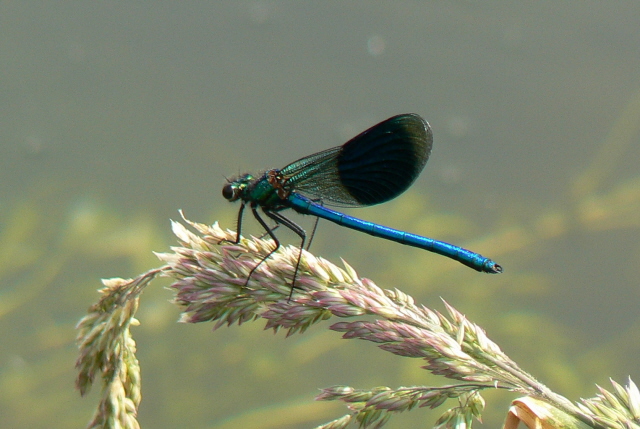
Banded Demoiselle
Common. Wanderers can be seen anywhere although, preferring running water, it is seen in the largest numbers along the stream that runs from White House Sluice to the railway crossing point by Ware Lock, and Hertford Cut.
Hairy Dragonfly
An early season flyer. After a long absence from Hertfordshire, the first Hairy Dragonfly was found in the Lee Valley in 1994. Since then, it has spread up the valley and has been recorded as far north as Amwell. The first record for King's Mead was in May 2001 and in 2003, a singleton was seen on the 24th May with 3 on the 30th May. Following management work the Hairy Dragonfly breeds at King's Meads.
Southern Hawker
An uncommon visitor to the site.
Brown Hawker
Present in small numbers. A mid to late season flyer. Commonly seen hawking insects along the streams and over the meadows.
Migrant Hawker
Late season flyer. Not particularly numerous and most likely to be seen hawking up and down the streams.
Emperor Dragonfly
Present in small numbers. Most common over the West pool and the New River.
Black-tailed Skimmer
Common. Numerous over West Pool.
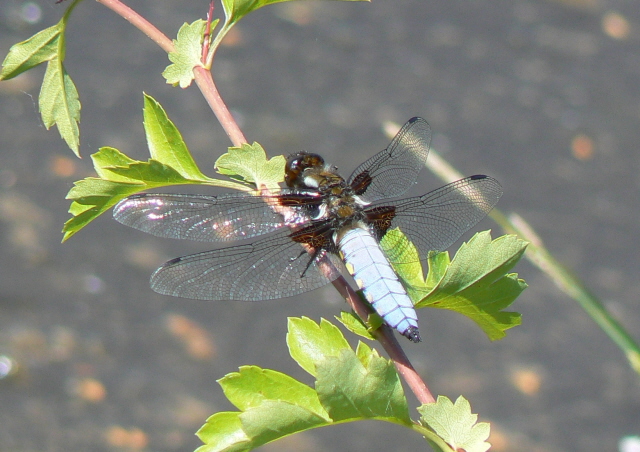
Broad-bodied Chaser
Present in small numbers. Likely to be seen anywhere.
Four-spotted Chaser
Present in small numbers, mainly over the ditches.
Ruddy Darter
Present in small numbers. Late season flyer. Most likely to be seen along the causeway and the ditches.
Common Darter
Present in small numbers. Late season flyer. Most likely to be seen along the causeway and the ditches.