 |
|
|
|
|
|
|
|
|
|
 |
 |
 |
 |
 |
 |
 |
| Previous Page |
| Next Page |
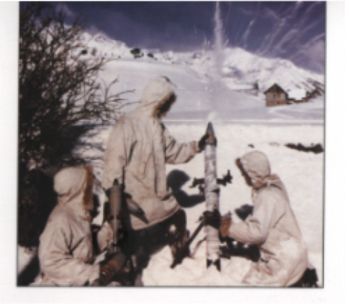
| Winter Warfare- GIs on a mortar crew fire at a german poition in the French Alps. They were lucky to have their overcoats and hoods. The americans thought they would have the war won before the winter of 1944-45, so most of their clothing was entirely inadequate and they had no camouflage. A blue sky in Europe that winter was unusual, as it was the worst winter of the century across the contienent. How cold was it? Often below zero. Thousands of men developed trench foot, which put more men out of action than German fire. Some forty-five thousand men- the equivalent of three full infantry divisions-had to be pulled out of the front line because of it. Many lost their toes; some had their feet amputated. If gangrene set in the doctors had to amputate the lower leg. This scene looks like the men were on maneuvers, but they were not. The Germans were experts at defensive arfare, especially in the mountains, where they used every advantage of terrain to stop the Americans. The village under attack in this picture had troops, rocket launchers, mortars, big arllery, and more. To be taken it had to be destroyed. But whatever the weather or the defenses, the GIs stuck to their guns, doing their duty. They endured and prevailed. |
| Winter Warfare |
| Pacific Campaign |
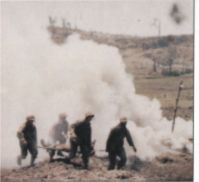
| Pacific Campaign- A wounded american is evacuated from the front line to an aide station in okinawa, April 1945. A combined army -marine force of three hundred thousand men attacked the island, which was honeycombed with caves. It was not possible for GIS and marines to simply bypass the caves and push on, because the Japanese would emerge at their backs and subject them to withering fire. offeshore, some 350 kamikaze planes pounded the navy. More U.S. sailors were killed or injured and more U.S. ships were sunk by kamikazes off Okinawa than in the Japanese attack on pearl Harbor. Altogether American forces suffered 49,200 casualties, the heaviest American toll of the war in the Pacific. The last Japanese stronghold did not fall until June; by that time Japanese losses totaled 110,071. When there were no Japanese soldiers left to fight, General Ushijima and his subordinates knelt in full-dress uniforms before their headquarters cave and cut out their own entrails. They had fought on a in a hopless situation, dooming tens of thousands of young Japanese and Americans to senseless deaths, then tried to never seen previously, a willingness on the part of Japan's military dictators to commint national suicide rather than to surrender. All across America people wondered, Isn't there another way to make these fanatics surrender? |
| Taking Of the Ludendorff Bridge |
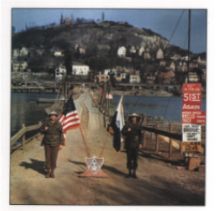
| Taking Of the Ludendorff Bridge- One of the six pontoon bridges thrown across the Rhine River by american combat engineers. On March 7, 1945, GIs had captured the Ludendorff Bridge at Remagen. Hitler ordered it destroyed and German aircraft and artillery, floating mines, and other devices were put on the mission. The damaged bridge collapsed ten days later, but by then the pontoon bridges were up and running . The engineers worked night and day to erecct the crossings, buil on rafts that were held in place by triple anchors, The bridges were 969 feet long, the longest floating bridges ever constructed A tank could cross on them every two minutes, and during the first seven days, two thousand five hundred vhicles did so. Building these pontoon bridges was a superb feat of engineering. This was the first crossing of the Rhine River by an enemy force since Julius Caesar. The unit that captured the bridge was typically all-American. The officer who led the men over the bridge to the far bank was Lt. Karl Timmermann, whose father had been in American occupation force in 1919 and married a girl from Remagen, then brought her back to his native Nebraska where timmermann was born. As he dashed across the bridge in the face of mortars , machine gun fire, hand granades, and German explosives meant to blow the bridge, he was accompanied by Sgts. Jo DeLisio, Joe Petrenecsik, and Alex Drabik. Engineers came right behind them, searching for demolitions and tering out electrical wires. Their names were Chinchar, Samele, Massie, Wegener, and Jensen. They were Italian, Czech, Norwegian, German,, and Russian. A diverse unit with one mission. |
| Mine Sweeping |
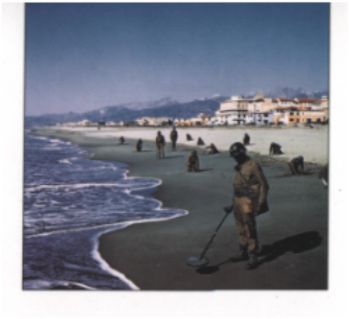
| Mine Sweeping- An African American unit of the 92nd Dvision searching for mines on an Italian beach. Throughout its many branches, the army segregated its black troopers and, for the most part, would not allow them into combat; ironic that the world's greatest democracy fought the world's greatest racist with a segregated army. But in the winter of 1944-45 , General Eisenhower asked for African American volunteers for frontline units and 4,462 left their jobs searching for mines, unloading ships, or driving trucks in order to fight. Black sergeants had to give up their stripes in order to become privates in an intergrated unit. Many perfomrmed well, even magnificently. One battalion commander in the 78rh Division said of his experience, "white men and colored men are welded together with a deep friendship and respect born of combat and matured by a realization that such an association is not the impossiblility that many of us have been led to believe. When men undergo the same privations, face the same dangers, there can be no segregation." The black soldiers' conduct was so impressive that the army brass changed its mind about black troopers and began the process of integrating them into white units. Within a decade the army had emerged from being one of the most tightly seregate organizations in the country to the most successfully integrated. |
| War in the Air |
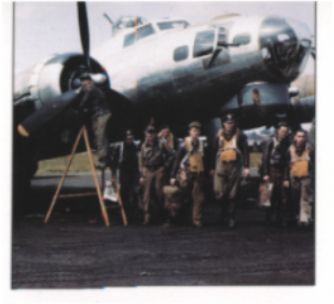
| War in the Air-Americans emerge from their b-17 four- engine bomber, similar to the one used in the first schweinfurt raid on August 17, 1943. The eighth Air Forcesent 230 bombers to destroy the factories in Germany's biggest ball bearing plant. They were attacked by German figheters all the way from the English Channel to the target, where antiaircraft gunners opend fire upon them. The Americans lost thirty-six B-17s (with ten men on each plane) on the raid and took hundereds of casualties on the bomers that managed to limp back to base. The attack did cause a temporary 38 percent decline in prodution, but that was not enough to hold back the Germans. A second raid too place on October 14, "Black Thursday" as it was called, because 65 of the 291 bomers were shot down and 17 others sustained damage that was beyond repair. It was the most expensive air attack of the war. Early in the war, American airmen had to fly twenty-five missions before they could be discharged. Later that number was raied to thirty-five. Chances of survivng intact were slime. Some planes exploded when an antiaircraft shell burst inside or a stream of bullets hit the fuel tank. In such cases no one got out alive. Other eighth Air Force bombers lost once, then two, then finally three engines. Few in that state mangaged to return to England. In some cases, the crew had to bail out over enemy territory and, if they landed sfely, most became POWs. On raids deep into Germany the air armada took tremendous losses, up to 50 percent overall. It was hell, but it had to be done- and it was. The big bombers did not win the war on their own, but it couldn't have been won without them |
 |
|
 |
 |
|
|
|
 |
|
|
| The Last Resort |
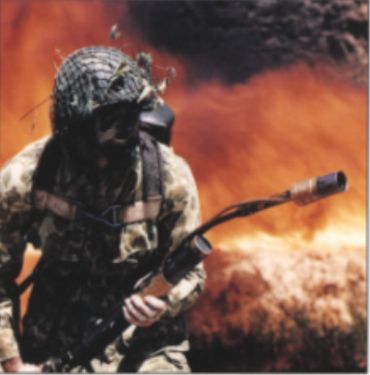
| The Last Resort- A GI with his flamethrower crouches in front of a bunker he had attacked. Germans in a hopeless situation would usally surrender, while the japanese would not. To drive them from their caves or to kill them inside, the Americans were forced to resort to the flamethrower. This weapon was extremely dangerous to the man using it as the flame attarcted enemy fire and a sinngle bullet could set the backpack containing liquid afire. In Europe flamethrowers were usally mounted on tanks or armored cars, but in the pacific they had to be carried forwared by a single man> in a war characterized by its gruesome nature, this was the most terrible handheld weapon. Few men volunteered to use the one- man flame throwers, partly becuase of what it did to ther men even if they were a part of the enemy force. The Americans did not choose to use them, but if the Japanese- held islands were to be taken, it had to be done. The young men firing the flame throwers would much rather have been back home throwing softballs instead of flames at other young men. But this war was fought without mercy. |
|
| Winter Warfare Pacific Campaign Taking Of ludendorff Bridge Mine Sweeping War In The Air The Last Resort |
| Preparations For D-Day D-Day Home Coming A Slice Of Life Heros Of The War Would The War Ever End |
| Page 1 |
| Page Contents: |
| Page 2 |
 |
| Homepage Our Movie Page Title Page Members Forum Links Screenshot Pages: Land Warrior: Page 1 Page 2 Delta Force 2 Page 1 Page 2 |
|
 |
|
|
|
|
|
|
 |
 |