| |
|
|
|
|
|
|
 |
|
|
|

Are you trying to get
pregnant, already pregnant, or nursing your
newborn infant? if your answer is "yes"
to any of these questions, then you have very
special nutritional needs.
The Importance of
Nutrition During Pregnancy
Pregnancy is one of the most nutritionally
important times of your life. Your growing baby
is completely dependent on you for nourishment.
|
Nutrients from the foods you eat become the building
blocks that form the organ systems, brain, skeleton,
muscles, and all the other components that make up your
baby. Therefore, what you eat can be one of the most
important factors in determining the future health of
your baby.
Pregnancy Weight Gain
Did you know that 60% to 70%
of pregnant women gain too much or too little weight
during pregnancy?1 There are potential
risks to both you and your baby if you gain too little
or too much weight during pregnancy.
Total recommended weight gain depends on your
pre-pregnancy weight. Average weight gain should be
about 25-35 lb. if your pre-pregnancy weight was
considered to be normal. If you were underweight before
becoming pregnant, then you should gain 28-40 lb. If you
were overweight prior to becoming pregnant, then you
should gain 15-25 lb. Check with your doctor to
determine how much weight gain is healthy for you.1
The rate of weight gain during pregnancy should be
gradual, with most occurring during the last trimester.1,2
Only a 2- to 4-lb gain is recommended during the entire
1st trimester, whereas approximately 3-4 lb/month is
recommended during the 2nd and 3rd trimesters.1,2
Energy Needs During
Pregnancy
Contrary to popular belief, you should not
actually "eat for two," or double your calorie intake.
However, in order to gain weight, you do need to eat
extra calories. Energy needs for pregnant adult women
typically range from 2500-2700 calories/day, but may be
more or less depending on factors such as pre-pregnancy
weight, height, age, and activity level.1
In general, no additional calories are needed during
the 1st trimester because the baby is still very small,
and recommended weight gain is minimal. On average, you
should eat an extra
340 calories/day during the 2nd trimester and an extra
450 calories/day during the 3rd trimester to provide
much-needed energy for your rapidly growing baby.3
What Is a Healthy Diet?
A well-balanced, healthy diet is one that provides
nutrients in the correct proportions from a wide variety
of foods, emphasizing —nutrient-dense foods—
those that are high in nutrients relative to the amount
of calories they contain. The following table*
summarizes foods included in each food group, the
amounts of foods that count as one serving, daily
recommended servings, and key nutrients supplied.
*Refers to a 2,000 calorie/day diet.
|
Food Group |
Foods Included
in Group |
Standard Amounts |
Amounts/Day |
Key Nutrients |
|
Bread and Grains |
Whole-grain or enriched
breads |
1-oz slice |
6 oz (3 oz whole grains, 3
other grains) |
Iron
Folic acid
B-vitamins
Fiber
Carbohydrates |
|
Dry cereals |
1 C |
|
Rice, pasta, and other
grains |
1/2 C |
|
Vegetables |
Cooked vegetables or
vegetable juice |
1/2 C |
2 1/2 C |
Vitamin C
Vitamin A
Fiber
Carbohydrates |
|
Raw vegetables |
1 C |
|
Fruit |
Fresh fruit |
1 medium piece |
2 C |
Vitamin C
Vitamin A
Fiber
Carbohydrates |
|
Fruit juice (100%) |
1/2 C |
|
Berries, melon |
1 C |
|
Canned fruit |
1/2 C |
|
Dried fruit |
1/4 C |
|
Milk |
Milk and yogurt
(non-fat/low-fat) |
1 C |
3 C |
Calcium
Riboflavin
Carbohydrates
Protein |
|
Cheese (non-fat/low-fat)
|
1 1/2 oz |
|
Meat and Beans |
Lean beef, pork, poultry,
or seafood |
1 oz |
5 1/2 oz |
Iron
Protein
Vitamin B6
Vitamin B12
Fat |
|
Beans or legumes |
1/4 C cooked |
|
Eggs |
1 whole |
|
Nuts and seeds |
1/2 oz |
|
Nut butter |
1 Tbsp |
|
Other Foods |
Butter, margarine, oils,
jams, desserts, dressings, cookies, soft drinks,
candy, chips, snack foods |
Serving sizes vary; eat
only in moderation |
No amounts recommended |
This group is a significant
source of sugar, fat, and sodium. |
Note: Omega-3 fats, which are important
for your baby's brain growth and development, are
present in certain types of fish and seafood, as well as
some eggs, nuts (walnuts), seeds (flax), and oils
(canola, soy). Do not eat any shark, swordfish, king
mackerel, or tilefish (golden or white snapper) because
they may contain high levels of mercury. Also, limit
"white" or "albacore" tuna to 6 oz/week, and limit
"light" tuna to 12 oz/week. Fish and seafood that
contain low amounts of mercury include salmon, shrimp,
pollock, cod, halibut, and catfish.
|
|
|
.gif) |
 |
|
|
Managing Nausea and Other Pregnancy Symptoms
You may experience some of the following gastrointestinal upsets
and symptoms during your pregnancy: nausea, vomiting, heartburn,
constipation, hemorrhoids, food aversions or intolerances, and
food cravings. Some tips for dealing with these issues include:
- Eat
small, frequent meals and snacks, eating at least 4-6
times/day
- Eat
only solid foods at meals and drink liquids between meals
- Eat at
least 25-30 grams of fiber/day
- Drink
at least 6-8 glasses of liquid/day, primarily water
- Choose
foods that you tolerate well; you'll learn by experience
- Eat
saltine crackers or other dry, bland carbohydrates before
you get out of bed
- Avoid
strong food odors; use a fan to reduce odors while cooking
- Avoid
highly seasoned foods and heavy, fatty foods
- Add
ginger to foods; it's considered a natural remedy for nausea
- Suck
on a fresh lemon wedge or drink water with fresh lemon juice
- Eat
slowly and take time to enjoy the food you are eating
Tips for Healthy Snacking
Snacks are a great way to satisfy hunger pangs or cravings
between meals, help manage nausea, and, if chosen wisely, add
important nutrients to your diet. Make fruits and vegetables
more convenient by having small containers of them already
washed and chopped up in your refrigerator. Also, keep
individual containers of low-fat milk or yogurt, 100% fruit
juice, whole-grain crackers or pretzels, and low-fat granola
bars on hand. These snacks are convenient to carry to work or
take on long car rides.
Here are
some healthy snack suggestions:
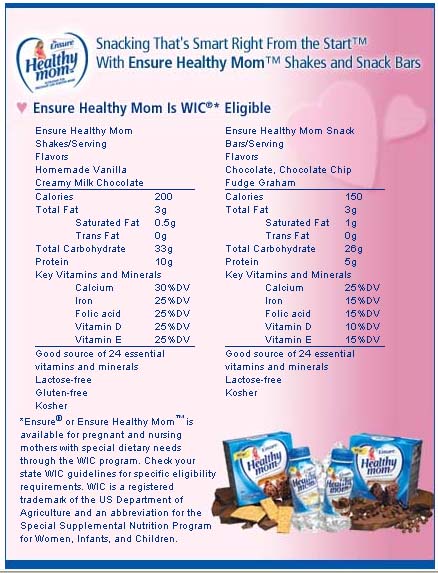
- Ensure
Healthy MomTM
Shakes and Snack Bars
-
Chopped fruit topped with low-fat cottage cheese or yogurt
and chopped nuts
- Wheat
crackers or apple wedges with low-fat cheese slices or
low-fat string cheese
- Baby
carrots dipped in hummus
- Rice
cakes or graham crackers with peanut butter and a banana
-
Low-fat granola bar and a glass of fat-free or low-fat milk
- Trail
mix made of nuts, seeds, and dried fruit
- Find
smart nutrition substitutions when craving empty calories;
for example:
-
Chocolate: try fat-free chocolate syrup drizzled over
fresh strawberries
-
Sweets: try dried fruits (apricots or raisins) or
low-fat yogurt with fruit
-
Salty foods: try low-fat popcorn sprinkled with herbs
Good Nutrition During Nursing
Good nutrition is also important following your delivery,
especially if you are nursing. Nursing increases your need for
calories, as well as for many key nutrients. On average, women
who are nursing need an additional 500 calories/day during the
first 6 months and 400 calories/day during the second 6 months
to ensure adequate milk production.3 Key nutrients
include protein, calcium, zinc, folic acid, and vitamins E and B6.
Be sure to drink plenty of water to help stay well hydrated
during nursing. Also, be sure to watch what you eat and drink,
since caffeine, alcohol, and spicy foods may affect your breast
milk. If you are trying to lose the weight you gained during
pregnancy, be sure to lose weight gradually by eating a healthy,
well-balanced diet and exercising regularly.
The Bottom Line
As always, be sure to discuss your diet and eating plan with
your health care professional. With all this information, some
determination, and motivation, you can begin a journey of
healthy eating to help ensure the optimal growth, development,
and future health of your baby, as well as optimizing your own
health and well-being. You both deserve it.
References
-
Position of the American Dietetic Association: Nutrition and
lifestyle for a healthy pregnancy outcome. J Am Diet
Assoc 2002;102(10):1479-1490.
- Kline
DA: Macronutrient requirements during pregnancy. Today's
Dietitian 2004;6:20-24.
- Food
and Nutrition Board, Institute of Medicine: Dietary
Reference Intakes for Energy, Carbohydrate, Fiber, Fat,
Fatty Acids, Cholesterol, Protein, and Amino Acids
(Macronutrients). Washington, DC: The National Academies
Press, 2002.
Back to main |
|
|
|
|


