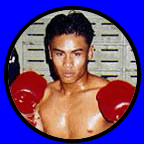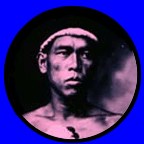
Muay Thai is both a sport and form of combat that as it's name implies is native to Thailand. It is thought by many to be the most effective stand-up fighting system in the world today. Not because of any special or secret technique, but because it teaches the student simple technique which are then drilled endlessly, giving the students a solid base in the art and in self defence. The philosophy of the teaching method can be summed up as "Better to be good at one thing than mediocre at many".

In Thailand it is also the national sport and obsession. A professional Thai boxer will begin his training at an early age, as young as eight, or nine. At that point the child will train after school at an local "camp". The training is free but the child is expected to perform. Normally it is at this point that the coach at the camp begins to try and single out the young boys who show promise, they receive special attention, and instruction. Over time there will be one or two young boys who stand out from the rest, at this point their training will become more intense, and they may even be asked to leave school, and come live and train at the camp full time.

The camp becomes a second family for the children, they eat together, train together, and fight together. Many will make their professional debut at eleven or twelve, although this seems strange to us, this is simply accepted as the age to begin competition. They will compete regularly for the rest of their short careers, and retire by their mid-twenties.

Wai Kru

Intertwined with Muay Thai is their rituals and traditions. These traditions act as the philisophical pillars which support the sport. The most notable of these traditions is the Wai Kru, and Ram Muay.

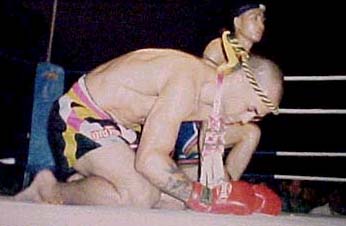
The Wai Kru is a ritual performed in the centre of the ring before any fight it is meant as a sign of respect to ones teachers and camp. It is characterized by the bowing from a kneeled position three times facing the direction of ones camp.


Sean Seagrave performs the Wai Kru. Sean SeagraveŠ


Ram Muay


The Ram Muay is an eleborate dance, which originally was used to express stories from anciant vedic text and identify the camp to which the fighter belonged. As times have changed there are now fewer and fewer Ram Muay which identify the actual camps to which a fighter belongs, now it is more likely that the Ram Muay is used to advertise the skills and abilities, both real and imagined, that the fighter posesses.
A well done Ram Muay will often result in money being thrown into the ring as a sign of admiration by the gathered fans.

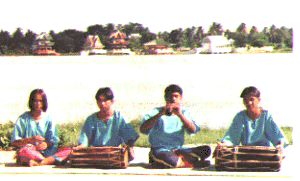
The Wai Kru, and Ram Muay are traditionally accompanied by a three piece though in the south of Thailand sometimes four piece band, the band consists of a glong-kag drum, pee java flute, and the ching cymbals.

The band as well as providing background music also plays a much more integral role than one may first think. Th eband both controls and influences the tempo of the fight as the fight lulls the band may pick up the pace and tempo and the fighters will pick up the tempo as well.


TRAINING FIGHTING FIGHTERS TRADITION
GALLERY ARTICLES STADIUMS KIETBUSABA THAILAND HOME

Hosted by www.Geocities.ws

1