| Eduard Gufeld (1936-2002)
Grandmaster Eduard Gufeld passed away on September 23, 2002. He was a prolific writer and journalist. He was known for his love of the art of chess, often preferring beautiful combinations to solid (and unartistic) play. In this game, GM Gufeld shows us the art of attack against a master of attack and former World Champion, Mikhail Tal. For a tribute article to GM Gufeld, I refer you to Sam Sloan's article on the Kasparovchess website.
Gufeld,E - Tal,M [C77]
URS-ch26 Tbilisi (11), 1959
[Castro]
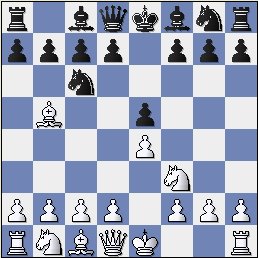
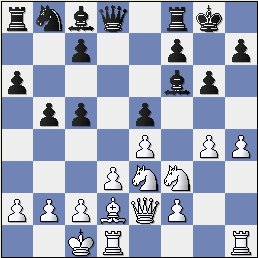
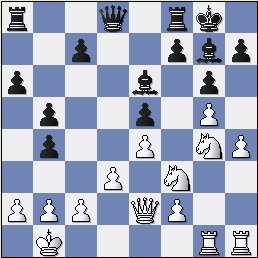
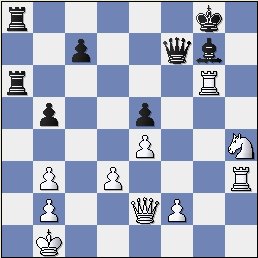
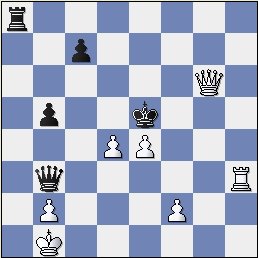
1.e4 e5 2.Nf3 Nc6 3.Bb5 Diagram The Ruy Lopez is one of the oldest and most popular openings in chess. White develops logically. In most double king pawn openings, White's main goal is to eventually push d2-d4. One of Black's main tasks in the opening is to prevent this, or at least make this move a little painful for White. White's bishop attacks the knight, which defends d4 as well as the pawn on e5. 3...a6 4.Ba4 Nf6 5.Bxc6 This delay in capturing the bishop is a nuance used to avoid certain variations in the Exchange Variation. 5...dxc6 6.d3 Supports the e4 pawn. Although d4 is the general goal, sometimes it is better not to go at it in one move. Also, in this game, White does not want to open the center up since his main attack will be on the kingside. 6...Nd7 7.Nbd2 Be7 8.Nc4 Bf6 9.Qe2 Moving from the back rank. This is White's first sign that he will castle queenside. 9...c5 10.Bd2 0-0 11.g4 The kingside attack begins. 11...b5 12.Ne3 g6 Although this creates a weakness in the pawn structure, Black plans to bring his bishop back to g7, where it will serve on defense. 13.h4 Nb8 14.0-0-0+/= Diagram The battle lines are drawn. White will attack on the kingside while Black will attack on the queenside. Opposite side castling often leads to sharp battles where time is often a more important factor than material. Here, White's pieces are better developed. Also, notice that White already has some targets on Black's queenside due to Black's weak pawn structure around the king (pawns on f7, g6, and h7). White's pawns on a2, b2, and c2 have not been moved from their initial positions, giving them more flexibility to defend against Black's coming attack. 14...Nc6 15.Rdg1 Simple attacking development is best, put your rooks behind your pawnstorm. 15...Be6 16.Kb1 Nb4 This is the grandmaster version of making a "one move" threat...in this case more like a three move threat. Black threatens to win a pawn, but White's counterattacking chances make this maneuver silly. Perhaps Black should seek counterplay elsewhere or work to slow down White's attack. 17.Bxb4 The bishop is not participating in the attack, so this exchange is not bad as it also slows up Black's counterplay. [ 17.g5 For example, here, Black's threat means nothing. 17...Bg7 ( 17...Bxa2+? 18.Ka1 Nxc2+ ( 18...Bg7 19.Bxb4+-) 19.Kxa2+-) 18.Bxb4 cxb4 transposes.; 17.b3?! is a few problems. Although it blocks off the White bishop, it also creates a target for Black's pawn storm. Also, the move is not an active one--it does not contribute to White's overall plan. With Gufeld's actual move, White trades Black's attacking piece (his knight) for a relatively inactive piece (the bishop).] 17...cxb4 18.g5 Bg7 19.Ng4 Diagram The knight has many options from here. It eyes f6 or h6 (points weakened by the g-pawn's advance). One idea might be to play Nf6+ and if the knight is exchanged, opening the g-file. 19...f5? In general, opening up the position is not good when you are defending. 20.gxf6 Conversely, as an attacker, try to open up the lines of attack to your opponent's king! 20...Bxg4 21.Rxg4 Qxf6 22.Rh3 a5 23.h5 Ra6 This move prepares to double rooks on the a-file, as well as providing a means for defense along the 6th rank. 24.hxg6 hxg6 25.Rg2 b3 26.axb3 a4 27.Nh4 [ 27.bxa4? Rxa4+/= offers Black counterplay while not moving forward White's attack.] 27...axb3 28.Rxg6 Rfa8 Threatening the mate on a1. 29.cxb3 [ 29.Rxf6?? Ra1#] 29...Qf7 Diagram 30.Rxg7+! White offers up the exchange in order to expose the king. 30...Kxg7 [ 30...Qxg7 31.Rg3 Ra1+ 32.Kc2 Rg1 33.Rxg7+ Rxg7+-] 31.Nf5+ Kg8 32.Qg4+ Rg6 33.Ne7+! The fork works here because it deflects the queen away from the defense of the rook. 33...Kg7 [ 33...Qxe7 34.Qxg6+ Kf8?? ( 34...Qg7 35.Qe6+ Qf7 ( 35...Kf8 36.Rf3+ Qf6 37.Rxf6+ Kg7 38.Qf7+ Kh8 39.Rh6#) 36.Qxe5+-) 35.Rh8#] 34.Nxg6 Qxb3 35.Nxe5+ Kf6 36.Qg6+ Kxe5 37.d4+ Diagram A nice finish to a beautiful attacking game by Gufeld. [ 37.d4+ Kxd4 38.Rxb3+-; 37.f4+ Kxf4 38.Qf5#] 1-0
This game shows us a few things about attacking when castled on opposite sides:
- Time (tempo) is sometimes more important than material. GM Gufeld freely gives up material to open up lanes to the King.
- When you are on the defense, try not to open the position. When you are the one attacking, do everything you can to open it up.
- When castled on opposite sides, often your attack will consist of a pawn storm supported by pieces. Since White's king was on the queenside, he was free to advance his pawns upon Black's castled position on the kingside.
- It is easier to attack the king's position when he has advanced one of his pawns (e.g. g7-g6). Pawns on their original squares allow the defense more flexibility in the appropriate time to advance them.
| |