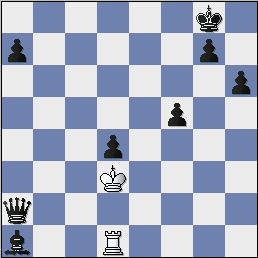
Gianniny,B (1326) - Castro,B (1418) [D35]
Winter Chess League (2), 04.12.2000
[Castro]
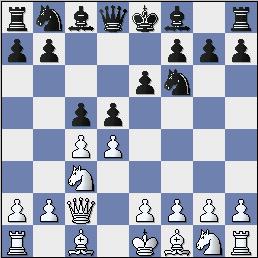
1.d4 d5 2.c4 e6 3.Nc3 Nf6 4.Qc2 A move I haven't seen before in this opening. I just "played chess" at this point. My plan is to solidify d5. I believe that White wants to bring the light-square bishop to d3 and create a battery against h7. [ RR 4.Qa4+ Bd7 5.Qb3 dxc4 6.Qxc4 Be7 7.Nf3 0-0 8.Bf4 Na6 9.Rd1 c5 10.dxc5 Qa5 11.Nd4 Qxc5 12.Qxc5 Nxc5 13.Be5 Rfc8 14.Bxf6 Bxf6 15.Nd5 0-1 Pantaleev,D-Lalev,D/Belgrade 1991/EXT 97 (15); RR 4.c5 Nc6 5.Bf4 a6 6.a3 Bd7 7.Nf3 Ne7 8.e3 Ng6 9.Bd3 Nxf4 10.exf4 Be7 11.0-0 0-0 12.Qc2 g6 13.Rae1 Nh5 14.g3 Ng7 15.Re2 Re8 16.Rfe1 b6 17.b4 a5 18.g4 axb4 Araji,I-Habib,G/Beirut 2000/EXT 2001/1-0 (46)] 4...c6N A bit more passive, but playable I think. [ 4...c5 Diagram
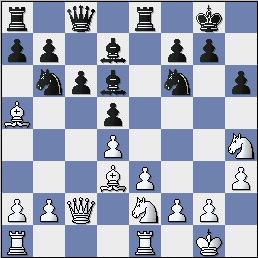
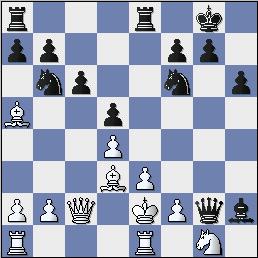
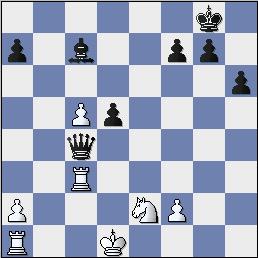
attacks White's center more directly.5.Nf3 ( RR 5.e3 cxd4 6.exd4 dxc4 7.Nf3 Nc6 8.Be3 Nb4 9.Qb1 Nd3+ 10.Bxd3 cxd3 11.Qxd3 Be7 12.0-0 0-0 13.Rac1 Nd5 14.a3 a6 15.Rfd1 Bd7 16.Ne5 Bf6 17.Ne4 Bb5 18.Qd2 Ba4 19.Re1 Nxe3 Abdo,L-Abente,R/San Cristobal 1998/EXT 2001/1-0 (40)) 5...dxc4 6.Bg5 Nbd7 7.0-0-0 Qb6 8.e4 Be7 9.e5 Nd5 10.Nxd5 Bxg5+ 11.Nxg5 exd5 12.dxc5 Nxc5 13.Rxd5 h6 14.Bxc4 hxg5 15.Rxc5 0-0 16.h4 g4 17.Rd5 Be6 18.Rd6 Qc5 19.Rxe6 Rac8 20.b3 Qa3+ 21.Kb1 Rxc4 22.Qxc4 fxe6 23.Qxe6+ Kh8 24.Rc1 Rxf2 25.Qe8+ Rf8 26.Qh5+ Kg8 27.Qxg4 Qe7 28.Qc4+ Kh7 29.g4 Qxe5 30.h5 Kh6 31.Qb4 Rf2 32.Qc3 Qe4+ 33.Rc2 Rxc2 34.Qxc2 Qxc2+ 35.Kxc2 Kg5 36.Kd2 Kxg4 37.h6 gxh6 38.Ke2 Kf4; RR 4...Nc6 5.a3 Be7 6.e3 a5 7.Nf3 0-0 8.b3 b6 9.Bd3 Bb7 10.0-0 Rc8 11.Rd1 Nb8 12.cxd5 exd5 13.Bf5 Nbd7 14.Bb2 Re8 15.Ng5 h6 16.Nf3 Bf8 17.Ne5 Qe7 18.a4 Red8 19.Nb5 c5 20.Nxd7 Nxd7 21.dxc5 Rxc5 22.Ba3 Qg5 23.Bxc5 Nxc5 24.Nd4 Rd6 25.Rac1 Rf6 26.f4 Qh5 27.h3 1-0 Peregudov,N-Alfinov,V/Prokojevsk 1997/EXT 2001 (27)] 5.Bd2 Nbd7 6.Nf3 Be7 7.e3 0-0 8.Bd3 Nb6 9.cxd5 exd5 10.0-0 h6 11.Rfe1 Re8 12.Ne2 Bd6 13.h3 Bd7 14.Ba5 This pin is useless considering that I plan to put my queen on c8 anyway. 14...Qc8 15.Nh4? [ 15.Nf4 would have been much better. 15...Qc7=] 15...Bxh3! Here I saw my opportunity. 16.gxh3 Qxh3 17.Ng2 [ 17.Nf5? The only other safe square for the knight??? 17...Bh2+ 18.Kh1 Bg3+ 19.Kg1 Qh2+ 20.Kf1 Qxf2#] 17...Qh2+ 18.Kf1 Qh1+ 19.Ng1 Bh2 20.Ke2 Qxg2-/+ This is the position that I saw when I played ...Bxh3. I was proud of the fact that my calculation was fairly accurate. Had I not seen this eventuality, I would not have played ...Bxh3. It is very exciting for me to have seen this as well as exciting to sacrifice a piece, although I knew it would only be a short term sacrifice, because I was able to see that White would have to give back the piece with change to avoid being mated. 21.Bf5 Planning Bh3 and covering against ...Ng4. 21...Ne4 Forcing the trade, otherwise, White loses more material. [ 21...Bxg1? Would be a great mistake. 22.Rxg1 Qh2 23.Rh1 Qd6 24.Rag1<=> and now things start to look dangerous for white.; 21...Ng4 22.Bxg4 Qxg4+ 23.Kd2 ( 23.f3 Qg2+ 24.Kd3 Qxc2+ 25.Kxc2 Bxg1 26.Rxg1 Rxe3-+; 23.Kd3? Qf5+ 24.e4 dxe4+ Discovering an attack on a5. 25.Ke2 Qxa5-+) 23...Nc4+ 24.Kc3 Nxa5-+] 22.Bxe4 Rxe4 23.Kd3 Rae8 24.Qe2 Qg6 Threatening a discovered attack. For the next few moves, I'm just trying to force the issue. My plan is not definite. However, I know that if White errs with his king movement, he will be punished. 25.Kc3 Forced. [ 25.Kd2? Nc4+; 25.Kc2? Rxe3+] 25...Bc7 Preparing another discovered attack! 26.Kb3 Here I decided to simplify the situation. I get a pawn and a queen for the two rooks. 26...Rxd4 27.exd4 Rxe2 28.Rxe2 Qd3+ Here White gets into a little danger. He plays the only move he can. 29.Bc3 [ 29.Kb4?? Qc4+ 30.Ka3 Qa4#] 29...Qc4+ After looking at the position, I decided to try to trade down even more. That was the idea behind this check. 30.Kc2 Na4 31.Re3 Nxc3 32.bxc3 Here my opponent offered a draw. However, I'm in now hurry. 32...c5 33.Ne2 [ 33.dxc5 d4] 33...b5 Bringing in the b-pawn from the other side to attack the pinned defender. 34.dxc5 b4 I don't care about that pawn for now. I don't want to waste a move in my attack. 35.Kd1 bxc3 36.Rxc3 36...Qh4! Forking h1, winning a rook and f2. Also, White rooks are lined up for a skewer on the h8-a1 diagonal. White doesn't have many choices here. Black has to keep in mind the c-pawn. However, my way of doing this is to keep the pressure up. 37.Rcc1 [ 37.Rg3? Bxg3; 37.Ng3? Qd4+ ( 37...Bxg3?! 38.fxg3 Qh1+? 39.Kc2 Qxa1 40.c6 Qxa2+ 41.Kd3 Qa6+ 42.Kd4= White can't stop the pawn without losing material. So he has to keep the checks up with the queen. This is the danger of leaving a passed pawn alone.) 38.Kc2 Qxf2+ 39.Kb3 Bxg3-+; 37.Kd2? Be5] 37...Qxf2 38.Rab1 Ba5 Threatening to win the knight. 39.Nc3 Although I did not see this move, I will win the knight anyway. [ 39.Kc2 Qxe2+-+] 39...Qd4+ 40.Ke2 Bxc3 41.Rd1 Qc4+ 42.Kf3 Qxc5 No more passed pawn. A sigh of relief. White hopes to get a tiny bit of counterplay with the pin, but the d-pawn shuts down that idea. 43.Rbc1 d4 44.Ke4 f5+ 45.Kd3 Qb5+ 46.Kc2 Qb2+ 47.Kd3 Qxa2 48.Ra1? Bxa1 White resigns. A lesson for me during this game is to have a plan when trying to finish off a losing opponent. In this case there were many different plans (e.g. trading down, keeping the queen active, attacking White's hanging pawns). However, one principle I used to win was stopping my opponent's counterplay. I realized that I had a winning game, and I took my time to increase my material advantage. 0-1
Generated with ChessBase 8.0