Castro,B (1385) - Golyak,I (2270) [B22]
RAT Rochester, NY, 16.02.2001
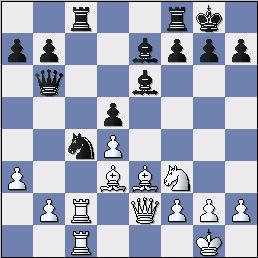
This was a G/30 at the Rochester Chess Center. I love playing here because there are many strong players, especially my opponent, whom I can learn from. This game illustrates the importance of tactics. Even masters can slip in this regard. 1.e4 c5 2.d4 I enjoy playing the Smith-Morra Gambit. Although one might say it is silly to play this against a master, I would rather play what I know rather than go into theory in the Open Sicilian. 2...cxd4 3.c3 Nc6 Isay had avoided accepting the gambit the only other time we had played, so I was expecting this. [ 3...d5 which he played against me before, would transpose into this game. However, I blundered in that first game an quickly lost. I was hoping to put up more of a fight this time. 4.exd5 Qxd5 5.cxd4 Nc6 6.Nf3] 4.cxd4 d5 5.exd5 Qxd5 6.Nf3N [ RR 6.Be3 e6 7.a3 Prevents the pin which happened in my game. 7...Nf6 8.Nc3 Qd8 9.Nf3 Be7 10.Be2 ( RR 10.Bb5 0-0 11.0-0 Nd5 12.Nxd5 Qxd5 13.Bd3 Bf6 14.Rc1 Qd8 15.Qc2 h6 16.Bh7+ Kh8 17.Be4 Bd7 18.Qd2 g5 19.Qe2 Rg8 20.Rfd1 g4 21.Ne5 Nxe5 22.dxe5 Bxe5 23.Bxb7 Bxh2+ 24.Kf1 Qe8 25.Rc5 Rb8 26.Rh5 Rg6 27.Be4 Bb5 28.Bd3 Bxd3 29.Rxd3 Be5 30.Rxe5 f5 31.Bxa7 Rc8 32.Bc5 Qc6 33.b4 1-0 Kerschenbauer,F-Glanz,J/Werfen 1992/EXT 97 (33)) 10...0-0 11.0-0 Nd5 12.Nxd5 Qxd5 13.Qc2 Bf6 14.Rfd1 Ne7 15.Bf4 Qd8 16.Be5 Nd5 17.Bd3 h6 18.Rac1 Bd7 19.Qb3 Bc6 20.Bb1 Rc8 Ubeira,E-Cantora Alvarez,A/Asturia 1997/EXT 2001/1/2-1/2 (43)] 6...e6 7.Nc3 Attacking the queen. I do not know the specific theory of this line, but I do know that one gains time by attacking the queen. 7...Bb4 8.Bd2 [ 8.a3 Bxc3+ 9.bxc3 was my other thought in this position. I thought either would be fine.] 8...Qd8 9.a3 Be7 Diagram
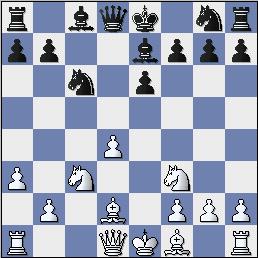
|
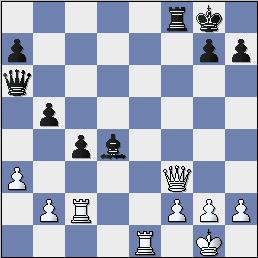
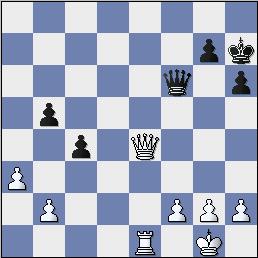
Black avoids trading, because it would improve my pawn structure and give me the two bishops.10.Be3 Defending the pawn again. 10...Nf6 11.Bc4 I want to develop my bishop to a good post. With the pawn on e6, maybe Bd3 would be better. 11...Nd5 12.Nxd5 exd5 13.Bd3 I think this exchange benefited me because it made our pawn structures more symmetrical, which actually worsens his structure! Also, my bishop which didn&apost have much to do on the a2-g8 diagonal, now aims at h7. 13...0-0 14.0-0 It is well known that one must not begin an attack until finishing development. However, my thoughts begin to wander towards ways to attack the king. 14...Be6 Our positions are very similar. This must be equal. 15.Rc1 Occupying the open diagonal. 15...Rc8 Both of our rooks take up residence on the open file. 16.Qd2 I wanted to connect our rooks. Also, I thought of trading dark-square bishops, as his is good. Also, a trade would bring my knight to g5. However, I have to be patient, because Black can easily defende these threats at the moment. 16...Qa5 Perhaps Black&aposs idea is to trade down and enter an endgame where his experience would show. However, we still have to play the middlegame. 17.Qe2 I&aposm not interested in trading queens, because I feel I have more attacking chances on the kingside. [ 17.Qxa5 Nxa5; 17.Rc3 Is another idea that came to mind during the game with the intention of doubling rooks on the c-file or playing b4 to drive the queen out.] 17...Qb6 18.Rc2 Now I intend to double rooks. 18...Na5 Here I took much time on the clock. At first I thought that Black's intention was to play Nb3. However, I then realized that Black intended instead to play ...Nc4 with the idea that if b3 (to kick the knight out) then a3 is hanging and also the option of taking the bishop on e3. Therefore, it will be difficult to get rid of the knight without giving some concessions (e.g. the bishop pair). However, my time thinking paid off. [ 18...Bf6 might have been better, attacking the d-pawn. 19.Qd2 Protecting the pawn tactically.] 19.Rfc1 Doubling the rooks. 19...Nc4? Diagram I thought this is what Isay was planning. However, he overlooked a combination. [ Now 19...Nb3 20.Rxc8 and if 20...Nxc1 21.Rxf8+ Bxf8 22.Bxc1 and I am up a piece.] 20.Bxc4! dxc4 [ 20...Rxc4 comes with the same result. 21.Rxc4 dxc4 22.d5+/-] 21.d5! With a double attack against the bishop and queen. 21...Qa6 protecting the c4 pawn. 22.dxe6 So far so good. Unfortunately, I took too much time making sure I had not overlooked anything. I should have been more confident in my combination. 22...b5 23.exf7+ Rxf7 24.Re1 Getting the rook to a more active file. 24...Rcf8 25.Ne5 Rf5 26.Bd4 Bf6 27.Nf3 We are both running low on time. This is perhaps the time that my blitz experiences on USCL are paying off! 27...Rxf3 Again, Black overlooks the tactics of the situation. However, he was probably thinking of the discovered attack on my queen after I take the rook. 28.Qxf3 Bxd4 Diagram 29.Qd5+! Kh8 30.Qxd4 Qg6 Attacking the rook. We both have less than two or three minutes on the clock. I was still a little worried about the pawn majority as well as back rank threats. 31.Rce2 Qf5 Attacking f2. However, it is solidly protected. 32.Re5 Qf6 33.Re8 h6 34.Rxf8+ Qxf8 35.Qxa7 Qf6 Attacking the b2 pawn. 36.Qa8+ Kh7 37.Qe4+ Kg8 38.Qa8+ Kh7 39.Qe4+ Diagram and we agreed to a draw here. My heart was pounding. I had drawn a master! Of course, I was winning this game, but I had about a minute left on the clock, and I wasn't sure about my ability to finish him off in that time. However, I am proud of this game overall because I was able to see the tactics and I was patient with my development. 1/2-1/2
Generated with ChessBase 8.0