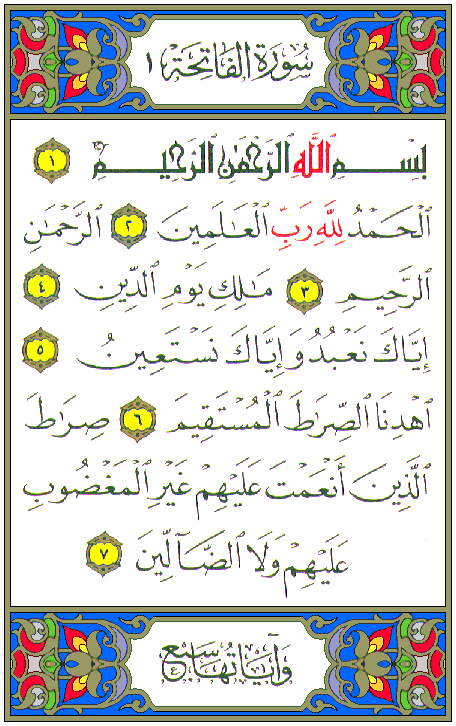
In the name of Allah, Most Gracious, Most Merciful.
Surah Introduction
by Abul 'Ala Maududi:
Name
This Surah is named Al-Fatiha because of its subject-matter.
Fatihah is that which opens a subject or a book or any other
thing. In other words, Al-Fatihah is a sort of preface.
Verses
This Surah has a total of 7 verses.
Period of Revelation
It is one of the very earliest Revelations to the Holy Prophet.
As a matter of fact, we learn from authentic Traditions that it
was the first complete Surah which was revealed to Muhammed (PBUH).
Before this, only a few miscellaneous verses were revealed which
form parts of Surah Alaq, Muzzammil, Muddathir, etc.
Theme
This Surah is in fact a prayer which Allah has taught to
all those who want to make a study of his book. It has been
placed at the very beginning of the book to teach this lesson to
the reader: if you sincerely want to benefit from the Quran, you
should offer this prayer to the Lord of the Universe.
This preface is meant to create a strong desire in the heart of
the reader to seek guidance from the Lord of the Universe, who
alone can grant it. Thus Al-Fatiha indirectly teaches that the
best thing for a man is to pray for guidance to the straight
path, to study the Quran with the mental attitude of a seeker-after-truth
and to recognize the fact that the Lord of the Universe is the
source of all knowledge. He should, therefore, begin the study of
the Quran with a prayer to him for guidance.
From this theme, it becomes clear that the real relation between
Al-Fatiha and the Quran is not that of an introduction to a book
but that of a prayer and its answer. Al-Fatiha is the prayer from
the servant and the Quran is the answer from the the Master to
his prayer. The servant prays to Allah to show him guidance and
the Master places the whole of the Quran before him in answer to
his prayer, as if to say, "This is the Guidance you begged
from Me."
Al-fatiha, or the Opening Chapter. 18
INTRODUCTION TO SURAT AL-FATIHA,
First comes that beautiful Sura, 15
The Opening Chapter 16 of Seven
Verses 17. Rightly called the
Essence of the Book. It teaches us the perfect Prayer. For if we
can pray aright, it means That we have some knowledge of Allah
And His attributes, of His relations To us and His creation,
which includes ourselves; that we glimpse the source From which
we come, and that final goal Which is our spiritual destiny Under
Allah's true judgment: then We offer ourselves to Allah and seek
His light.
Prayer is the heart of Religion and Faith But how shall we pray?
What words shall convey The yearnings of our miserable ignorant
hearts To the knower of all? Is it worthy of Him Or of our
spiritual nature to ask For vanities, or even for such physical
needs As out daily bread? the Inspired One Taught us a Prayer
that sums up our faith, Our hope, and our aspiration in things
that matter. We think in devotion of Allah's name and His
Cherishing care; We call to mind the Realities, seen and unseen;
We offer Him worship and ask His guidance; And we know the
straight from the crooked path By the light of His grace that
illumines the righteous.
15. Each chapter or portion of the Quran is called a Sura,
which means a Degree or Step, by which we mount up. Sometimes
whole Suras were revealed, and sometimes portions, which were
arranged under the Prophet's directions. Some Suras are long, and
some are short, but a logical thread runs through them all. Each
verse of the Sura is called an Ayat, which means also a sign. A
verse of revelation is a Sign of Allah's wisdom and goodness just
as much as Allah's beautiful handiwork in the material creation
or His dealings in history are signs to us, if we would
understand. Some Ayats are long, and some are short. The Ayat is
the true unit of the Quran.
16. Al-Fatiha = Opening Chapter.
17. These seven verses form a complete unit by themselves, and
are recited in every prayer and on many other occasions.
18. By universal consent it is reightly placed at the beginning
of the Qur'an, as summing up, in marvellously terse and
comprehensive words, man's relation to Allah in contemplation and
prayer. In our spiritual contemplation the first words should be
those of praise. If the praise is from our inmost being, it us
closer to Allah. Then our eyes see all good, peace, and harmony.
Evil, rebellion, and conflict are purged out. They do not exist
for us, for our eyes are lifted up above them in praise. Then we
see Allah's attributes better (verses 2-4). This leads us to the
attitude of worship adn acknowledgment (verse 5). And finally
comes prayer for guidance, and a contemplation of what guidance
means (verse 6-7).
Allah needs no praise, for He is above all praise; he needs no
petition, for He knows our needs better than we do ourselves; and
His bounties are open without asking, to the righteous and the
sinner alike. The prayer is primarily for our own
spiritual education, consolation, and confirmation.
That is why the words in this Sura are given to us in the form in
which we should utter them.
19. The Arabic words "Rehman" and "Rahim"
translated "Most Gracious" and "Most Merciful"
are both intensive forms referring to different aspeects of
Allah's attribute of Mercy. The Arabic intensive is more suited
to express Allah's attributes than the superlative degree in
English. The latter implies a comparison with other beings, or
with other times or places, while there is no being like unto
Allah. Mercy may imply pity, long-suffering, patience, and
forgiveness, all of which the sinner needs and Allah Most
Merciful bestows in abundant measure. But ther is a Mercy that
goes before even the need arises, the Grace which is ever
watchful, and flows from Allah Most Gracious to all His
creatures, protecting them, preserving them, guiding them, and
leading them to clear light and higher life.
Opinion is divided whether the Bismillah should be
numbered as a separate verse or not. It is unanimously agreed
that it is apart of the Qur'an in Sura An-Naml. Therefore it is
better to give it an independent number in the first Sura. For
subsequent Suras it is treated as an introduction or head-line,
and therefore not numbered.
20. The Arabic word Rabb, usually translated Lord, has
also the meaning of cherishing, sustaining, bringing to maturity.
Allah cares for all the worlds He has created.
21. On realizing in our souls Allah's love and care. His grace
and mercy, and His power and justice (as Ruler of the Day of
Judgment), the immediate result is that we bend in the act of
worship, and see both our shortcomings and His all-sufficient
power. the emphatic form means that not only do we reach the
position of worshipping Allah and asking for His help, but we
worship Him alone and ask for His aid only. For ther is none
other than He worthy of our devotion and able to help us. The
plural "we" indicates that we associate orselves with
all who seek Allah, thus strengthening ourselves and
strengthening them in a fellowship of faith.
22. If we translate by the English word "guide', we shall
have to say: Guide us to and in the straight Way". For we
may be wandering aimlessly, and the first step is to find the
way; and the second need is to keep in the Way: our own wisdom
may fail in either case. The straight Way is often the narow Way,
or the steep Way, which many people shun. By the world's
perversity the straight Way is sometimes stigmatized and the
crooded Way praised, How are we to judge? We must ask for Allah's
guidance. With a little spiritual insight we shall see which are
the people who walk in the light of Allah's grace, and which are
those that walk in the darkness of Wrath. This also would help
our judgment.
23. Note that the words relating to Grace are connected actively
with Allah: those relating to Wrath are impersonal. In the one
case Allah's Mercy encompasses us beyond our deserts. In the
other case our own actions are responsible for the Wrath, -- the
negative of Grace, Peace, or Harmony.
24. Are there two categories? -- Those who are in the darkness of
Wrath and those who stray? The first are those who deliberately
break Allah's law; the second those who stray out of carelessness
or negligence. Both are responsible for their own acts or
omissions. In opposition to both are the people who are in the
light of Allah's Grace: for His Grace not only protects them from
active wrong (if they will only submit their will to Him) but
also from straying into paths of temptation or carelessness. The
negative gair should be construed as applying not to the
way, but as describing men protectd from two dangers by Allah's
Grace.
See also :
Qura'nic Recitation: Shaikh Al-Sudays
Maulana Zafar Qasmi Shaikh Khalil Al-Husari
Salient
Information About Holy Quran
The Battle of Badr A detailed description of the Battle of Badr.