 |
|
|
|
|
|
|
|
|
|
|
|
|
|
|
|
|
|
|
|
|
|
|
|
|
|
|
|
|
|
|
|
|
|
|
|
|
|
|
|
|
|
|
|
|
|
|
|
|
|
|
|
|
|
|
|
|
|
|
Telescopes |
|
|
|
Home |
|
|
|
|
|
How do telescope work ? |
|
|
|
Telescopes which make use of rays of light are called optical telescopes. Light is given out by the Sun anf Stars, and is reflected from the surface of moons and planets.
It travels through space and reaches Earth. The image made by the light is picked up by the human eye. |
|
|
|
 |
|
|
|
Refracting Telescopes |
|
|
|
 |
|
|
|
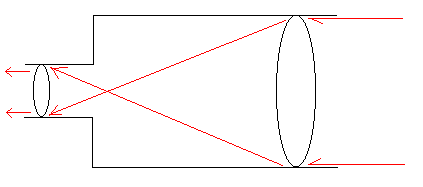
In a refracting telescope, the rays of light pass through a curved piece of glass, or lens, at the front of the tube. This bends them so that they meet, or focus, on a lens called the eyepiece. This magnifies the image they make. |
|
|
|
|
|
|
|
Reflecting Telescopes |
|
|
|
 |
|
|
|
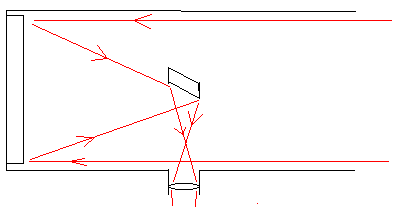
In a reflecting telescope, the rays of light fall on a mirror at the back of the tube. This reflects them on a second mirror, which beams them on to a eyepiece lens at the side of the tube. In some reflecting telescopes the mirrors are arranged differently. |
|
|
|
|
|
|
|
Giant Telescopes |
|
|
|
The world's biggest refracting telescope was built in 1897. It is at the Yerkes Observatory, near Chicago. It has a lens that is 102cm across.
Today's giant tlescopes are of the reflecting type. Mirrors give a much clearer image. The whole telescope is controlled by computers. Instead of looking through an eyepiece at the image, modern astronomers use electronic equipment which reacts to light.
Photographsare taken of the image. Some of the telescopes in use today are huge. A human figure is dwarfed by the biggest telescope at the Kitt Peak Observatory in Arizona. It has a mirror that is 400cm across. |
|
|
|
 |
|
|
|
|
|
|
|
Radio Telescopes |
|
|
|
Objects in space do not only give out light rays. They give out radio waves, X-rays, ultraviolet and infra-red rays.
Light and these other rays travel through space with a wavy motion. The distance between dips or crests is called wavelength.
Radio waves have longer wavelengths than the other rays. They can be picked up by radio telescopes.
The dish picks up radio waves and reflects them on to a central antenna. They are turned into electrical signals. |
|
|
|
 |
|
|
|
|
|
|
|
X-ray detectors |
|
|
|
Light and radio waves can pass through the air, which surrounds our planets. X-rays, which have short wavelengths, cannot. This is why X-ray detectorsmust be at least 150km above the Earth. The first ones were sent up on balloons or rockets.
Today X-ray detectors pick up X-rays coming from distant stars. The signals sent back are turned into pictures by computer. |
|
|
|
|
|
|
|
Ultraviolet Telescopes |
|
|
|
Stars, especially new and very large ones, give out large amounts of ultraviolet rays. These have a shorter wavelength than light, and only a few pass through the atmosphere.
The best place to pick up ultraviolet rays is out in space. The International Ultraviolet Explorer was launched in 1978. It was equipped with a special telescope fotted with instruments called spectrometers. The signals sent back were turned into fascinating pictures of distant stars. |
|
|
|
|
|
|
|
Infra-red Telescopes |
|
|
|
Infra-red rays have a longer wavelength than light. They are given out by hot objects in space. When you feel the heat of the Sun, you are feeling infra-red rays that have travelled 150,000,000km to Earth..
Infra-red rays can pass through the Earth's atmosphere and telescopes have been built to detect them on Earth. They are sited on mountain peaks, where they are less affected by water vapour and other gases which absorb the rays.
infra-red detectors may also be carried up on aircraft or balloons. The best place for infra-red telescopes is in space. The Infra-Red Astronomy Satellite was launched in 1983. |
|
|
|
|
|
|
|
Copyright reserved by kh_tan89. |
|