Nekojarashi

May/June 1999 No.19


Topics, Michino-eki, Suwa Dialect, Dango, Learning Japanese


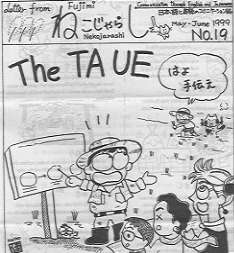
The TAUE

It's about time for the "Ta-ue" season. What's "Ta-ue"? "Ta" means "rice paddy" and "ue(ru)" means "planting", thus "Ta-ue" is "rice planting". But how many of you know exactly how and what is done?
See the next page and find out what "Ta-ue" is. Then you will be able to explain "Ta-ue" to those who don't know it -- small children, city-dwellers and people from different cultures.


"The Long and Winding Road" to Ta-ue

Nawashiro : Rice nursery

Select seeds

At the beginning of April, put the unhulled rice (seeds) reaped last year into salt water to eliminate those which float to the surface (these are bad).
Soaking seeds

For about 10 days before sowing. soak the seeds in water. Some people put the seeds in the hot bath in order to further promote budding.
Seeding

Prepare the seedling beds by filling soil in planters beforehand. Sowing is usually automated; put the planters on the conveyer belt of the sowing machine, which discharges the planters with seeds sowed.

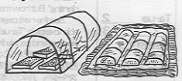
Place the planters in lines in large hothouses or long tunnel-like hothouses and thus under the most suitable conditions for seeds, wait for them to bud and grow.

Plow a rice paddy

Taokoshi

Turn up the paddy with tractors, etc. in order to loosen the soil which has become packed during the winter. In old days, people used to do this hard work by themselves with hoes.
Azenuri

In order to prevent water from leaking out from the paddy, apply mud and clay thoroughly over the ridge between rice fields. Today, some people put plastic sheets over it.

Shirokaki

Fin the paddy field with water and till the soil with cultivators until the soil becomes soft enough to plant the rice.

Narashi
After the paddy field is tilled, level and smooth the field with a tool like the leveler used on baseball grounds.

In about 1 month after sowing, the seedlings will have grow as tall as about 20 cm' and they at last are transplanted into well-prepared paddy fields and taken good care of until reaped in the autumn.


Learning Japanese (at Japanese page)


Season's word: KOINOBORI
carp-shaped streamers made of paper or cloth put up around Children's Day (KODOMO-NO-Hi) May 5, traditionally the Boy's Festival (TANGO-NO-SEKKU)


Suwa Dialect

OTSUKUBE, or OTSUKUNBE, or OTSUNBEKO
These expressions depict a position or movement.

Q What is their meaning?
A SEIZA : sitting on floor in proper Japanese style ( sitting on one's knees)

OTSUKUBAI, which originally means to prostrate oneself seems to have turned into OTSUBE or so on.


Easy Easy Snacks from around the World
JAPAN

DANGO : rice-flour dumplings

Dango
150g refined rice flour
1) Knead 150g refined rice flour, with 1/2 cup water added little by little, until it is as soft as an earlobe. Make into bite-size balls.
2) Boil water over high heat; Drop in 1)
3) After 2) floats to the surface, boil 2 minutes; ladle them into cold water; let them drain
4) Put 3 dumplings on a skewer

Sauce
A: 1/2 cup soy sauce (SYOYU)
B: 2 tablespoons sugar (SATO)
C: 1 and 1/2 tablespoons dogtooth violet starch (KATAKURIKO)
1) Boil A and B
2) Dissolve C in an equal amount of water; add to AB. Stir well.
3) Steep dumplings in sauce.

New Series! Would you please contribute to us a recipe for making a snack popular in your country?


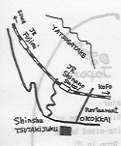
Open! Michi no Eki, Shishu Tsutaki-juku

What is a "Michi no eki"?

It's a parking oasis, a rest facility along public roads. There are not only parking , rest houses, and rest rooms, but also shops in which the specialities of that particular region are sold. They help revitalize their surrounding area.

What are some features of "Shinshu Tsutaki-juku"?

There are hot springs including rotenburo (open-air baht), saunas and a restraunt serving local dishes (homemade-soba, hot noodles). And you can experience making soba if you make a reservation. Local farm products, soft cream, and yogurt are also popular.

Closed: On Tuesdays
Tsutaki-no-yakata (onsen) 10:00 a.m. to 10:00 p.m.
Fee 600 yen ( 400 yen after 5:00 p.m)

Tenohira-kan (restaurant)
10:00 a.m. to 8:00 p.m.


Suwa Japanese Language Class

Let's learn Hiragana & Katakana!
Date: Saturday, May 8, 15, 22, 29
Time: 3:00 p.m. to 5:00 p.m.
Place : Suwa-shi Kominkan 3F
tel 0266-53-6219
(next to Suwa-shi Bunka Center)
Fee: 500 yen
Info : Emiko Onogawa tel 0266-58-4274 (Japanese, English)
Noemi Imamura tel 0266-58-8276 (Japanese, Portuguese)


Tenth Annual Suwako Charity Walk

Let's think about our Lake on foot.
Date: Sunday. May 16 "Rain or Shine"
Time: Meet at YAGAIONGAKUDO (Open-air Theater) at 8:15 a.m.
Ended at 1:40 p.m.
Free of Charge
Bring your own lunch and a pen or pencil.


Cinema Club

Movies of the Month : Welcome to Sarajevo
When: June 26th at 2:00 p.m. and 7:00 p.m.
Where: Fujimi Community Plaza
Fee: undecided
This is the true story of an English journalist who wanted to save children from Sarajevo.


Back
Hosted by www.Geocities.ws

1