Nekojarashi
January/February 1999 No.17
How about some Shock therapies for a cold?
As in an usual year, some kinds of flu are going around now. At this time last year, we introduced some Japanese
folk therapies for colds such as "Miso-soup" with spring onion and the Japanese eggnog (Tamago-zake),
and we had good responses from our readers. In winter, not only Japanese, but also many other people around the
world have hot drinks (sometimes alcoholic) of their own. In this issue, we are introducing recipes for some such
drinks at Seasonal Guide.
Quiz
What's this?
--- a mysterious thing in the Suwa area in winter ---
(How much will the non-Japanese around you know about this?)
(1)
 |
<Hint>
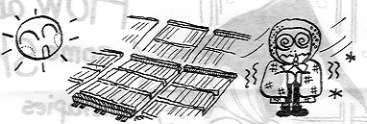
Some people start to work in paddies from early morning in winter to make this. It is made of a kind of seaweed,
called "tengusa". In this area there is a little snow and there is great difference in temperature between
day and night in winter. This is why the seaweed is brought all the way from the sea. It looks like gelatin, but
it's a little harder. |
(2)
 |
<Hint>
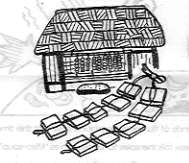
This is a specialty of Suwa which is bought at supermarkets and this like. It's made of by freezing same typical
Japanese soft food. And cold climate in this area is utilized to freeze it. In old days it was bound with rice
straw and was hung under the eaves, but we rarely see this scene nowadays. After soaking it in water for a while,
we use it in dishes like 'miso-soup', and 'tamagotoji'. |
(3)
 |
<Hint>
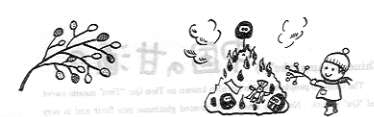
You can see these around January 15th. They are pink and white balls made with rice-flour, and are stuck on to
branches of willow and the like. They look like flowers, but are more than that. Tradition says that we will have
good health throughout the year if you roast them in the bonfire of 'Dondoyaki', (which is held on January 15th
) and eat them. |
(4)
 |
<Hint>
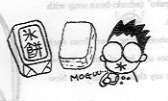
This is a frozen version of a typical Japanese food we eat on New Year's. In old days it was hung under the eaves
like in No.(1), but nowadays it is sold at JA Supermarkets and the like. It looks lovely, but how does it taste? |
(5)
 |
<Hint>
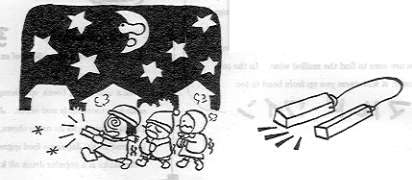
These are what pieces of wood joined together by a rope. You can make a sound by hitting them together. They are
generally used when the curtain rises, but in old days they were also used for 'yomawari'. This means a patrol
for cautioning about fire at night. The inhabitants of districts used to patrol at night by turns, hitting them
and shouting out "Be careful with fire." In some districts in Fujimi 'yomawari' is still being carried
out. |
Hot Drinks
Around the World
Chinese "Amazake" (?)
The Chinese people have No Zo, also known as Tien Qu: "Tien" means sweet and "Qu" sprits. No
Zo is made of fermented glutinous rice flour and is very similar to the Japanese "Amazake". In old days,
they used to make it at home, but it takes about one week for the flour to ferment, and as it is very difficult
to control the fermentation temperature, they now buy it at restaurants and stores.
Generally, the Chinese have a large festival at the lunar New Year rather than on January 1 and No Zo is indispensable
at the New Year festival. No Zo is very god for warming your body and some people drink it with a dumpling or an
egg put in it. It may look like the Japanese "O-Shiruko" ( adzuki-bean soup with rice cake) and "Tamago-Zake"
( the Japanese eggnog).
On the Chinese New Year festival, family members living apart from each other get together, and they have lots
of festival dishes and lots of fun. Chinese people who have been living in Japan for many years say that they miss
the New Year in their home country.
North Europe: mulled wine
Recipe : All you need is: 1 bottle of red wine, 1 cup of port wine, 1 cup of brandy, peels of an orange and a lemon,
6 cloves, 2 cinnamon sticks, 1 Tbs. of sugar, 1 tsp. of nutmeg and 2 tsp. of powdered cinnamon.
Put all of the ingredients above in a pan and warm it until just before boiling. And some sugar to make it as sweet
as you like.
At the Christmas markets in northern Europe, you are sure to find the mulled wine. In the cold winter, it will
warm you up from head to toe.
Brazil: An indispensable drink at winter parties in Brazil-Qentao.
Recipe:
- Put a desired amount(!?) of sugar and a little water in a sauce pan and heat it up to make caramel.
- Put some crushed ( or ground) ginger in 1. above and then add equal amounts of Pinga and water and warm it.
If it is too strong, add some more water.
- Add some orange peel and a few sticks of cinnamon to serve.
Pinga is a Brazilian spirit made of sugar cane and it is very strong (80 proof). In Japan, you can get it at
Brazilian food shops. Brazil is in the southern hemisphere, so the winter months are June, July and August. They
have the winter festival "Festa Junina (festival in June)" when the people get together to enjoy Quentao.
They say it is very good to drink Qentao with an egg yoke mixed in. It's Brazilian eggnog. The above recipe is
translated from a Brazilian cook book, and it really says "a desired amount of sugar"!
Germany: hot beer
This is a kind of German folk medicine for a cold. It is simple: just warm beer. The warmed beer has a strong
smell, so you'd better swallow it at a gulp holding your nose.
Why don't you try it when you have a cold?
Japan: Amazake
Recipe: All you need is: 500g of sake lees, 1 to 1.5 liters of water, 250g of sugar and 1/2 tsp of salt.
In a sauce pan, break up a lump of sake lees, and water and sugar and heat it to a boil. Dissolve the sake lees
thoroughly and serve. Just before serving, you may add a tint of ground ginger to add flavour. The sake lees is,
as its names shows, the dregs of Japanese sake having a moderate amount of alcohol, and it is a traditional Japanese
food ingredient.
Amazake is popular drink all kinds of people from young to old.
People
A Foreign Perspective
Let me introduce myself. My name is Kim McFarlene, and I am Fujimi's Assistant English Teacher (A.E.T.). I come
from a town called Invercargill in New Zealand, and I have been in Japan since the end of July -- my first visit
to Japan. I am teaching at two of Fujimi's schools: Kogen Junior High School and Minani Junior High School. I would
like to share with you my perception of these two schools.
Kogen Junior High School is modern. Having built a new school in 1996, the feeling at school is still one of excitement
-- a child with a new toy, the wonder of such a new school ever present. The surroundings, in the middle of town,
are sure to be the best.
Minami Junior High School, on the other hand, is the exact opposite. Nestled into the countryside on the outskirts
of town, I hear it's about 30 years old. The wooden floors and corridors, filled with stairs which follow the natural
slope of the hills outside, complement the nature superbly. Minami Junior High School has a real "lost in
nature" feel about it. Quite the opposite of Kogen J.H.S. with it's "middle of a big city" feel.
However, because of these differences the two schools represent more than just educational facilities, designed
to fill the minds of Japanese youth. To me, they epitomise Japan as a nation, in it's entirety.
Let me explain .... Kogen is modern Japan. Japan has become a thriving economic nation in the last few decades,
and so Kogen reflects this now, changing, developing country. It has the moderness of Japan's "bright lights
and big city". It is progressive, modern and leaves nothing to be desired. Kogen J.H.S. is Japan.
Minami J.H.S. must then reflect old Japan, the Japan rich with tradition, culture and "old world charm".
Minami J.H.S. has the elegance and grace of a country full of centuries-old custom and tradition. From the surroundings
in nature -- the trees to the nearby nice paddies -- Minami J.H.S. exudes charm. From gently sloping recreation
field outside to the creaky 30 year old floors, Minami J.H.S. is Japan. But, as modern Japan is full of tradition,
and is forever changing, the schools can depict this too. Kogen J.H.S, in all of its modern ways, still has the
time-old genkan, school cleaning time for the students and the pride in sports and club activities. The teachers'
and students' dedication is typical of Japanese society's lack of fear to work hard, even to the half day of school
every other Saturday. Some things will never change. Minami J.H.S. has the feel of Japan at it's rebirth as a modern
nation. Never in New Zealand have I seen a school better equipped with computers complete with Internet access.
The computer room itself is modern and accessible to all the students.
But despite the differences between K.J.H.S. and M.J.H.S (neither school being better nor worse, just different
from a foreigner's perspective) it's good to know the important things are the desire to learn and succeed and
the determination of the teachers and staff to help those dreams becomes realities.
How to communicate with Foreigners
" Spirit is most important!" Mrs. Morozumi
I hosted a couple from Indiana, U.S.A. for 2 weeks this summer. I'll tell you about some things that I felt during
their stay.
I heard them pronounce rain as RA-I-N (line), today as TU-DA-I (to die). Their accent was a little bit different
from that of other Americans I've met. So sometimes I couldn't understand, and said "Pardon?" over and
over again. I discovered that they spoke with a southern accent. It's only natural to speak with an accent. In
Japan we also speak in dialects. Americans sometimes don't speak English in the same way that we learn at school.
And each person has his own way of speaking. I think that Americans so for Japanese it's all right to Japanese
English.
I have an inferiority complex about pronunciation. If I kept thinking about my pronunciation, I wouldn't be able
to talk with foreigners any more. The spirit of communication is more important than pronouncing well. The person
who has such a spirit will be able to communicate by drawing pictures and using gesture, and dictionaries, etc.
It's Great!
Back