 |
|
|
|
|
|
|
|
|
|
|
|
|
|
|
|
|
|
|
|
|
|
|
|
|
|
|
|
|
|
|
|
|
|
|
|
|
|
|
|
|
|
|
|
|
|
|
|
|
|
|
|
|
|
|
|
|
|
In the 1970�s, the popular acrylic nails made their way to the Midwest and east coast. Classes were started for people who wanted to know how to do nails professionally, by Phyllis Monier in Chicago (The History of Nail Care). In 1973 the first adhesive specifically made for nails was created. In 1974 and 1975 the FDA took products off the market that were made with methyl and methylacrylate because the chemicals were dangerous. They also forced the manufacturers to come up with nails that were safer and gentler to the natural nail. Also in the mid �70s, nail competitions began. They made square tips more popular than oval or rounded tips because they were easier to judge in the competitions and would win more often than the ovals. Nail tips were being used more than nail forms, which covered the entire nail, which made it easier for nail technicians and manicurists because they were easier to use. |
|
|
 |
|
|
|
|
|
Nail technicians were trained to do manicures correctly and nearly flawless. People paid a lot of money to get their nails done this way, reather than with a kit to do it them selves at home. |
|
|
|
|
|
 |
|
|
|
|
|
Then in 1980, nail drills became common. It was made to file down the nail and fill in dents to make the nail even. Sometimes they would create a type of piercing, and put a hole through the tip of the nail to put a metal ring through it. Nail art also became popular, even using gems or other charms. Also in 1980 the first nail care magazine, titled �Mainly Manicuring� was put on to the market. |
|
|
|
|
|
|
 |
|
|
|
|
|
This nail drill is used to file and fill the nail. Sometimes fingernails get small indents in them that make them uneven, and this tool helps to fill them out. |
|
|
|
|
|
Through the �80s, nail care became increasingly popular. Nail technicians were going to school for their future career. Many organizations and companies were started for cosmetics and nail care, including Star Nail Products, OPI, Essie Cosmetics, Ladyfingers, National Nail Technicians Group, World international Nail and Beauty Association (WINBA), and even Nails Magazine. This is when nail care became popular to the point that it was creating thousands of jobs and many new businesses. In 1982 there were 80,000 nail technicians working in the US, and 13, 435 working in salons. (The History of Nail Care). Prices were also working their way up to costing 25 dollars for a full set of acrylics to be put on your nails, and 6 dollars for a manicure with your natural nails. |
|
|
|
In 1990, �In nail styles, anything goes! With the number of artificial extension systems available, women can choose the one that fits them best. It�s the era of the successful woman who considers nails as part of her overall professional look, and most important, it�s the era of the educated client.� (This History of Nail Care) |
|
|
|
 |
|
|
|
|
|
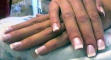
A nice professional look is what women were looking for. Nice, clean lines and simple colors like the classic French Manicure looked sophistocated, giving off the impression of success for women. |
|
|
|
|
 |
|
|
|
|
|
|
In 1993, the number of nail technicians and people working in salons almost doubled in less than a decade. There were now 175, 832 technicians in the US, with 25, 547 in salons. Also, the prices continued to grow. A manicure was now up to 11 dollars, and the set of acrylics was up to 42 dollars. (The History of Nail Care). |
|
|
|
|
The prices were going up! |
|
|
|
|
|
Today, nails are still very popular. The prices are still high, but have come down. One place in particular in Brattleboro, Vermont costs 35 dollars for an acrylic set. The Classic French manicure, with a natural colored nail and white tip is very popular. There are also kits that can be bought in local stores that include 2 nail colors, white and natural, and guiding stickers to put on your nails. The stickers are curved to go along with the �moon� of your nail (the white tip), to give smooth lines. They are applied just under the line, and when the polish is dry they are removed for clean lines. Simple looks are very popular, but on occasion people will do their nails for special occasions. |
|
|
|
 |
|
|
 |
|
|
|
 |
|
 |
|
|
|
|
|
|
|
 |
|
|
|
|
|
|
|
|
|
|
|
|
|
|
|
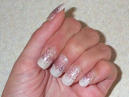
The classic, clean lines of a French Manicure will always be popular. On the left, a twist is added for a decorative effect with gems and charms. |
|
|
|
|
|
|
|
|
|
|
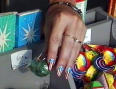
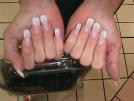
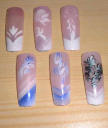
Colorful and decorated tips are very popular. On the left, are versions of the french manicure with different designs. On the right, this peron decorated their nails for the Fourth of July. Use your imagineation to create whatever look you want! |
|
|
|
|
 |
|
|
|
|
 |
|
|
|
|
|
 |
|
|
|
|
|
|
|
|
|
|
|
|
Chem X Home |
|
|
|
|
|
|
|
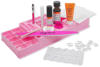
There are many kits to choose from to do your own manicure at home. You can also shape and file your very own nails to avoid using artificial ones if you'd like. |
|
|
|
|
|
|
Back to previous history |
|

