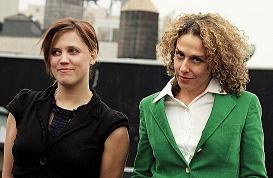
| This is not the kind of reaction one might expect from a pair of graduates from the School of Propaganda Filmmaking who are only interested in digging at and making a spectacle of Christians. These two have clear interest in the subject matter and affection for the kids in the movie. In fact, they seem to find them downright inspiring.
Heidi: I think that these children are astonishing and fascinating and articulate and of great interest to people who are not Pentecostals, who are not Christians. I think on their own, they�re a fascinating subject � to see what kind of deep faith they have and how they�re being raised and watching a worldview take root in a child. And while the kids in their last film, The Boys of Baraka, lived in what Heidi describes as �chaotic homes� in �drug-infested and boarded-up neighborhoods,� with too much freedom stemming from a lack of parental guidance (�Lacks any structure, that�s key,� Rachel chimes in), the kids in Jesus Camp � though they share the same country � may as well live on the other side of the world. Rachel: I had never seen such engaged parents. I mean, these parents� they revolve their entire lives around their children. Heidi: Their lives are so structured. There is a rigidness to the everyday. Their parents always know where they are, what they�re doing, what they�re reading, I mean it�s very heavy parenting. But the kids are well fed and they�re clean and they�re safe and they�re loved. Rachel: Incredibly well behaved. Polite and loving. Heidi: They�re obedient and loving and you know what? There are a lot of great things going on for these kids. Now, does that mean that you have to be such an intense parent in order to get that kind of result in your child? No, of course not. But it was interesting for us to experience from one film to the next these completely different ways you can parent your child. So people like to say, �Are they brainwashing? Are they being abused?� Well, no and no, I think, because those are very loaded words anyway. Throwing things like abuse and brainwashing around, I don�t think anything positive can come out of starting with that kind of conversation. But it is very, very strict. They are definitely showering their kids with a very specific, absolutist worldview and most Americans are not raised that way. So you get taken aback by it at first. But then I think a lot of parents ask themselves, �How am I raising my kids? Am I just passing my exact beliefs on to my kids even if they�re liberal beliefs?� I like the conversation that comes out of this more than anything else because we can�t answer that question. There are no answers to [whether this is a] right or wrong way to raise your kids. But it�s definitely thought-provoking. I think it makes us all look at how we were raised and how we raise our own kids. I think that may be the productive conversation to have instead of, �Is this abuse and is this brainwashing?� This theme is starting to come up more and more � the conversation that emerges from the film. I have to wonder if this picture is more about making a statement or about asking questions. So, I wonder aloud. Rachel: It�s absolutely about asking questions. There is an emotional component to it as well, but I really think of it as a �think piece� and different questions come up as you watch it. We really try to mirror the journey that Heidi and I went on in the arc of the film. So, there�s no answer at the end of the film. All the way through, it�s open to interpretation, which I think might be a wee bit frustrating to an audience because they�re used to people telling them what their perspective is and then they agree or not. But in this particular instance, they have to come up with their own position the whole time. I think that�s hard sometimes. Heidi: And also I think people are getting used to the concept that a documentary filmmaker starts with an answer, starts with a result and then goes and builds an entire movie around that premise. Kevin: Michael Moore. Heidi: Some would say Michael Moore. There are other filmmakers that definitely fall into that category. Kevin: Absolutely. Heidi: So, I don�t think either of us filmmakers in our early 30s would ever pretend we can answer the big questions of life in 85 minutes! I mean this is politics and religion, questions about philosophy and theology and ideology and so many things that everyone has opinions about are issues in the movie. So, far be it from us to make some sweeping conclusion. It just would be unwise. And irrelevant, really. But there�s something still nagging me. In all this talk of objectivity, interesting stories, asking questions, not making statements, and letting the audience draw their own conclusions; I can�t shake the image of radio host Mike Papantonio. I also can�t shake the idea that he is the film�s soothsayer, balancing conservative ideology with liberal truth. Heidi: He�s the foil. Rachel: He�s the voice of dissent. That�s what he is; he�s the voice of dissent. And he�s not our point of view, per se. On a personal level, I don�t think that Heidi and I are on the exact same page as this particular person on every issue. Kevin: Well, sure, but on what�s featured in the movie though� Rachel: We definitely wanted it to work as a counter to what the rest of the community in the film was saying because we found that without him, despite that fact that it�s very provocative material, that it fell flat because there was no dissent. There was no conflict. There�s nobody questioning anything and I don�t care how good your footage is, if there�s no conflict, it�s boring. So, really, it was a matter of creating a conflict, creating ebbs and flows in the dialogue, in the arc. Heidi: And certainly you don�t want to insinuate that every Evangelical is like the people in our movie. You also don�t want to insinuate that everyone in the United Sates agrees with what our subjects are doing. I mean it�s like, with no voice of dissent, with no one weighing in saying, �I think this is wrong. I don�t like this...� Rachel: It�ll seem like a propaganda piece. I think that, actually that Mike�s biggest [concern] is that he feels like it�s dangerous for Christianity because political parties come and go. Christianity�s supposed to be forever. So, why would you marry yourself to something that could fall? Heidi: And I think also some constituents and parishioners are starting to sometimes feel that they�re being pawns of someone else�s agenda. And so he�s commenting on that, so we thought it was important to have someone weigh in on these big issues because there is a disagreement going on. And he does only get six minutes in the movie. So, we thought 80 minutes vs. six minutes was fair, you know? At this point, I felt like I might be getting a handle on this thing. Though some in Christian culture seem to doubt what Heidi and Rachel say were their intentions with this film � and they�re free to do that � I feel utterly compelled to take them at their word. It�s not just because they�re nice and I�m a writer looking to get a good story and I like film people. It�s because beyond just sincerity, these ladies have well-thought out ideas about this. They not only say they have nothing against Becky or the kids at her camp, they are excited by their eloquence, their passion and their faith. They may not share that faith, but their status as filmmakers (contrary to the beliefs of some contemporary Christians) does not preclude them from having no ill will toward Christians. Heidi and Rachel seem to be genuinely seeking understanding about a group of people they have too long been ignorant of. This point is made quite clear when I ask them my final question. Kevin: What did you learn from making the movie? Heidi: Oh, so many things� Rachel: Yeah, really. How about if we give you one? Kevin: Yeah. One thing. Rachel: One thing I learned is that we are all very provincial and despite if you�ve gone to a nice university, you live in an East Coast city and you�re supposed to be so sophisticated and knowledgeable, you can be completely ignorant of an enormous segment of your own country. That chilled me very much to learn that about myself. And I�m glad I know different now. I really am. Heidi: Mine�s pretty similar, really. I mean, there are parallel Americas living their lives and not talking to each other. And I think both feel slightly superior to the other and I think that doesn�t get us anywhere. Whatever conclusions you may draw from Jesus Camp or from the minor furor surrounding it, whatever questions it causes you to ask and whatever biases you come to it or walk away from it with, I think it�s pretty clear that on at least this one point, Heidi and Rachel are absolutely right. �Do nothing out of selfish ambition or vain conceit, but in humility consider others better than yourselves.� Philippians 2:3 Maybe that�s a better place to start the conversation. Copyright 2006 Kevin C. Neece Back to Page 1 Jesus Camp is currently in limited release and opens nationwide on October 6. For more information about the film, please visit the Official Website. For the full transcript of this interview, click here. MAIN All Written Website Content Copyright 2001 - 2007 Kevin C. Neece |
 |
 |
| Page 2 |
 |
 |