 |
| An Interview with the documentary filmmaking duo behind Jesus Camp. |
 |
| By Kevin C. Neece |
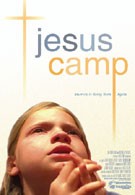
One little documentary that hasn't even seen wide release yet is already raising a lot of questions - and the ire of many in the Evangelical Christian community. The film is called Jesus Camp. It�s provocative � and short. In just 85 minutes of digital footage, there�s a heavy spate of startling, divisive material. We follow the world of Becky Fischer, a Pentecostal children�s minister in North Dakota. She�s not the children�s minister at a larger church. Her ministry stands alone and includes the �Kids on Fire� camp. Her methods seem radical to many - using strong religious experience and training camp mentality to shape young minds in an attempt (in part) to greatly affect the future of America. At counterpoint with Fischer�s camp in the film is Air America talk radio host Mike Papantonio. Papantonio is a Christian, but doesn�t much like what Fischer is doing, largely because of the close ties her camp, other parts of Evangelicalism, has to strictly conservative politics. Peppered throughout the film are segments of Papantonio doing his live broadcast, at one point debating on the air with Becky Fischer, who was a call-in guest. Is Papantonio speaking for the filmmakers? Is Fischer? What about Levi, the magnetic 10 year-old preacher who dominates much of the film�s space? Flooded with images of children crying, praying, preaching and speaking in tongues, at the end of the picture, I'm not sure how to take all of it. What do we have here? An honest look at some conflicts over religion in America? A piece of propaganda that tries to use extreme Christian religious experiences to make Evangelicals look crazy? A sad tale of children being manipulated and controlled in their formative years by megalomaniacal religious leaders? After seeing the film, I wasn�t getting a strong feeling one way or another. Either this was a poorly made picture, or it was trying to do something other than make an outright point. So , in an upper level room of a Dallas office building, I endeavored to find out. Through a swinging glass door, I came to the fount of knowledge for all things Jesus Camp, Heidi Ewing and Rachel Grady. Rachel, all bright eyes and leggy enthusiasm, controlled explosion of reddish curls atop her head and Heidi, sleek and urbane, her dark brown hair flowing neatly backward, looking polished but with an edge that might be at home on a basketball court, had to either be complete opposites or sisters. They�re sisters. Not literally, but they may as well be. Both greeted me warmly and brightly, each eagerly extending a hand, Rachel doing so after quickly shuffling back into her shoes. The tone was quite immediately welcoming, friendly and comfortable. The two women almost simultaneously got the �ice-breaking� done in a jiffy, asking when and where I�d seen the film and joking about Tuesday night movie audiences (or the lack thereof). Alright then, straight into the hard-nosed, in-your-face questions! �How did this project get started?� Okay, that�s a softball. I�m trying to be friendly. Rachel, a self-described �spiritual Jew� and aware that I write for a Baptist newspaper, seemed pleased to point out that their inspiration was a Baptist child. Rachel: Devon Brown is a 12 year old aspiring preacher that was one of the stars of our last film The Boys of Baraka. And we adored him and we thought that it was just so interesting, for instance how devoted he was as compared to his sister. And we thought it would be a really interesting way to explore faith � through the eyes of a child � so we were looking for a story that would allow us to do that. [We] started poking around and stumbled upon Becky Fischer�s ministry. And Heidi called her up and checked out her website. She has a ministry that is completely devoted to children, so we thought that was an interesting angle because usually it�s a subset of something else, but that�s all she does is kids, and Heidi called her up and started a dialogue. Rachel was quick to point out something that I was already prepared to ask about � the pair is well aware that a small group of Pentecostals is by no means representative of the whole of Evangelical Christians in America, a group of people whose numbers she said stand at 80 to 100 Million, according to the statistics she had seen. Heidi pounced on this idea. Heidi: I think there�s far too much focus on that in [responses to] the film. We definitely didn�t set out to, and I don�t think we make it look like a small summer camp in North Dakota is representative of 100 million people. I think that the film has a lot more to offer than that and we�re definitely trying to change that conversation because the more we keep talking about that over and over again, the more we keep defending that, it just takes so much away from what else the film has to offer, which I think is a lot, really. We�ve been at screenings�where the audiences were mostly Evangelical Christians. They had told us that they almost didn�t come because they�d had this impression that it was painting them with a broad brush, but boy aren�t they glad they came because [those accusations] didn�t turn out to be accurate and they took something away from the movie. Kevin: I think a lot of that has to do with a pretty strong reaction against charismatic spirituality from some sectors of Evangelical Christianity. Rachel: Yeah! Which we didn�t know about �til now! We aren�t in that fight. Heidi: We find ourselves defending charismatic Christians day and night and neither of us are charismatic Christians! (Heidi is a lapsed Catholic.) And it�s totally strange that we�re in this position. And 27% of Evangelical Christians are charismatic, so it�s not like we�re talking about� Rachel: 20 of �em that are making everyone look bad. Heidi: And it�s the fastest-growing sect of Evangelicalism across the globe. Are we really gonna try to brush this all under the rug because you don�t like the expressive worship or the tears? Come on. She�s got a point. Charismatics simply cannot be ignored by the Christian community and style is often a very strong dividing line that keeps that group pushed into a corner of Christian culture. Rachel seems particularly keen on the disconnectedness of most Christians with certain charismatic groups. Rachel: Also, it�s kind of ironic and a little sad that basically complete outsiders are more open-minded about the way they choose to worship that the people in their own community. It�s strange because I don�t know why anyone would care. I point out, however, that there are theological and Scriptural issues at stake as well. For example: in the film, Fischer incorporates the gift of tongues into her ministry in a way that many believe is outside Biblical guidelines. Heidi: I think that is an interesting conversation. I think that is a smart conversation and something of interest to discuss if they violated a Biblical [guideline]. I think it�s productive more than �We�re not all like that!� That�s an interesting perspective that people think it�s okay to speak in tongues, but not under the condition that you did at this camp. Kevin: Right, because many believe essentially it�s not something that�s supposed to be taught. (In the film, Fischer instructs the children en masse on using the gift of tongues.) Rachel: Oh! Heidi: Right, I�d heard that. Kevin: They believe it�s not something you should be teaching people to do and certainly you shouldn�t be teaching it to kids. Because you can teach anyone to speak in tongues. That doesn�t mean it�s inspired by the Spirit. It�s supposed to be an utterance of the Holy Spirit. Rachel: Right, which is totally organic. Kevin: Yes. Exactly. Okay, that�s just one aspect of the issue, but this isn't a theology class. I start to notice, though, that Heidi and Rachel seem really interested. They really wanted to understand. They realize these Christians are considered fringe, but they want to know why. Page 2 Copyright 2006 Kevin C. Neece MAIN All Written Site Content Copyright 2001 - 2007 Kevin C. Neece |
 |