
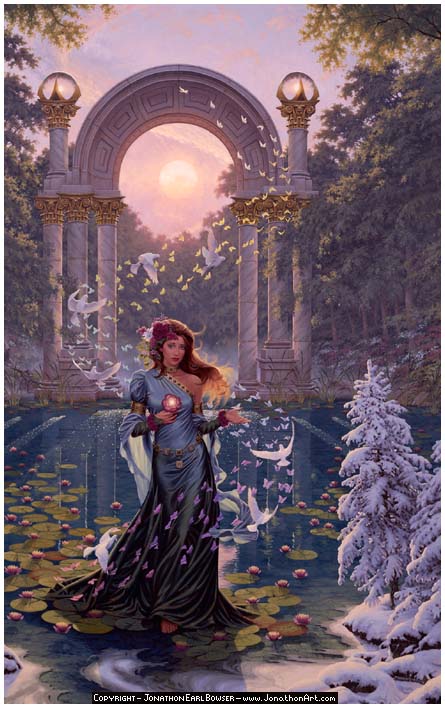
Elaine: The Lily Maid
 |
|
|
Once upon a time, there was a powerful Roman emperor named Macsen Wledig. One day, he suddenly fell asleep while hunting, and had a fantastic dream. He traveled over vast and beautiful terrain, and finally found himself in a castle wherein he met a hauntingly beautiful woman. Upon waking, he sank into despair for hopeless love of this woman. He sent his men far and wide to find her. When they discovered Macsen's dream lover, she refused to consider the emperor's suit until she has met him in person. So Macsen Wledig journeyed to the castle himself, and he and the maiden, whose name was Helen, were wed.
Hidden in this fairy tale from the Mabinogion is a kernel of history. The man known as Macsen Wledig to the Britons was also the Spanish-born Roman officer, Magnus Maximus, a real man who lived in fourth-century Wales. He married a British heiress, Elen, and this alliance made him the ruler of great territories. Elen is remembered as a remarkable woman; she was called "Elen of the Hosts" because she marched with her husband's troops one one of his campaigns. She was also instrumental in having roads built between major settlements in Britain; there can still be found numerous Elen's Causeways, Elen's Roads, and Elen's Paths.
Was it simply her queenly competence that gave Elen the mythic persona she takes on in the Mabinogion? She was certainly revered; she had her own feast day, sometimes given as May 2, sometimes as May 22. This, of course, is right around Beltane-time, and might suggest a pagan goddess with whom the mortal queen Elen was identified and assimilated. The fairy tale told of her courtship, too, is reminscent of other Celtic myths, especially the Irish and Scottish tales involving the magical courtship of the Young God Angus and his true love, named Caer and Bride respectively. Was the original Elen a Spring Maiden or May Queen, for whom the fourth-century heiress was named, and with whom she was later confused?
We do know that the figure of Elen continued to inspire Britain's poets; she can be seen, fragmented, throughout Arthurian legend. There are five or six Elaines, but two of them are famous. One is Elaine of Carbonek, daughter of the Grail King, who is Lancelot's lover. She bears his son, Galahad, and nurses Lancelot back to health when he goes mad. He lives with her for a time, but eventually leaves her to return to Gwenhwyfar. The other famous Elaine is the Lily Maid of Astolat, or in one poem, the Lady of Shalott, who pines away and dies of a broken heart after being rejected by Lancelot. So, both Elaines are still irrevocably tangled up with the dashing and handsome knight who plays the role of Young God or May King in the legends. And perhaps I make a huge leap here--but Norma Lorre Goodrich traces the name Lancelot in her book Guinevere, and suspects that it is the French rendering of the Celtic "the Angus". Perhaps in the Arthurian legend we have a hazy memory of the eternal marriage between the Young God and the Spring Maiden, seen in the strange ties between Lancelot and his Elaines.

