Brigid: The Flame and the Well

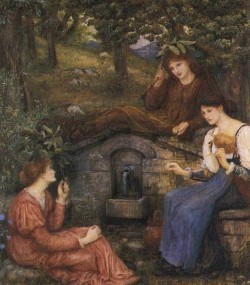
"By a clear well, within a little field", Marie Spartali Stillman

Hail reign a fair maiden with gold upon her toe
Open up the West Gate and let the old year go
Hail reign a fair maiden with gold upon her chin
Open up the East Gate and let the new year in

(Traditional Imbolc Charm)

This page is devoted to Brigid--who was one of the most beloved goddesses in ancient Ireland--who was so popular that she was not eradicated with the coming of the Christian missionaries, but instead canonized--whose sacred flame burns once more in her old sanctuary--who is still loved today by the Irish, and by many Pagans.

Brigid was the goddess of fire; she was probably originally associated with the sun. She was seen as a trinity of sisters, all named Brigid; one presided over the warm comforting flame of healing (she was also associated with sacred healing wells), one over the purifying and tempering heat of the forge, and one over poetry, the "fire in the head."

In later Christian tradition, Brigid was referred to as the "foster-mother of Christ." A foster-mother was all-important in Celtic society; many children were sent to foster parents who would bring them up, educate them, and train them in war or a trade. There was a saying that the ties of foster kinship were stronger even than those of blood, for there was a deep spiritual bond there. Why is this relevant? I consider Brigid to be a sort of spiritual foster mother to me. She was the first Deity I came to know well in my pagan wanderings, and she has always been there for me. She has been beside me, guiding my steps, comforting me, and letting me cry on her shoulder. This is why I see her as a sort of foster mother, or godmother--or should I say Goddess-mother?

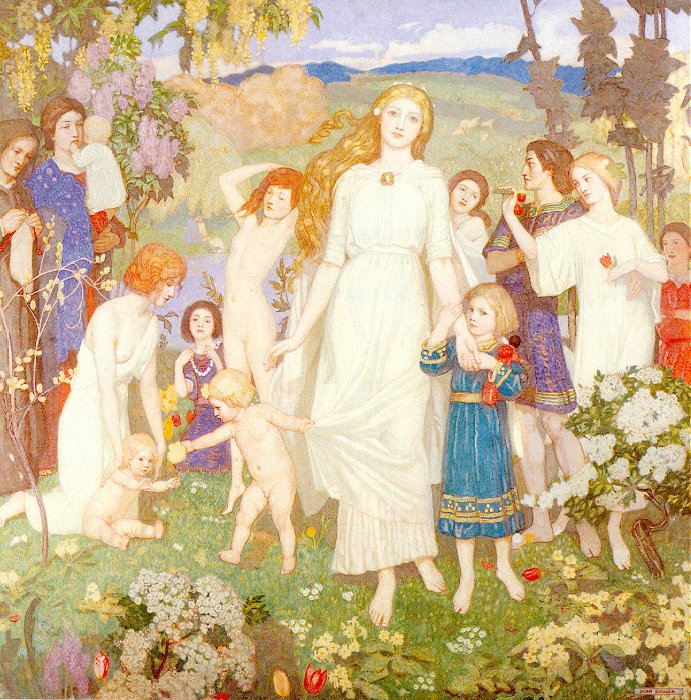
In Scottish myth, Brigid was called Bride and was the personification of Spring. Every year, she would be locked away in the castle of Cailleach Bera, the Winter Hag, and then rescued by her lover, Angus, who fell in love with her in a dream and sought her throughout the world. This story reminds one of the Irish tale of Caer, and since the male figure in the story is the same, it makes me wonder if the two female characters, Bride and Caer, are in fact linked as well. I believe this ancient myth has survived into the present day, as the faery tale "Rapunzel". Rapunzel, like Bride, was locked away by an old crone, and fell in love with a young man. When Rapunzel heals the prince's blindness with her magical tears, one is reminded of a story once told of St. Brigid. The saint is supposed to have blinded herself to repel an unwanted suitor; she later healed her own eyes by magic. The hints are there.

"The Coming of Bride", John Duncan

I wrote a poem last year about the elopement of Bride (admittedly, before I knew much about the details of the story), incorporating a traditional Imbolc charm; here it is:

THE BRIDE

(Refrain: Traditional. Verses: (c)2000, Kelly C. Lasiter.)

The Queen was in her fury, and the frost lay on the land
An icy silver hammer she carried in her hand
And within her frozen castle sat a maid with hair of gold
And despite her heart of fire, she shivered in the cold
Then through her high slit window she beheld the Queen's own son
The moon was bright upon his face; was this the worthy one?
"For if it is," she whispered, "then I shall be free;
I shall not touch the Queen, and the Queen shall not touch me."

Hail reign a fair maiden with gold upon her toe
Open up the West Gate and let the old year go
Hail reign a fair maiden with gold upon her chin
Open up the East Gate and let the new year in
Levideu sing Levideu the water and wine
The seven bright gold wires and the candles that do shine

Around him there were brambles, and paths that led nowhere
Before him there were walls to climb, yet he somehow made it there
Her smile was sure, her nod content, like the cat who's caught the mouse
She said just this, "I knew it! Now take me from this house."
So over barren fields they ran, and in her steps did grow
Blossoms of bright yellow, and some as white as snow
The ancient Queen, she followed; the cold wind gripped their bones
But so frigid and so hard was she that her hate turned her to stone

Hail reign a fair maiden with gold upon her toe
Open up the West Gate and let the old year go
Hail reign a fair maiden with gold upon her chin
Open up the East Gate and let the new year in
Levideu sing Levideu the water and wine
The seven bright gold wires and the candles that do shine

And so away they fled, and she put on her new green dress
Then she said, "Rest assured that I'm no damsel in distress.
The walls you climbed, the thorns you braved, the maze you clambered through,
And the old woman so ugly, who cast stony eyes at you,
All of these were me and me alone; they were a test;
You made it through my worst, my love, now you shall have my best."

Hail reign a fair maiden with gold upon her toe
Open up the West Gate and let the old year go
Hail reign a fair maiden with gold upon her chin
Open up the East Gate and let the new year in
Levideu sing Levideu the water and wine
The seven bright gold wires and the candles that do shine.

Brigid Sources

Charles Squire, Celtic Myth and Legend

Sheena McGrath, The Sun Goddess

Patricia Monaghan, The New Book of Goddesses and Heroines

Padraic Colum, A Treasury of Irish Folklore

Donald MacKenzie, Celtic Tales of Myth and Legend

Amber K and Azrael Arynn K, Candlemas

Brigit/Brigid/Bridget/Bride...
Patricia Monaghan's information on Brigid is among the best I have found. This page also includes Hrana Janto's painting of Brigid as a Triple Goddess.

Lady of the Depths
Brigid as a Goddess of Sovereignty, who may have been related to the Lady of the Lake.

Art on this page

Painting from ArtMagick
Rainbow bar by Nevr2L8's Bars
Fiery knot by Aon Celtic Art
Background from


Return to BeanSidhe Dreams


Hosted by www.Geocities.ws

1