 |
| The village street that leads to the world =============== Die Dorfstrasse die zur Welt fuehrt |
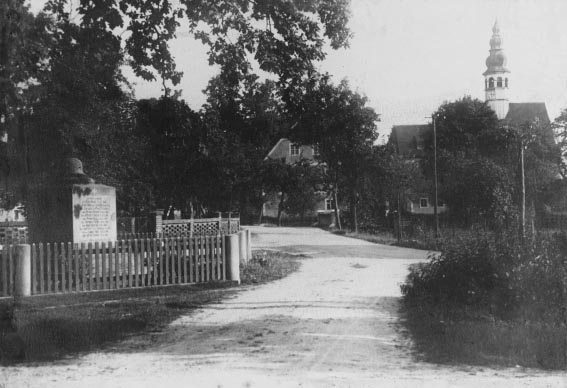
| For me the street led past the World War I memorial and the village church to the coast of Southern California and beyond, even Hawaii. For my son she led to Azteca, Mexico, where his wife's family have their roots. For the rest of the Kesselbacher former residents it led practically to all corners of the world for some. =============== Die Strasse fuehrte fuer mich am Denkmal der Gefallenen des ersten Weltkrieges und der Dorfkirche vorbei bis zur Kueste von Sued Kalifornien und darueber hinaus, Hawaii. Fuer meinen Sohn Ken sie fuehrte nach Aztec, Mexico, wo die Wurzeln der Familie seiner Frau verankert sind. Fuer alle anderen ehemaligen Kesselbacher fuehrte sie fuer einige zu allen Ecken der Welt. |
| This church of Kesselbach is first time mentioned in the year 1346, the building in the picture was opened in 1698 The inside of the church features a painting of Wigand Moller von Mollerstein, died 1707, the one time owner of the castle of Mittel - Sohra (Kesselbach). There were three bells located in the tower, a large sized, medium and small. The large sized was tolled every noon hour to announce the midday breack and at 6:00 o'clock in the evening, the medium sized, to ring in the end of the day. On festive occasions such as weddings or sad ones like funerals, all three bells sounded throughout the village, as well at the beginning of church servies. In the event of a death in the village, at 10:00 A.M. three times for five minutes, starting with the large sized and the other two chiming in later, the bells rang to announce farewell to the deceased. Until World War I the bells were made of bronze, they, however; had to be turned in to assist in the German war effort. In the year 1924 three new bells, made from steel, were installed. Toward the end of World War II the curch tower was blown up by the German troops, the bells, however; were saved. They are now set up on a wooden crate in front of the church. =============== Die Kirche in Kesselbach wird zum ersten mal im Jahr 1346 erwaehnt, das Gebaeude im Bild war im Jahr 1698 eingeweiht. Ein Portraet von Wigand Moller von Mollerstein, der einmal der Eigentuemer des Schlosses in Mittel-Sohra war, gestorben 1707, in Oel und Kupfer gemalt, in einem Steinaufbau eingefuegt, haengt im Gebaeude. Im Kirchturm waren drei Glocken angebracht, eine grosse, mittlere und kleine. Die grosse wurde jeden Tag um zwoelf Uhr mittags bei einem Mitglied der Engmann Familie gelaeuted,um die Mittagspause anzudeuten und um 18:00 Uhr abends, die mittlere Glocke um den Feierabend anzudeuten. An festlichen Ereignissen, wie Hochzeiten oder traurigen, wie Beerdigungen, alle drei Glocken klangen durch das Dorf, auch der beginn des Gottesdienstes. Wenn ein Gemeindemitglied verstarb, wurde das Mitglied um 10:00 Uhr morgens ausgelaeuted. Dreimal fuer fuenf Minuten, beginnend mit der grossen Glocke, die anderen beiden setzten spaeter ein. Bis zum ersten Weltkrieg die Glocken waren aus Bronze, mussten aber abgegeben werden fuer den Kriegseinsatz. 1924 wurden drei neue Glocken angebracht, die aus Stahl gegossen waren. Gegen Ende des zweiten Weltkrieges in 1945 wurde der Kirchturm von der Wehrmacht gesprengt, die Glocken aber bewahrt, sie sind jetzt auf einem Holzgestell vor der Kirche aufgestellt. =============== The fence to the left of the street is the enclosure of the villages WWI war memorial, showing 31 names, victims who sacrificed their lifes in that insane war. Had we been allowed to remain in Kesselbach, undoutedly 53 more names would have been added to honor the victims of WWII. another insane war. The memorial is topped by a wreath and a steel helmet and is overshadowed by a huge aok tree that was planted in the year 1837, as a tree of peace. Memorial celebrations were always conducted at this place. =============== Links unten auf dem Bild zweigt der Dorfweg von der Kreisstrasse ab, zeigt dort einen eigezaeumten Granitblock unter einer grossen Eiche. Sie wurde im Jahre 1837 als Baum des Friedens dort gepflanzt. Sie ueberschatted das Kriegerdenkmal, ein vierkantiger Granitblock mit einem Helm und Kranz indem 31 Namen verewigt von den Menschen, die ihr Leben hingeben mussten waehrend des ersten Welkrieges. Haetten wir in Kesselbach bleiben duerfen, wearen zweifellos 53 Namen, Opfer des zweiten Weltkrieges, hinzugefuegt worden. Alle Kesselbacher Gedenkfeinern fanden an dieser Stelle statt. |
 |
 |