all writings © July 2000, Mike L. Miller
Written for Professor Pollock's Thought and Image II course at San Francisco State University, Fall 1999
If I hope to convey any sense of WWI era Zürich and the denizens of the Cabaret Voltaire, I must be denied even the tiny shreds of comfort I find in proclaiming that a study of dadA is by definition a travesty and betrayal of its Great Spirit of Negation. I should kneel upon gravel, criss-cross my glasses with fork scratches, and type with my tongue, filling a single cell in the midst of a stock-portfolio spreadsheet with a million cries of primal gibberish. No! I should chop a hammer into tiny pieces with an axe and put the pieces in a bean can, bury it in a cemetery and leave my faithful professor directions to the cemetery, take spy pictures of him being questioned by the authorities for digging in a graveyard and turn the negatives in as my real final paper, each negative image glued to the center of an irregular leaf of sandpaper. No! I should buy a soda and dare to drink it and call it a day...No! I should... As in punk rock sixty years later, an impossible game was initiated when Dada centered it's motivation on anti-art.
The continuous, exhuasting process of one-upmanship, or one sidemanship or whatever--"harder core than thou" is what Jello Biafra of the infamous and brilliant Dead Kennedys called it in the punk music scene--could only lead to the disintegration of the movement as energies were drained. Whenever one creates work that goes against the mainstream, one ironically serves to bring the mainstream into focus. One cannot escape the fact that such negations would not be possible without the mainstream, and these ties cannot be removed as long as negation remains central to the new work; because no negation can ever precede that which it attempts to negate, it will always be seen as a secondary outgrowth of the first, like a rebellious child who wants to disown the backward, old-fashioned parents whose legacy overshadows her every move, to her ever increasing dismay. Such a child will eventually, of course, grow up or self-destruct. The upside is, while striving for that unattainable perfectly and definitively "anti" production (or act or some clever inversion of those things), the motivation of that dubious but seductive focus was tremendously invigorating to the daDIsts and those who came into contact with them (and didn't quickly run away in terror or disgust).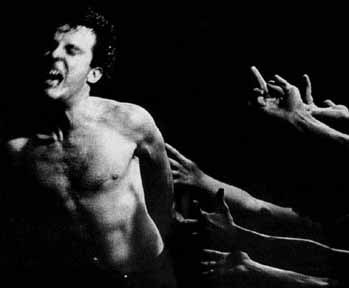
My punk Hero: Jello Biafra (click for more)
Implicit in the preceding is my sense that aaDD was never really "anti-art" because, of course, they made art. Art is too huge a concept to be generally opposed; perhaps the only true anti-artist is a theoretical individual whose every action is a practical gesture with the express purpose of acquiring food or shelter; perhaps the comatose infant on life support engages in no artful activity (though I tend to think she does). To be anti art, one has to oppose all symbolic gestures, all attempts to create meaning outside of the practical sphere. DddD would never welcome such an incomprehensible world of isolated, thoughtless organisms; they were against what art had become.
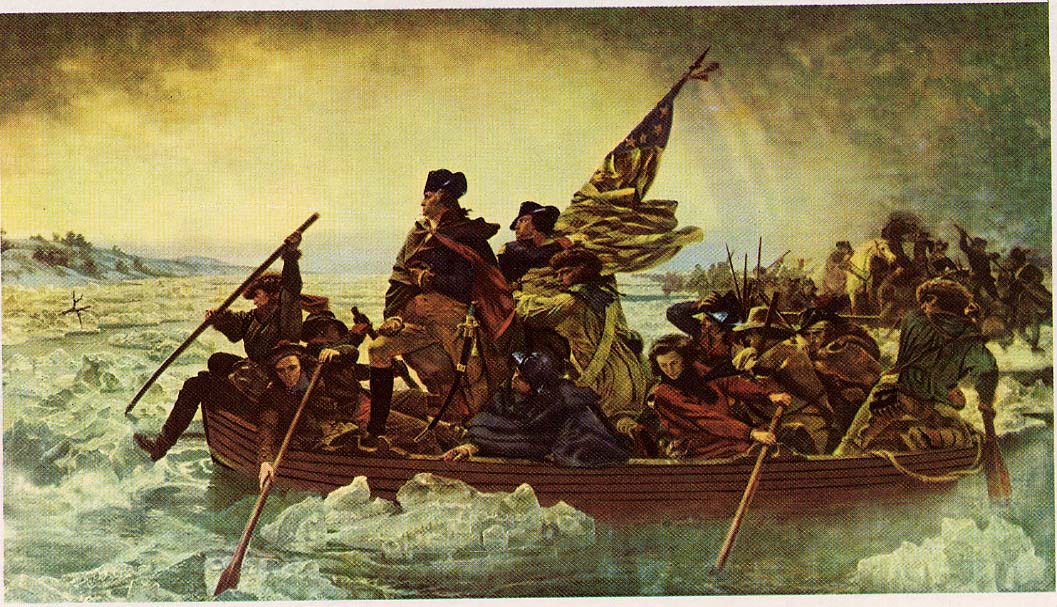
The Romantic era had seen the rise of a heroic, idealized "realism" in mainstream art; the latter part of the same era had seen the hideous swelling maelstrom of the Industrial Revolution. While art was revelling in secular humanism's celebration of the almighty Individual, setting God aside in favor of individuals' capacity for heroism, genius, sacrifice and leadership, the Industrial Revolution was busily crushing thousands of real individuals every day under the weight and momentum of the steam engine and the profit motive. All the gains of Enlightenment seemed to be culminating in human suffering, all progress and invention being twisted to the purposes of perpetuating the power of the powerful. And yet, art continued to romanticize and idealize human endeavor, looking more and more like a propaganda of the powerful, who enjoyed identifying themselves with these heroic figures and scenes.
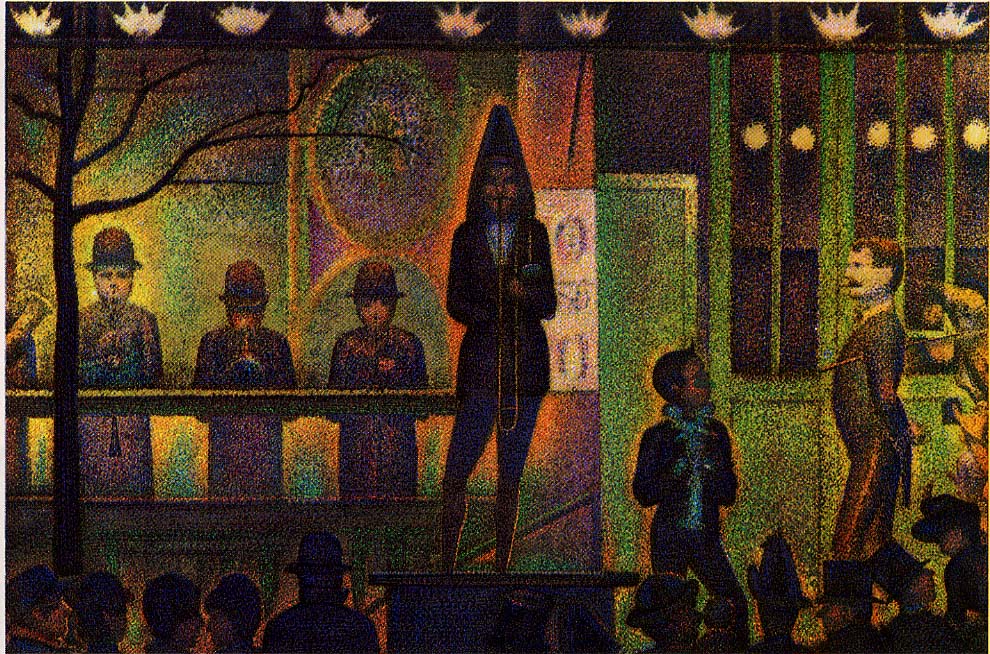
To the socially-aware aesthete who found the divide between the reality lived by the masses in Europe and the picture painted by Romantic art untenable, even the marvelous technical innovation of Impressionism was of little value, because the subject matter hardly changed; it was innocuous at best, vacuous and elitist at worst.
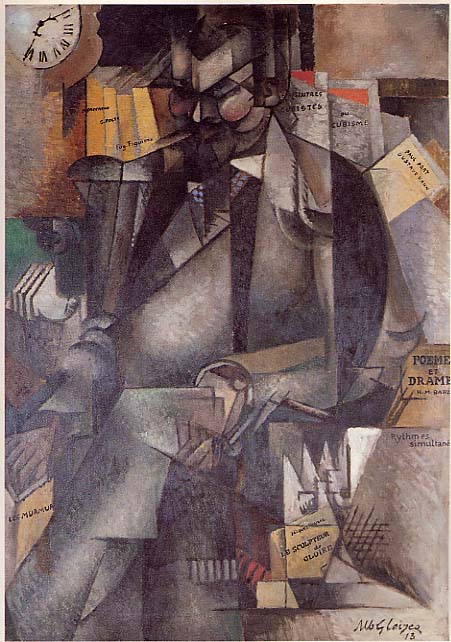 There were, of course, pre-aadA artists who were intent on finding a new vision, and further, using it to look at the real world. The Cubists--Picasso being the most famous of these--successfully questioned and overcame the monocular, immobile conception of realistic art and cartesian perspective. Perhaps because the canvas is flat and the dried paint does not move, one tends to assume that a painting will portray a single moment in time, seen from a single point of view. The Cubists not only reject that assumption, more importantly, they successfully portray both movement and multiple points-of-view within singular works. These works reinvented the visual language, demanding a completely new way of looking at the meaning of positive and negative space, the meaning of a line or brushstroke. Where before a line represented a physical edge or surface, now it might represent a path of motion, or the break between one point of view and the next, neither of which belongs to any three dimensional, physical reality but both of which act as temporal cues--visual representations of the mental process of perception--not of an image frozen in time, but a three-dimensional event. This is truly an astonishing innovation.
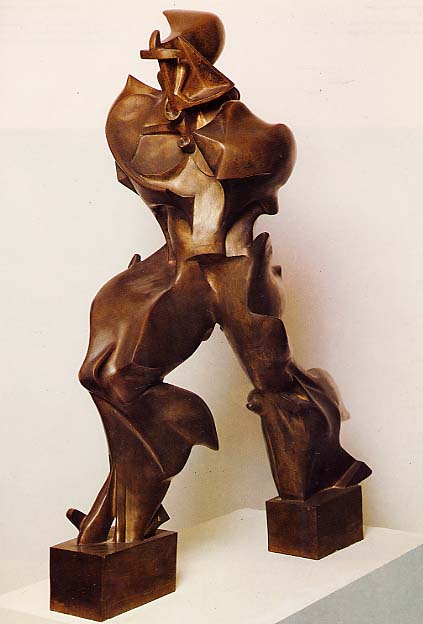 The Italian Futurists also embraced a new way of looking at subjects, but they concentrated more specifically on the portrayal of motion in static forms such as sculpture and painting. A adaDist might see them as the flip side of Impressionism, similar in that their technical innovations were marvelous but the works were ideologically unsound; the Impressionists' work was mostly devoid of social content but the Futurists were socially corrosive, really downright fascist. Rather than reject the horrors of the Industrial Revolution, they positively embraced the violent upheaval and scourge of humanity by modern science, welcoming the destruction of the worthless masses through the fires of progress. This is Fascism 101, with, of course, a "new man" to arise from the struggle: ugly, ugly ideological stuff...but technically awesome art.
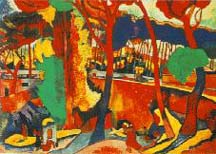 The last pre-cursor deserving mention is the colorful, bright Paris Fauve, with its primitivist bent. AdAA really embraced this style as a way to shake-off the modern baggage and get to our primal core; what was merely an interesting artistic avenue to explore, and some would say exploit, for the Fauve, became a integral part of ABAD's rejection of all-things mainstream.
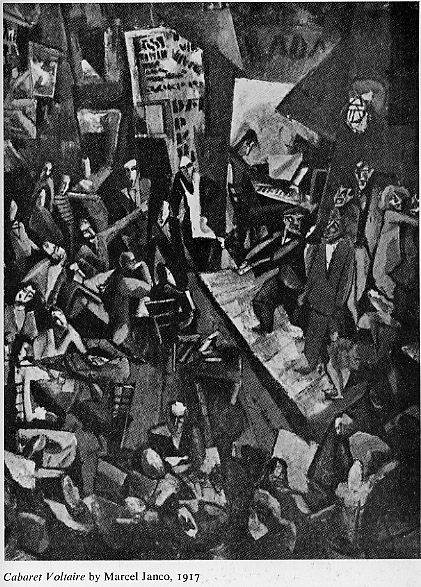 |
| View of the Cabaret Voltaire from the street. Click to see a painting of the inside... |
The tradition of the artist as "lone genius," an aesthetic manifestation of 19th century individualism, was nicely countered by the Cabaret Voltaire's group performance; paintings and collages hung all around, the masks and costumes of one artist being worn by others while performing songs and poems, audience roaring and raging while somebody played a drum or sat at the piano.
The early costumes and dances were heavily inspired by African tribal clothing, seen somewhat quaintly as an untainted human art, more primal and basic than the trappings of modern Europe. Soon, Hugo Ball began to create more striking, absurdist costumes of brightly painted cardboard for his poetry readings...
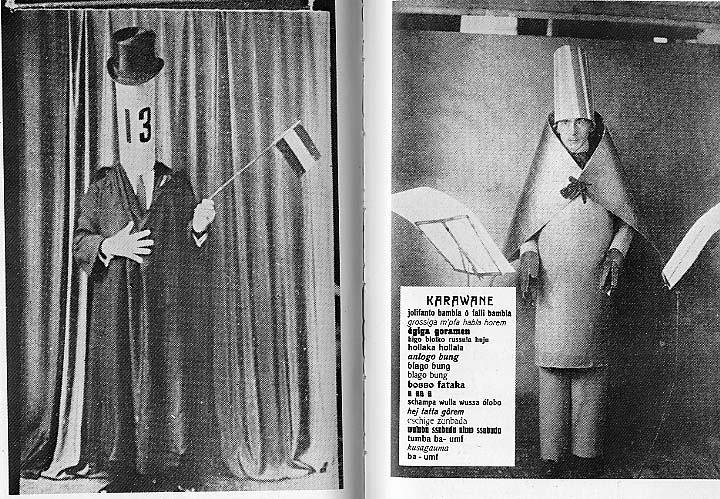
Further, this poetry rejected the entire history of human speech, attempting to revert to primal growls, whoops, plosives and sibilants. The written poem might contain strings of consonants, like "fmmmsbw," which forces the reciter to either mutter vowelessly or, as seems to have been more often the case, to reach inward for expressive sounds and tones outside the a-e-i o-u canon with which to fill out the tongue-mouth-lips-shaping consonants. This strikes me as a seminal moment in the genesis of the postmodern sensibility, when signified and signifier are first violently and willfully detached. Making these apparently meaningless sounds in a performance situation, clearly reading from a text, but with no suggestion of entertainiment as one's intent, calls into question the very process of finding meaning. "What does it mean?" becomes, obviously, a totally subjective question, because it means nothing...until you, the perceiver, decide to impose meaning upon it. This brings into stark relief the startling possibility that all meaning is thus derived, not arising from the symbol one sees or hears, but from the person doing the seeing or hearing. The meaning is imposed upon the symbol. When we ask what something means, we are really asking what everyone agrees it means. The meaning is not an intrinisic truth originating within the symbolic construct; it is a convention imposed upon it through consensus. This revelation gives the perciever a new autonomy, a new avenue for dissent. Of course, virulent postmodernists promptly throw the baby out with the bath water, fallaciously devaluing this consensus, asserting that it perniciously masquerades as truth, and wielding the concept of the "social construct" as a badge of invalidation, rather than a basically neutral tool of communication. The point is to accept the legitimately socially constructed truths that improve the quality of life and social relations, but never to do so without questioning the source. This entire thought process is opened up by the BdDD poets' thorough removal from their works all traditional poetic signifiers, making us ask where meaning comes from in the first place.