61B/23
all writings © July 2000, Mike L. Miller
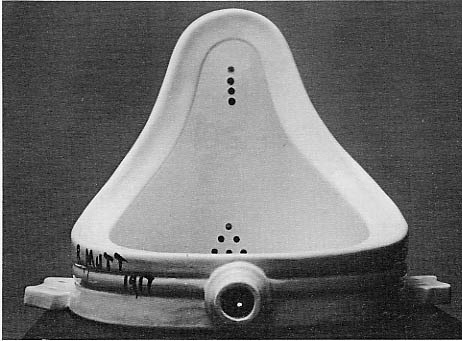 Further investigation into the sources of meaning comes later with the introduction of "readymades." By taking objects purchased at the hardware store, signing them and treating them as works of their own art, Marcel Duchamp, Man Ray and others raised some basic questions, e.g. what is art? When we employ the signifier "art," ...is a signed urinal, laid on its back and titled "Fountain," a member of the set of things signified? We cannot immediately reject these works without admitting that we have embraced the tyranny of our subjectivity. Further, when a QaFaist submits an egg-beater under the title "Man" (and then, a year later, under the title "Woman"), we have to consider the meaning of an eggbeater and the meaning of the word "man"; sensing how arbitrary this pairing appears, we wonder just how un-arbitrary are the pairings of other words and items.
 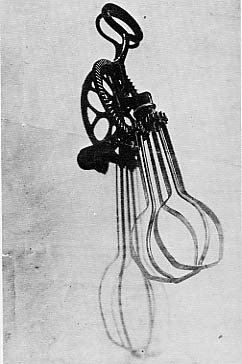 When is a grapefruit not a grapefruit? Maybe when you call something else a grapefruit? Certainly, there is no doubt in my mind that that eggbeater is in fact a "man," at least until it becomes a woman. At any rate, by asserting the subjectivity of labels, the fAqA artists invite us to do two things: question claims of objectivity we encounter and enjoy the ironic power of our own subjectivity. For this I thank and applaud them wholeheartedly.
Returning to the Cabaret Voltaire, the more satiric performed works involved the forcible removal of meaning from pre-existing poems and songs, simply by performing several simultaneously to render all the words meaningless. Sometimes the intent was clearly to irritate, with the underlying sense that an audience irritated into a rage was infinitely preferable to a society of mindless inaction; at least they were doing something. There was plenty to rage against in the midst of World War I and antagonism as a foil to chronic apathy seemed a worthy undertaking. Perhaps if someone recited the classifieds from an old newspaper while someone else kept ringing a bell, this would incite the fury of an audience who had to, having called the daQfists insane, consider the greater insanity of the world beyond the Cabaret.
The collages of Zürich Fqal also serve to predict the kind of guerilla art yet to come, as they freely appropriated images and words from newspapers, magazines and any print source they could find, combining slivers of image and word to angry, deconstructive effect.
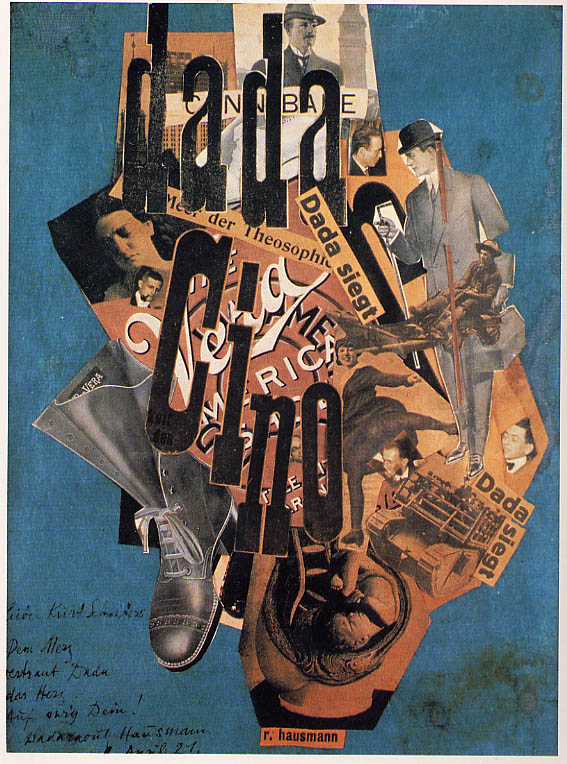 The collages also tie in to KlaD's use of the random, at times allowing those images and words to simply fall from a few feet above the surface, affixing them wherever they landed. This, of course, removed the artist a step further from the work, shedding a little more of the culturally-learned signification she might inadvertently impose upon it, just by controlling the placement of elements. This process was used in numerous works, with everything from newspaper clippings to string to smashed clock parts being dropped onto a surface.
Tristan Tzara suggests doing the same thing with poetry. His instructions for writing a PPLg poem, described in one of his many gfFP "manifestos," involve grabbing any old newspaper article, cutting the words out separately, throwing them all into a hat, and reading them one by one as you pull them out of the hat. Perhaps a central truth of the materials can be found through either of these processes of randomization; importantly, whatever is exposed will be removed from the influence of the author or artists artifice, perhaps giving us something deeper. Perhaps this "deeper" thing actually comes from within ourselves, because that's the real origin of the meaning we impose upon what we experience; whether or not the meaning we find is a social inheritance, aren't we better off getting to see what's really there?
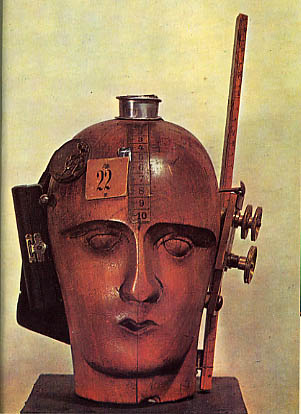
It is ironic, and another parallel to the Punk Rock movement, that it was only the fruits of progress and capitalism that provided numbers of leisurely, educated, middle-class young people with the time and understanding to not simply rebel, but create an art of rebellion. As usual, whether we invoke Modernism or Postmodernism, secular humanism or theology, just as the Cubists exposed the limitations of the literally monocular view in painting, we are foolish to put all our historical or theoretical eggs in one basket. The progress of technology and the spread of capitalism have both positive and negative elements; alienation and exploitation derive from both; so do the insights of DADA and the growth of the middle class. A purely negative standpoint cannot endure, but it can certainly provide a flashpoint for intelligent dissent, a tremendously important balance to the deadly weight of apathy.
-----------------------------273656358313616
Content-Disposition: form-data; name="userfile"; filename=""
