Personal | Academics | Home | Fieldwork

Gesher Benot Ya'aqov (Bridge of the Daughters of Jacob) is a Lower Paleolithic site situated on the east bank of the Jordan River north of the Sea of Galilee. It is named for the historic bridge that crosses the Jordan nearby. The current excavations are run by Naama Goren-Inbar of the Hebrew University of Jerusalem. I worked on the 1996 field season. The deposits are dated to around 500,000 years Before Present and represent an alternating lakeshore/lake bottom environment when the former Hulah Lake was much larger. The layers themselves are tilted at about a 45 degree angle due to tectonics- the Jordan Valley is a northern extension of the Great Rift Valley of Africa. The artifacts consist mainly of Late Achulean bifaces- handaxes and cleavers. Most of them are made of basalt obtained from the many boulders which still dot the hillsides nearby, along with a few made from chert obtained further away. During the time I was there, a photographer from National Geographic was there taking pictures for an article wich subsequently appeared in the May 1997 edition. In the center of a two-page picture of the site, Naama is holding a handaxe that I found in the foreground- my brief moment of fame! Since most of my pictures were taken with slide film, I only have a few taken with print film that I've been able to post here.
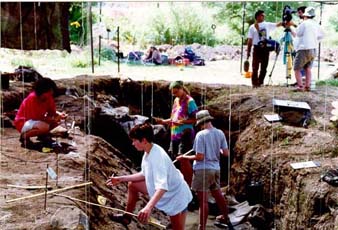
| Showing the crew excavating the main site; notice the tilt of the layers. The person in the kerchief and tie-died t-shirt is Emily Williams who was to be a grad student here at IU as well. |
| This is how the site looked at the start of the season. The back of the excavation is one of the exploration trenches, and you can see that the site is water-logged because it is right next to the Jordan River. We had to pump out the water each morning. | 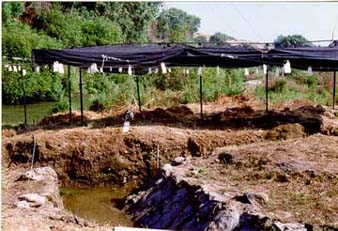
|
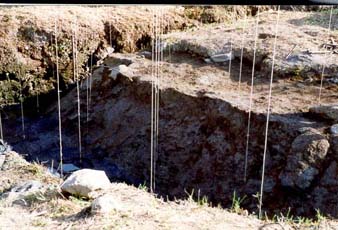
| This shows the hanging grid system used to mark the provenence of the artifacts found. |
| A further off view of the main site, looking north towards the bridge. The trees line the other bank of the Jordan River, which you can just make out in the background. | 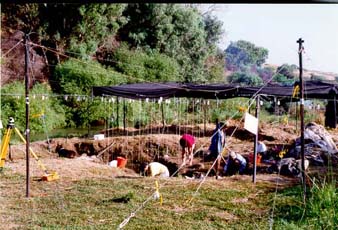
|
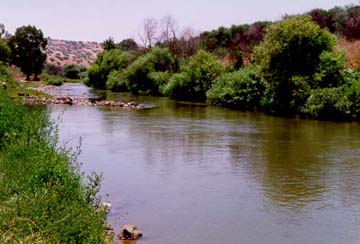
| Looking south down the Jordan to the area of "The Bar"; a portion of the site that is usually covered with water. It was there that I found the handaxe pictured in National Geographic when chasing a frisbee. |
| Here is Idit Saragusti (Second-in-charge of the excavation) and Craig Feible (Excavation Geologist) cleaning out the trench next to the main dig, so that Craig can study the lower layers of the stratigraphy. | 
|
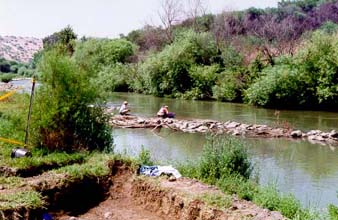
| Since the site is both waterlogged and clayey, all of the matrix was wet-sieved in the Jordan to get the micro-artifacts. In the foreground is the secondary area opened up that season. |
| It wasn't all work; we were fed well and had breaks. This shows lunchtime on the grass in the shade. | 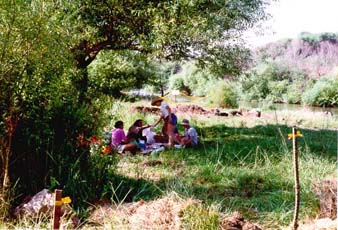
|

| On the right in her trademark sunglasses and hat is the excavation leader Naama Goren-Inbar. She's pointing out something in the main dig to Graciela Cabana, one of the crew from the University of Michigan. |
| We were each assigned a certain area within the main one to excavate. This shows mine at the start, which was the remains of a baulk that was first excavated the previous season by a volunteer named Chris; hence it was know as "Chris Baulk". The stone at the top was actually a large boulder core with several large flakes removed. Those flakes were probably made into bifaces. | 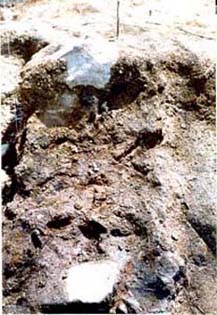
|
Any comments? E-mail me! [email protected]