O DIREITO PROCESSUAL DA IDADE MÉDIA
(PROCEDURAL LAW IN THE MIDDLE AGES)
CLÓVIS JUAREZ KEMMERICH
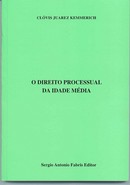 Paperback: 207 pages
Publisher: Sergio Antonio Fabris Editor
First printing: August, 2005
Language: Portuguese
ISBN: 8575253492
Product Dimensions: 8.66 x 6.1 x 0.5 inches
Main subject: Procedural Law
Price: R$ 63,00 (+/- US$ 28 on August, 2005)
Summary: Procedural rules regulate and prescribe the practice and procedure to be followed by the judicial authorities, and by the parties, in the course of the formative process of the acts of power denominated judicial decision.
This book reports the outcome of a research on the functions performed by the procedural rules during the Middle Ages. In this period, several rules which are nowadays still in effect were shaped. Therefore, it seems to be appropriate to recall the context that generated them and the functions they were conceived for.
It is expected that, by doing so, useful elements for an evaluation of the present procedural rules be obtained. Nevertheless, such evaluation is not produced in the present study, even because the elements obtained in it add up to just a little portion of those which would be necessary in order to carry out such a task.
It is perceivable that, along the analyzed period, procedural rules performed a number of functions. However, there was always a tension connecting the functions “instrument of power” and “limit to the power”. Through the first function, the rules favoured the use of power by the authorities. Through the second one, especially by limiting the ways an act could be practiced, the rules operated as a guarantee for the subjects and, therefore, supplied part of their needs for safety.
Key-words: lawsuit, procedural rules, functions, Middle Ages, Germanic procedure, Romano-Canonical procedure, English Common Law procedure, due process, sovereignty, judicial organization.
HOW TO BUY THIS BOOK
Try the following bookshops on the Internet:
LIVRARIA CULTURA (Brazil)
SERGIO ANTONIO FABRIS (Brazil)
LIST OF CONTENTS
1 Introdução
1.1 Apresentação do tema
1.2 A abordagem funcionalista
1.3 Utilidade das doutrinas de base jusnaturalista
1.4 Plano da exposição
2 Os antecedentes: os direitos dos povos germânicos
2.1 Fontes históricas sobre o direito germânico
2.2 Breve delineamento histórico
2.2.1 Visigodos
2.2.2 Lombardos
2.2.3 Francos
2.2.4 Anglos e saxões
2.2.5 A Igreja cristã
3 O poder jurisdicional no direito germânico
3.1 Assembléias das aldeias
3.2 Jurisdição do rei
3.3 Multiplicidade de jurisdições
4 As regras procedimentais do direito germânico
4.1 A autotutela e a tutela jurisdicional
4.2 A assembléia popular
4.3 A iniciativa do processo
4.4 O desenvolvimento do processo
4.5 As provas-julgamentos
4.5.1 Testemunhas
4.5.2 Juramento
4.5.3 Ordálios
4.5.4 Duelo
5 As funções das regras procedimentais no direito germânico
5.1 Ordem e justiça formal
5.2 Proteção contra o arbítrio
5.3 Realização do direito
5.4 Instrumento do poder
5.5 Necessidade de novas regras para o processo
6 Fontes referentes ao “renascimento” jurídico
6.1 O “renascimento”
6.2 As fontes históricas
6.2.1 Fontes do direito romano-canônico
6.2.2 Fontes da common law inglesa
7 O “renascimento” do direito romano
7.1 O direito romano até o final do século XI
7.2 Causas e conexões
7.3 A escola dos glosadores
7.4 O direito comum
8 A fundamentação do ordo iudiciarius
8.1 Necessidade de fundamentação
8.2 Fundamentação teológica
9 Regras do ordo iudiciarius na sua primeira fase (1100-1260)
9.1 A iniciativa do processo
9.2 A petição inicial
9.3 A citação do réu
9.4 A litiscontestatio
9.5 O sistema probatório
9.5.1 Meios de prova
9.5.2 Ônus da prova
9.5.3 Universo da prova
9.5.4 Valoração da prova
9.6 O juízo e a sentença
9.7 Os recursos
9.8 A execução
10 Processo e poder no “renascimento” jurídico
10.1 A centralização do poder
10.1.1 O imperador
10.1.2 Os reis
10.1.3 O papa
10.2 A posição do príncipe na ordem jurídica medieval
10.3 A vulnerabilidade das regras procedimentais
10.4 O lugar das regras procedimentais na ordem jurídica
11 Limitações processuais ao poder do príncipe (1215-1453)
11.1 O due process na Magna Carta
11.2 O sistema da prova legal: uma nova fase do ordo iudiciarius
11.3 As doutrinas sobre a justiça processual
11.4 A redução das formalidades
12 Conclusões
Referências
Índice
http://geocities.com/kemmerichepistemology/