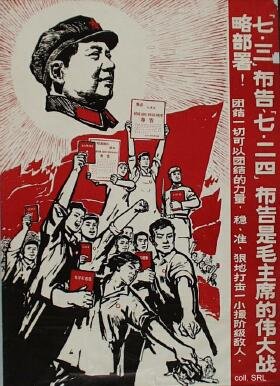
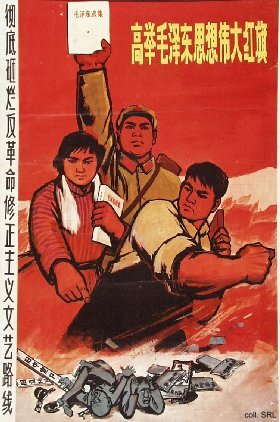
 The Chinese "Cultural Revolution" 1966-76, initiated by chairman Mao, sought to prove the inherent redness of China and its people. Since the birth of Communist China in 1949 Mao's fear of a developing rigid class system in the party and government would be combated withan attack on the so-called "Four Elements"--Customs--Habits--Culture and Thought of Chinese Society. Propaganda posters were clear and unambiguous signs of suitable slogans and behavior establishing "Correct Thought".
The Chinese Communist party came to power in 1949. Propaganda posters were produced in mass quantities illustrating the future and its slogans. Often massive murals were produced for public spaces but the smaller format of the poster made them cheap for the average worker to place within his or her homes, factories, schools and clinics.
Poster production following the establishment of a Communist government depicted the hardships of the average pre-Communist worker. The medium's main goal was to instill a feeling of hope and thankfulness within the social conscience of a new society.
The Chinese "Cultural Revolution" 1966-76, initiated by chairman Mao, sought to prove the inherent redness of China and its people. Since the birth of Communist China in 1949 Mao's fear of a developing rigid class system in the party and government would be combated withan attack on the so-called "Four Elements"--Customs--Habits--Culture and Thought of Chinese Society. Propaganda posters were clear and unambiguous signs of suitable slogans and behavior establishing "Correct Thought".
The Chinese Communist party came to power in 1949. Propaganda posters were produced in mass quantities illustrating the future and its slogans. Often massive murals were produced for public spaces but the smaller format of the poster made them cheap for the average worker to place within his or her homes, factories, schools and clinics.
Poster production following the establishment of a Communist government depicted the hardships of the average pre-Communist worker. The medium's main goal was to instill a feeling of hope and thankfulness within the social conscience of a new society.