 |
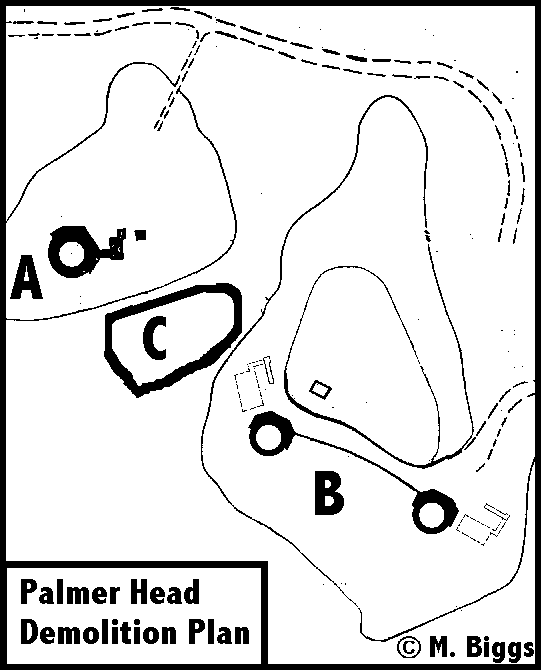
| Palmer Head/ Moa Point The first suggestions of anything that would involve demolition came about in 1961, a scant year after the guns had been finally removed. The proposal was for a massive state housing subdivision that would run from Tarakena Bay right up and around to join with Ahuriri Street. The land itself was never actually set apart for housing purposes, although subdivision plans of the area were drawn up. Finally the Works Department gave up on the idea when it came apparent that a large section of the proposed subdivision could not be gone ahead with due to the Civil Aviation Authority�s (CAA) facilities at Palmer Head. When it came to 1970, demolition was looked at for entirely different reasons. �Various pill boxes and buildings exist between the above (Palmer Head and Moa Point). They are exposed to the public eye and are notorious as places for children and undesirables to congregate. Complete demolition and removal is recommended.� Palmer Head was dealt with in two phases with a total estimate coming to $10,000. The first phase concerned the searchlight emplacements on the foreshore at the southern tip of Breaker Bay, as well as those facilities that remained in the valley in Tarakena Bay. Demolition was carried out in July 1970. The three searchlight emplacements at the base of the hill were levelled to their floors, with the rubble buried on site. The emplacement on Gibralter Rock was levelled and rubble carted off site. Palmer Head Fortress was next. The plan was for gun emplacement #1 (A) to be demolished to the emplacement base level. Emplacements #2 and #3 (B) were to be demolished to the existing ground level. The rubble from this was to be dumped in the gully between the two positions (C). The roof of the magazine for emplacement #3 was uncovered during the work, and it still there today. It is impossible to gain entrance to the magazine (which was damaged during the demolition work) without some excavation. |
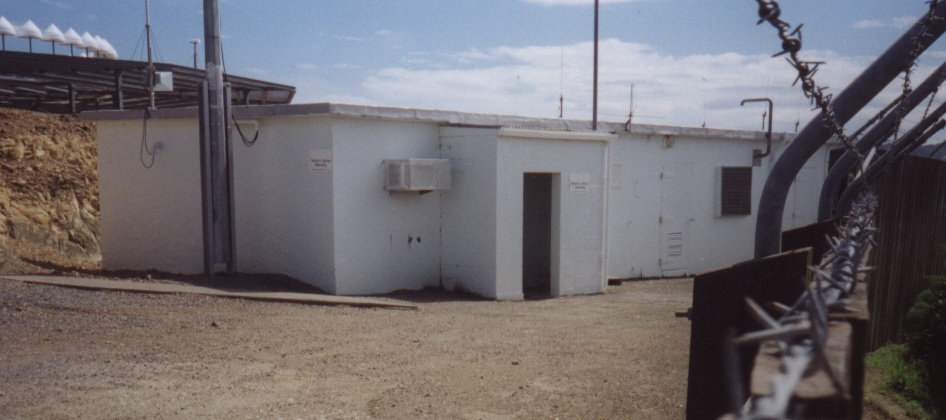
| Although it was not stated in the demolition plan, nor in any of the correspondence, earthworks were also carried out on the hill behind position (B). This was possibly an easy way for them to cover what was left of the emplacements, as well as providing soil for covering the rubble in the gully. Other demolition work included the foundations and other concrete work scattered about the fortress area, as well as the entrances to the underground plotting rooms, which were covered over. For many years the ventilation duct to the plotting room tunnels was left exposed. This would have been missed as it was within the fenced off CAA compound. It was finally buried in the 1990s due to alterations to the layout within the compound. Something else that has survived within the compound is a structure of which its original use is unclear. It is described as being the original Fortress Plotting Room for the battery in 1942. Yet another map of uncertain age has it being the Miniature Range. Of course it may have been used as the Plotting Room initially and once the tunnels were complete, then used as the Miniature Range. Whatever it was used for, it is definitely original. The Battery Observation Post that was also within this compound was removed at some point prior to 1971. Possibly something to do with the CAA, as it was not listed on the demolition plan in 1970. The Moa Point Radar station, the most obvious survivor, was also considered for demolition. At this time however one of the buildings there was being used by the CAA and NAC. The demolition plan notes that the other two structures are �not included for demolition in this stage�. In the end it was left as it is, although the single building in use was later abandoned. In terms of demolition equipment, heavy machinery was used in preference to explosives. In the case of Palmer Head, only twice was blasting carried out. First in a structural part of the old Power-house (in the valley in Tarakena Bay), and secondly in one of the gun emplacements below ground level. These were carried out in August 1970. |
|
 |
| Demolishing Wellington's Defences cont. |
| The old Plotting Rooms, or Miniature Range |