 |
| Demolishing Wellington's Defences |
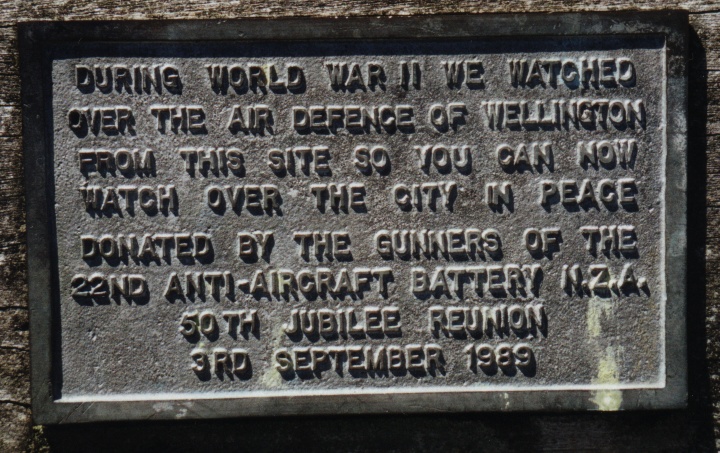
| Wellington is not unique in having lost parts of its military heritage to the bulldozer. However, what is unique in Wellington is that a concerted effort went into the demolition of these works. �Eyesores�, �danger to children�, and �encourages undesirables� are all terms that were used to describe many of the defence works dotted about Wellington. With pressure from the ratepayers and lobby groups of Wellington, the City Council looked to the Defence Department for a solution. However, Defence were unwilling to take responsibility. After much debate it was decided by the Government of the time that the Ministry of Works would undertake �remedial work� at any such site, IF the fortifications in question posed a risk to the public. Thus it was the Works Department who drew up the demolition plans, and carried out or supervised the work itself. The first of the large scale demolitions occurred in 1969 with the Tinakori Hill Heavy AA Battery. It was the first of five sites to be �cleaned up� between 1969 and 1970. Tinakori Hill Heavy AA Tinakori was the first site to be demolished during the 1969-1970 demolition program. It had been the subject of adverse commentary for many years. A sketch of one of the emplacements appeared in the Dominion in December 1966, with an appeal for either their use or removal. Then in 1968 the Wadestown Group Scout Committee took it upon themselves to ensure the removal of these emplacements. The Chairman wrote to the Town Clerk of Wellington on 11/12/68 urging that work be carried out to remove the emplacements as soon as possible. �It should not be necessary for me to detail the physical and moral hazards that exist in these emplacements. My committee simply asks that the Council look urgently into the possibility of demolishing, filling in, or otherwise blocking access to the emplacements as soon as possible, thus removing this danger from the area�. After the initial controversy over who was responsible for the demolition of old defence structures, the Ministry of Works started on the Tinakori emplacements. An investigation of the site was carried out in June 1969, the recommendation being that the emplacements be demolished and be buried on site. The estimated cost came to $2500. MOW commenced demolition on the 10th of November 1969 using bulldozers and other heavy equipment. It would appear that the emplacements were levelled to their base, and then buried. Mount Victoria Heavy AA The Mt Victoria emplacements were seen to be an eyesore from very early on. During 1946 investigations were made by the council regarding the emplacements and their removal. It was decided though that total demolition was not required. However the Government would be required to fill in the area between the emplacements to serve as a look-out area. A plan was drawn up by the City Engineer, and while one emplacement was partially back filled at some point, the plans themselves were not followed through with. No further demolition steps were taken until 1969, when (after Tinakori had been demolished) a request was lodged with MOW, by the Council, to investigate the demolition of the Mt Victoria site. An inspection was carried out in December 1969, and while the design of the emplacements were similar to Tinakori, the site was far more difficult. The hillside was steeper with less room for machines to manouevre, explosives were out of the question due to close proximity to housing and there was no suitable adjacent area for disposal of the rubble. The works would also have to be carefully managed to keep concrete from damaging the adjacent road or houses. A site for the disposal of the rubble was eventually found half a mile away in a gully near the fever hospital off Alexandra Road. This was cleared with the Council as a suitable site, and the estimate given for the demolition was $5,200. The work was started on 21/5/70. The job cost more than the estimate however, largely due to a request from the Council that the five bases be removed also. It led to a further $1,073 being spent on the demolition of the site. The only thing left to mark that anything military related was ever there, is a plaque on a bench seat placed by the gunners who used to man the site. |
|
| The plaque at Mount Victoria |