The European Union : A Brief History and Key Texts
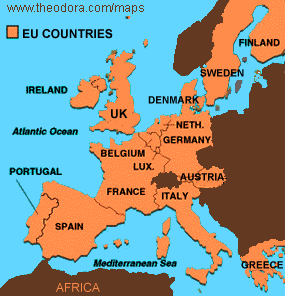
The European Union today is not the same organization of 50 years ago. Several
developments transformed the Community from one of Six members which discussed
coal and steel to a Union of 15 (and some 13 applicant states) which now deals
not only with economic aspects but also with harder issues including that
of security. Here is a brief, simple history which will put you in
the picture. Click here
.
Back in 1795, Immanuel Kant already believed that only integration on federal lines could avoid future wars. "No Treaty of Peace Shall Be Held Valid in Which There Is Tacitly Reserved Matter for a Future War", he argues in his Philosophical Sketch for a Perpetual Peace. A great piece of writing, which will prove interesting to those interested in politics and philosophy. Click here .
During the War, the Italian federalist, Altiero Spinelli, founder of the European Federal Movement, dreamt of a united Europe as the solution forward. In his Ventotene Manifsesto, he explains that a free and united Europe is the necessary premise to the strengthening of modern civilization. To read this manifesto, click here .
In 1930, the Frenchman A.Briand explained to the European leaders that compelled by their geographical position to live together, the peoples of Europe, if they are to enjoy security and prosperity, must establish a permanent regime of joint responsibility for the rational organization of Europe. This is his article about the future of Europe. Click here .
The 1939-1945 War shattered the ideas of those who believed that security on the European continent could be achieved by simply single states acquiring as much arms as possible. Many Europeanists started to understand that stability and peace could not be achieved without a form of unification between Euro-states. Winston Churchill, the great British statesman, had already a clear idea about what form the future Europe should take: a federal system, in his words, a United States of Europe. Click here .
The impetus for a real effort to begin some form of co-operation came from the French. Inspired by Jean Monnet's ideas, the French Foreign Minister Robert Schuman came out with his famous Declaration urging Germany and other European states to unite their production of coal and steel, as the first step towards what he calls the federation of Europe. Click here .