


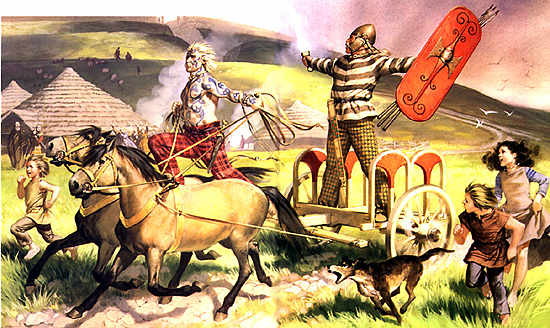




Although many classical writers emphasize and rightfully denounce the Druid practise of human sacrifice, they quite intentionally fail to point out any savagery in their own "civilized" cultures. Cicero chastises the Druids custom as "monstrous and barbarous," which it is to be sure; however, is it more monstrous than watching humans ripped apart by wild beasts in a public spectacle created for amusement? Is it more barbarous than watching a woman fatally coupled in intercourse with a bull, again for public amusement? It would be interesting to see what Celtic writers of the time would have had to say of such "civilized" Roman practises! Alas, Celtic civilization was illeterate and we must rely upon their enemies to describe their culture. All we know from archaeology is that a once thriving iron-working culture dominated most of northern Europe.
Often when combatants are ranged face to face, and swords are drawn and spears are bristling, these men (Druids) come between the armies and stay the battle...
Diodorus Siculus
Caesar certainly understood the Druids well enough to know how to destroy them. After defeating Vercingetorix at the battle of Alesia, Caesar had an ancient grove of oak trees known as "the sacred heart of the land" burned to the ground. The sacred grove was probably the most sacred place of Druid ceremony outside of Britain.
Caesar had studied the people he meant to conquer. Caesar tells us that the primary focus of Druid religious belief centered around reincarnation (de Bello Gallica VI 14). Diodorus (Book V. 31.3) informs us that the Druids were natural philosophers and moral philosophers "unusually honored" among the Gauls." Caesar proclaims that the Druids "have many discussions as touching the stars and their movement, the size of the universe and the earth, the order of nature, (and) the strenghth and powers of the immortal gods (de Bello Gallica VI. 14).
"For they (the Druids) generally settle all their (the Celts) disputes, both public and private. The Druids abstain from war, nor do they pay taxes with the others; they have exemption from warfare.
Julius Caesar
Where the sacred heart of the land once stood along a ridge overlooking the river Atura, the great Cathedral of Chartes now stands.

