IntroductIon *
STAGES OF THE DISASTER MANAGEMENT PROCESSES *
PREPAREDNESS *
MITIGATION *
RESPONSE *
RECOVERY *
ANALYSIS OF THE CURRENT ORGANIZATIONS *
CENTRAL PLANNING AND COORDINATION*
Center of Disasters Coordination Committee *
Turkish Red Crescent *
Regulations for Disaster-related Emergency Support Organizations
and Planning Procedures *
CITY AND COUNTY EMERGENCY SUPPORT ORGANIZATIONS AND
THEIR RESPONSIBILITIES *
EMERGENCY OPERATIONS CENTER *
EMERGENCY COORDINATION COMMITTEE *
DISASTER ASSESSMENT AND TRACKING COMMITTEE *
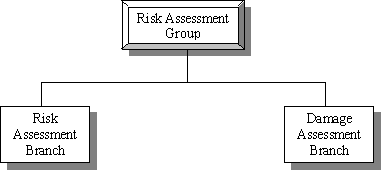
RISK ASSESSMENT GROUP *
Risk Assessment Branch: *
Damage Assessment Branch: *
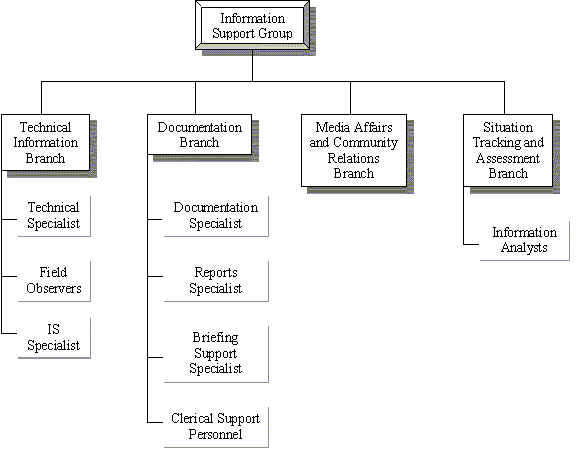
INFORMATION SUPPORT GROUP *
Technical Information Branch: *
Documentation Branch: *
Media Affairs and Community Relations Branch: *
Situation Tracking and Assessment Branch: *
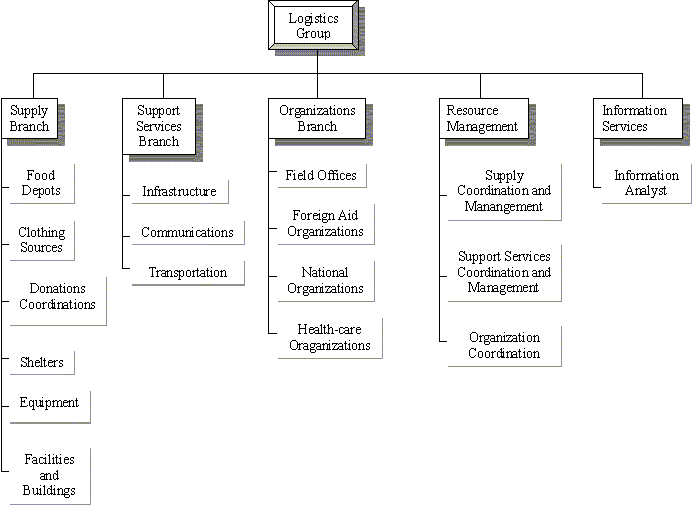
LOGISTICS GROUP *
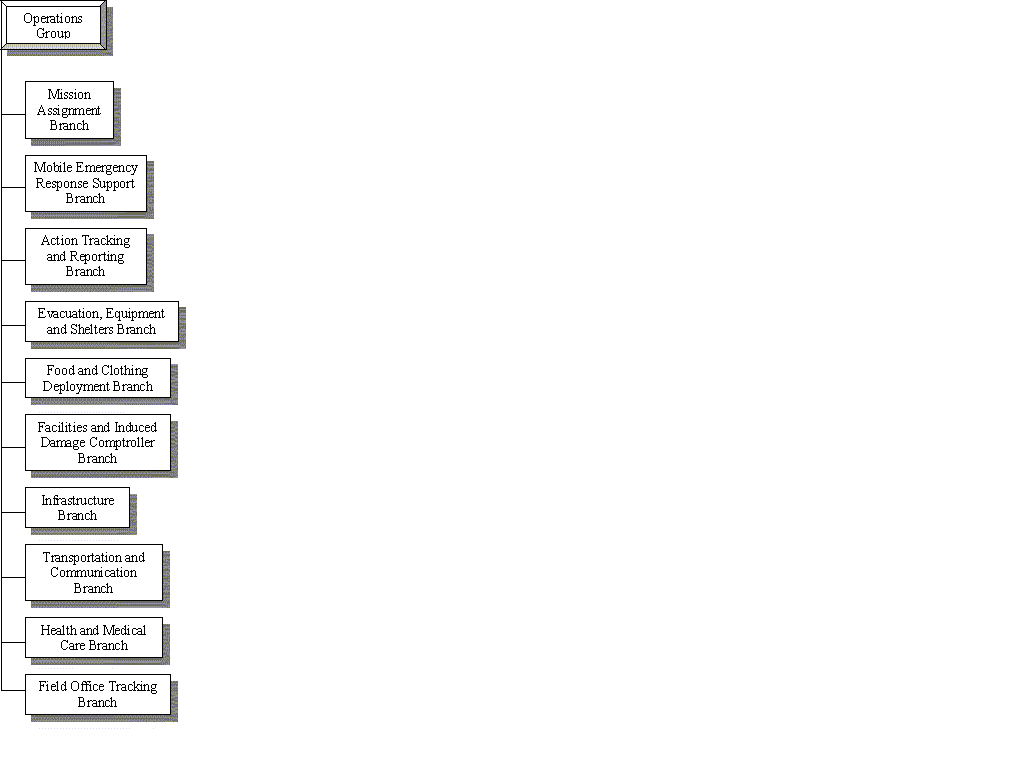
OPERATIONS GROUP *
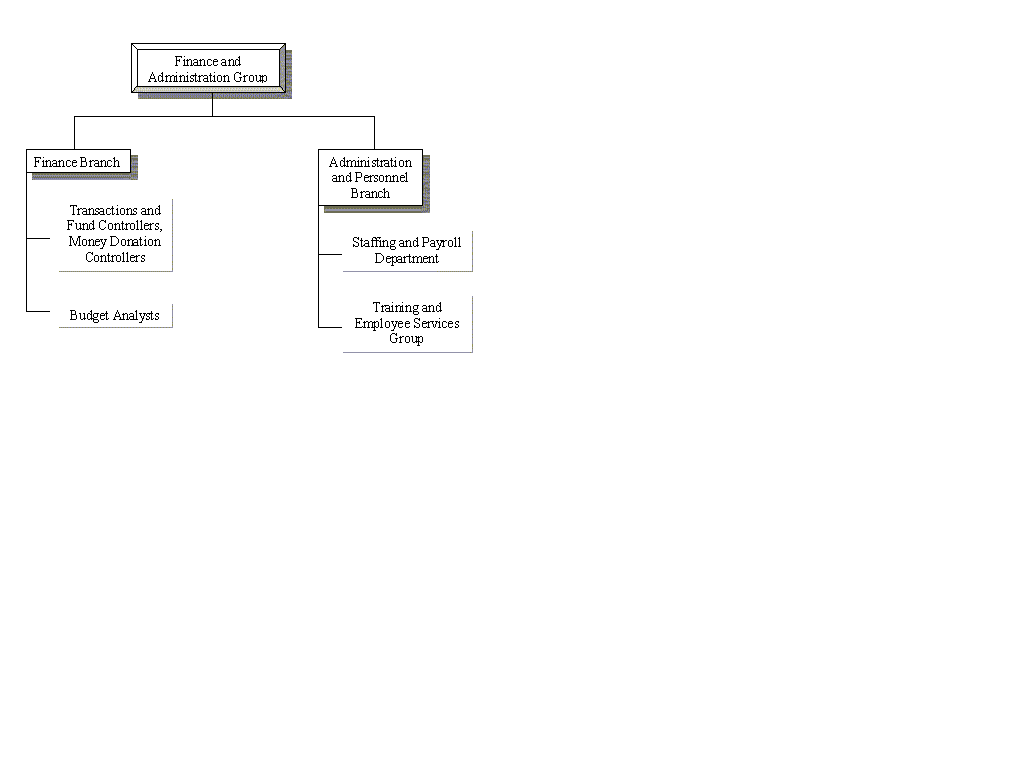
FINANCE AND ADMINISTRATION GROUP *
Finance Branch: *
Administration and Personnel Branch: *
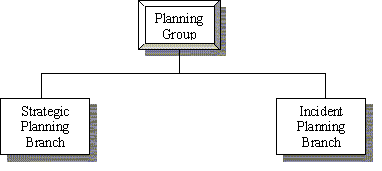
PLANNING GROUP *
Incident Planning Branch: *
Strategic Planning Branch: *
CONCLUSION *
INTRODUCTION
Even modest natural disturbances can yield disastrous consequences on
human scales. The ability of a nation to manage disasters, rather than
react to crises, is critically dependent on the availability of a disaster
management system.
In our disaster management project for IE 404, we will be trying to
build a better and well-defined organizational structure for mitigation,
preparedness, response and recovery in case of a national disaster like
the big earthquake we have experienced on the 17th of August,
1999. The 17th of August earthquake is a wake-up call for Turkey.
While the probability of major earthquake may be low, the consequences
of such an event are not. In fact, insufficient level of preparedness accompanied
by stringent seismic codes and construction practices exacerbates the risk
of a disaster. Risk management strategies must be developed at all levels
to mitigate potential losses. There we understood those weakness of our
governmental, military and private emergency organizations. At this point,
disaster management plays a very crucial role. We saw that there was no
disaster management-oriented structure. Although there were discrete organizations
throughout the country, lack of coordination and collaboration prevented
these organizations to perform their functions. In IE 404 project, our
project group, will mainly deal with building an organizational structure
for a non-existent-proposed organization.
As it is clearly understood; however the mission and objectives can
be defined deliberately, at the very beginning of these projects boundary
of the system can not be defined.
The structure we will try to build is concerned with mainly following
goals:
-
Coordination between the related national organizations and teams,
-
Information transfer,
-
Assistance in planning and decision making,
-
Provide organizational response,
-
Collaboration and partnership.
STAGES OF THE DISASTER
MANAGEMENT PROCESSES
PREPAREDNESS
Preparedness mainly includes data collection, forming databases and
community preparedness activities. Collected data and database will be
the most crucial factors for planning, analysis and real-time response
activities.
-
Risk data group: The aim of these data collection activity is to prepare
an earthquake map, gather historical data about earthquake intensity and
frequency, collect population and its distribution data and building characteristics
data. The crucial new data in this group is building characteristics data.
These includes data of regional plans, construction types, age of the buildings,
exact location of buildings, number of people living in a specific building
and the damages of the buildings due to previous disasters. With no suspect
this data collection activity requires a fieldwork by engineers and architects
supported by local directorates. For expert opinion on potential earthquake
risk, some sources can be stated as follows:
-
Governmental agencies
-
Local agencies
-
Academic researchers
-
Industrial researchers
-
Public interest group researchers
-
Professional associations concerned with the matter
All these 4 data sections are proposed to be collected under regional
basis which will so far be determined.
For each data section, each region will be assigned a risk value in
case of a disaster such as earthquake as follows:
Region: county m
Quake intensity risk value = X1m
Building characteristic = X2m
Population density = X3m
The critical activity for these data sections is to perform a cumulative
risk assessment over the whole country again on regional basis. This is
for assigning combined risk values to all regions as explained below:
Region: City m
Cumulative risk assessment value = A*X1m + B*X2m
+ C*X3m
Where A is the weight factor of earthquake intensity risk, B is the
weight factor of the building characteristic risk, C is the weight factor
of the population distribution risk.
Most of the activities in this data collection activity is performed
by technical and expert knowledge of engineers or statisticians.
-
Facilities and induced damage sources: Facilities should be identified
over the whole country and possible induced damage sources should be indicated.
-
General inventories: It should be indicated what kind of resources should
be brought to emergency responses and recovery. The problem is to quantify
and list them to be able to compare the resources available with the resources
needed for an effective emergency response. Shortfalls may require negotiating
agreements with private suppliers or out-source suppliers. General inventories
include such resources:
-
Food depots and food
-
Clothing and textile industry
-
Health-care organizations, personnel and equipment
-
First-aid organizations, personnel and equipment
-
Other volunteer organizations
-
Equipment resources
They will also become conscious of the planning assumptions to be
used in functional disaster-specific procedures planning
It should be indicated what kind of resources should be brought to emergency
response and recovery. The problem is to quantify and list them to be able
to compare the resources available to the resources needed for an effective
emergency response. Shortfalls may require negotiating agreements with
private suppliers.
Data about mentioned organizations should be provided with information
of their locations, contact information, capabilities and their personnel.
Inventory data such as food, clothing, equipment and shelters should be
collected on regional basis and all will be converted into a useful database
format.
In addition to these data collection and database collection activities,
there are two critical activities in this stage: Risk prioritization and
scenario analysis. Both of these activities are supported by mitigation
prioritization.
-
Compare and prioritize risks: This is the activity to determine which damages
merit special attention in planning. This activity is mainly based on cumulative
risk assessment procedure. During planning activity, frequency of the earthquake
and potential severity of its consequences should be combined with cumulative
risk assessment procedure to develop a single indicator of the threat.
So comparison and setting of priorities due to combined factors are explored.
-
Apply scenarios and analyze: Mainly, scenario activities aim to identify
the needed disaster specific resource requirements. While it is important
to have a sense of magnitudes involved (estimated number of people affected),
these are static. Planning is concerned with actions that take place in
time. The most prioritized risk factors that have a significant and distinguished
risk effect should be considered before planning. The above mentioned activities
can be thought as brainstorming. Through this initial brainstorming, the
experts will decide what actions and resources will turn out to be critically
necessary.
MITIGATION
Mitigation in disaster management is defined as sustained action taken
to reduce or eliminate longer-term risk to people and property from disasters
and its consequences. These activities should be distinguished from preparedness
activities in the sense that these have a long-term impact. The primary
purpose of mitigation is to ensure that fewer people are victims of natural
disasters. In this respect, this stage mainly includes planning activities
such as communications planning, land use planning, human resources planning,
organizational planning. These activities end up mainly with operating
procedures that should be implemented during real-time response. During
these planning activities, the following functions are tried to be performed:
-
Assigning responsibility to organizations and individuals
-
Sets forth lines of authority and relationships
-
Describe show people and property will be protected
-
Identifies resources available
-
Identifies mitigation concerns during response and recovery activities
Moreover, all plans should be organized in a hierarchical order such as
-
Government action plans (should somehow be possessed by a special organization/center,
which is proposed to be independent.)
-
Local action plans (mainly under the direction of local directors such
as the governor and the governor of the county)
In addition, at the very beginning of planning activities, mitigation prioritization
should be performed in such a manner that uses risk prioritization scenario
analysis results.
A state action in this stage is to make up necessary laws and regulations
for building code that can be performed by analyzing building characteristic
data that has been mentioned in Risk Data Group. Regional properties, population
properties and economic impacts of regulations should be taken into consideration
prior to putting the laws into act.
The intent is to focus on actions that produce repetitive benefits over
time, not on those actions that might be considering emergency planning.
Another important benefit is that current dollars spent on mitigation will
significantly reduce human suffering and the demand for large amounts of
future money when the disaster shoots. Current mitigation expenditures
will also reduce the economic disaster that often follows the natural event
by destroying property, losing jobs and disabling businesses.
Before coming to mitigation expenditures, it should be strictly taken
into account that risk reduction alternatives should be evaluated to know
how should the money be spent in the mitigation. Risk transfer, meaning
that the investment should be made on the factor which is the most risky,
crucial and cost contributing one of all, is performed in this stage.
Furthermore, another critical action is the implementation of risk reduction
alternatives, such as placing early warning systems to critical facilities
and strengthening buildings. Interrelated with the risk reduction becomes
the combinatorial course of action between the two stages. This implies
that preventive decisions should be clarified at the last level of the
mitigation stage.
RESPONSE
The onset of an emergency creates a need for time sensitive actions
to save lives and property as well as for action to begin stabilizing the
situation. These activities are known as recovery functions. Such response
actions include:
-
Notifying emergency management personnel
-
Warning, evacuating or sheltering the population if possible
-
Support telecommunication
-
Assessing damage, conduct of ground and aerial surveys to determine the
scope of the damage, casualties, and the status of key facilities
-
Removal of trapped and injured persons from landslides, building collapses,
and other structural collapses, administering first aid and assisting in
transporting the seriously injured to medical facilities
-
Allocating response resources (food, shelters, blankets, etc.) to demands,
requesting help from outside the region
-
Keeping population informed
-
Maintaining the rule of law
-
Control of access to the area until it is safe. Only those people directly
involved in emergency response operations should be allowed to enter
-
The identification, removal, and disposal of rubble, landslides, wreckage
and other material which block the performance of emergency response functions
-
Demolition to clear obstructed roads, repair or temporary reinforcement
of roads and bridges, construction of emergency access roads
-
Inspection of buildings and other structures to determine whether it is
safe to inhabit or use them after an earthquake has occurred, inspection
of buildings that are critical to emergency services or that may threaten
public safety, marking those that are unsafe, inspection of dams.
-
Restoration and repair of electrical power, natural gas, water, telephone
and other communications systems.
-
Addressing mitigation issues that arise from response activities.
The response stage is the most critical stage that we meet after the disaster
has occurred. This period is a justification of the previous stages- preparedness
and mitigation. The outcomes of the previous stages can be valuable inputs
to the response activities. Resource coordination and management is crucial
in the response stage. A general outline is as follows:
-
To the maximum extent possible, local resources should be used as the first
line of support in response to a disaster.
-
Once the resources and capabilities of the city are exhausted, assistance
may be provided to support operational requirements and priorities.
-
Needed goods can also be supplied from the private sector or from the nonaffected
cities.
-
An appropriate level of management oversight, protection and accountability
must be assured – from acquisition through final disposition – for all
provided property brought to, used at, loaned by, or acquired at a disaster
site.
-
Voluntary organizations that provide a wide variety of disaster relief
goods and services can be coordinated. Donations often play an important
role in supplying disaster victims with essential needs.
-
Local authorities are encouraged to take advantage of current partnership
relations with the private sector. Businesses, both inside and outside
the disaster area, can supply critical resources during response operations,
and assist in restoring essential services and rebuilding the economic
base during recovery operations. (as potential disaster victims, private-sector
businesses are also urged to identify their risks, develop appropriate
contingency plans, and take corrective actions prior to a disaster)
RECOVERY
In the recovery stage, activities should start with some feedback questions
such as:
-
What are the area and population-at-continued risk and their vulnerability?
-
What are the short, medium and long-term damages?
-
What are the geographic areas of damage?
By the answers of these questions, it’s found out how safe the do the procedures
applied provide. If there are needs for changing tasks, priorities, budget
and schedule of the program, these must be turned back to mitigation and
preparedness stages to recover the general policies of the disaster management
system.
Before going on to economic impacts of the disaster, the following questions
should be answered in advance:
-
What lifeline or other critical facilities have been affected?
-
What long-term evacuation requirements are there and where?
-
What kinds of business losses have occurred due to disaster damages?
In guidance of these questions and cost implications considered in the
mitigation stage, facilitating government agencies should perform budget
planning and economic analysis. Pre-disaster planning for long-term mitigation
and recovery would involve identifying strategic priorities for restoration,
improvement, and growth; here emergency management planning starts to intersect
the community development planning of other agencies.
ANALYSIS OF THE CURRENT
ORGANIZATIONS
CENTRAL PLANNING AND COORDINATION
CENTER OF DISASTERS COORDINATION COMMITTEE
Center of Disasters Coordination Committee consists of permanent undersecretaries
of the below ministries, with the chairmanship of Ministry of Public Works
and Settlement. The other members are from:
-
Ministry of National Defense
-
Ministry of Foreign Affairs
-
Ministry of Internal Affairs
-
Ministry of Finance
-
Ministry of National Education
-
Ministry of Healthcare
-
Ministry of Communications
-
Ministry of Rural Affairs
-
Ministry of Forestry
-
Ministry of Labor and Social Security
-
Ministry of Industry and Trade
-
Ministry of Energy and Natural Resources
and also with the participation of the general manager of Red Crescent.
They meet after a great disaster in Turkey.
Responsibilities;
-
They apply the instructions given by the prime ministry.
-
Depending on the information that comes from the governor of the disaster
area and some other resources, they take necessary decisions. According
to these decisions, they provide coordination between ministries and other
organizations. The problems that could not be solved are forwarded to the
prime ministry.
-
They coordinate the aids coming from both inside and outside the country.
-
They inform the prime ministry after the evaluation of the collected information
and reports.
-
They monitor all levels of operations done by the organizations to support
the ongoing works in cities that experience disaster.
Prime Ministry
-
Gives the necessary instructions to Center of Disasters Coordination Committee,
-
Analyses the topics which could not be solved by Center of Disasters Coordination
Committee,
-
Without taking quotas into consideration, gives permission to import required
materials in the fastest way, puts principles that organizes these issues
before a disaster and informs the related organizations,
-
Takes precautions against the depletion of fuel oil at the disaster area,
-
Takes precautions to provide shelters for disaster survivors, such as dormitories,
buildings of social foundations and etc.
General Staff Presidency
-
Applies the defined regulations under disaster laws,
-
Determines the principles of emergent aids that are to be carried out by
Turkish Army,
-
Prepares plans of emergent aids in coordination with state organizations.
Ministry of Justice
-
If necessary conditions are satisfied, determines the trustee of the ones
whose family are dead,
-
Ensures the transfer of sentenced people and prisoners from the disaster
area, in case of a damage in the prisons located there,
-
Enables the renovation of documents that are destroyed.
Ministry of National Defense
-
Gives permission to ones in the disaster area who are obligated to join
the army and who are still in the army,
-
Takes part in help and healthcare services.
Ministry of Internal Affairs
-
Satisfies the safety and security of the disaster area, takes entry to
and exit from the area under control in order to prevent plundering,
-
Takes the traffic under control at the disaster area,
-
Follows the changes in population records due to deaths and missing people,
-
Ensures the safety of life and property of the people during the transport
to temporary shelters,
-
Helps communication by using all kinds of communication systems,
-
Enables the coordinated work of the organizations of both Civilian Defense
and Ministry of Public Works and Settlement in the cities or counties,
-
Arranges programs for the education of the personnel working during the
rescue and help activities in the disaster area,
-
Prepares general safety plans including the precautions that should be
taken depending on different kind and severity of disasters,
Ministry of Foreign Affairs
-
If it is decided to take aids from abroad, informs about the kinds and
quantities of requirements via using international organizations or informs
directly without using any organization,
-
Coordinates enabling the arrival of the urgent aids from abroad,
-
Coordinates people that come from abroad during a disaster,
-
Satisfies communication with the abroad,
-
Gives recommendations about foreign contacts due to the disaster,
-
Helps solving the problems of citizens who work abroad,
-
Takes part in deciding on principles of the determination of required aids
from foreign countries and international organizations, coordination of
these aids and monitoring them.
Ministry of Finance
-
If there is insufficient money in the Disasters Fund, takes precautions
to supply appropriation,
-
Enables the temporary or permanent allocation of land and immovable properties
belonging to Treasury,
-
Satisfies easy transition of aids and import materials from the customs
during a disaster.
-
Takes precautions and gives highest priority to official organizations
that are receiving materials from Devlet Malzeme Ofisi.
Ministry of National Education
-
Provides means of repairing the damaged school in disaster regions urgently,
-
Under necessary conditions, provides temporary places for the schools and
the dormitories,
-
Takes precautions to prevent delays during education period,
-
Distributes the aids that come from both inside the country and the foreign
countries to schools.
Ministry of Public Works and Settlement
-
After being informed about the disaster, sends urgent aid appropriation
to the area,
-
Under necessary conditions, calls the Center of Disasters Coordination
Committee for duty,
-
Takes part in the prior damage estimations in the disaster area,
-
In addition to Red Crescent tents, provides temporary settling by constructing
prefabricated buildings, renting or allocating official social foundation,
-
Determines the places for temporary settlement, takes necessary precautions
and if necessary, helps the victims in terms of money,
-
Enables purchasing of equipment, vehicles and other kinds of materials
to be used in construction,
-
Opens bank accounts for the incoming helps and enables the coordination
of them,
-
Determines the reasons of the disaster, influenced field, results, borders
and precautions that reduces the damages of the disaster and informs the
related organizations,
-
Participates in the damage assessment in the disaster area,
-
According to the results of the damage determination reports, prepares
reports for the buildings that may cause adverse effects in the future
and informs the related organizations,
-
Determines the damages in the municipalities’ electric, water and drainage
systems and helps the repair of them,
-
Determines the damaged roads and art buildings in the disaster area and
enables the repair of them urgently,
-
Determines the places that can be affected by the overflow of water from
dams, rivers and lakes, warns the public via using military and civilian
services and takes precautions by cooperating related organizations,
-
Prepares a directive about the discharge of materials that are provided
from Disaster Fund or from donations after the disaster,
-
Monitors the ongoing work in the disaster area,
-
Prepares programs to train the public living in the disaster area,
-
Takes preventive precautions,
-
Prepares plans for the realization of these responsibilities on time and
in a complete manner.
Ministry of Health
-
Provides means for carrying out first aid operations and medical treatment
quickly, effectively and in an amount that will satisfy the requirements,
-
Enables the operating of protective healthcare services that are related
with the environment and the community and takes precautions accordingly,
-
Executes vaccinate services to struggle against infectious disease,
-
Provides personnel, vehicle, medical materials, blood derivatives and monitors
them,
-
Takes care of people and children that are homeless and need to be protected.
-
Prepares plans to perform these responsibilities on time and in a perfect
manner.
Ministry of Communications
-
The request of using communication devices in order to inform people about
the disaster and the aids are accepted without asking any money,
-
Takes precautions to provide communication between the disaster area and
the other parts of the country and repairs damaged devices, networks and
foundations urgently,
-
Sets up additional networks at the temporary settlement areas and also
at the other required places,
-
Enables the transportation of all rescue and help teams, machines, materials,
equipment, devices, foodstuff, clothing, tents and all other supplies to
disaster area by using the land, sea and air vehicles, and under necessary
conditions, takes the payment later,
-
Takes precautions and if necessary, reinforces the transportation means,
and gives a higher priority to the transportation of people and the materials
throughout the disaster region,
-
Determines the kinds of airplanes that can land to the airports in the
disaster area and informs the Ministry of Foreign Affairs about this subject,
-
Determines the minimum price for the transportation to the disaster area
and these prices are paid by the related organizations unless there is
a contrary decision taken by Center of Disasters Coordination Committee,
-
Arranges the utilization of all types of vehicles belonging to the private
sector during the disaster time, if there are volunteer applications permitting
to do so,
-
Repairs or if necessary, constructs transportation means at the transportation
area,
-
Prepares plans to perform these responsibilities on time and in a perfect
manner.
Ministry of Rural Affairs
-
Enables the transportation of animals to be
slaughtered at ‘Et ve Bal?k Kurumu’, to prevent animal losses,
-
Takes precautions to meet the requirements of fertilizer and seed at the
disaster area,
-
Takes precautions against all epidemic and parasitic illnesses of animals,
-
Helps the transportation of aids to disaster area,
-
Provides disinfected water to the villages and the temporary settlings
and repairs the roads of the villages,
-
Provides infrastructure, equipment and short term illumination to temporary
settlings,
-
Determines the damages and losses of the farmers in terms of vehicles,
animals, crops and facilities,
-
Prepares plans to perform these responsibilities on time and in a perfect
manner.
Ministry of Forestry
-
Provides wood for heating, timber to repair homes and heavy logs to build
houses and barns in the disaster area,
-
Takes precautions against forest fires because of disasters,
-
Prepares plans to perform these responsibilities on time and in a perfect
manner.
Ministry of Labor and Social Security
-
Gives a higher priority for finding jobs to the people who experienced
a disaster,
-
Gives a higher priority to those affected people while sending workers
to abroad,
-
Initiates all the healthcare foundations around the disaster area to enable
medical treatments of victims, by coordinating Ministry of Healthcare and
Red Crescent,
-
Deals with the problems of the affected citizens who work abroad,
-
Prepares plans to perform these responsibilities on time and in a perfect
manner.
Ministry of Industry and Trade
-
Sends urgently the required materials that are produced by its organizations,
to the disaster area,
-
Determines the critical industrial foundations and by getting in touch
with the Ministry of Energy and Natural Sources, takes precautions in order
to utilize them as soon as possible,
-
Supports the damaged public and private industrial foundations in the disaster
area by giving credits to them,
-
Prepares plans to perform these responsibilities on time and in a perfect
manner.
Ministry of Energy and Natural Resources
-
By taking winter conditions into consideration, takes precautions to supply
the disaster regions with fuel, wood and etc.,
-
Repairs the damaged electric generating institutions,
-
Provides illumination for both the permanent and temporary settlings,
-
Takes precautions to supply energy to the critical industrial foundations
that are determined by Ministry of Industry and Trade,
-
Prepares plans to perform these responsibilities on time and in a perfect
manner.
TURKISH RED CRESCENT
The organization of Turkish Red Crescent consists of two parts: the
General Headquarters and the branches. The organs of General Headquarters
and Branches are formed by elections. The members elected to these authorized
organs, render their tasks as honorary members. Turkish Red Crescent has
648 local branches through out the country in cities and sub provinces.
The General Headquarters of Turkish Red Crescent is in Ankara.
The establishment tasks, authorities of the Directorate General of Turkish
Red Crescent which had been founded to regulate the services of the General
Headquarters within the direction of the purposes and principles of Turkish
Red Crescent. Directorate General is composed of experienced and expert
paid staff. Directorate General has 18 departments at General Headquarters
and various units in provinces working depending on said departments.
Turkish Red Crescent has established 1 Central Warehouse (Etimesgut)
and 7 Regional Warehouses and it also has 22 Blood Centers, 7 Blood Stations
and 38 dispensaries (one of those is Medical Center), 21 soap kitchens,
6 day nurseries and 4 elderly houses which perform depending on Red Crescent
Branches.
Main responsibilities of Turkish Red Crescent are as follows:
¨ Establishes its organization
to satisfy urgent needs such as: tent, blanket, foodstuff, clothing of
the disaster area,
¨ According to the severity of the disaster,
makes contact with related organizations to supply requirements,
¨ Takes aid materials that come from
both inside the country and abroad and distributes to depots and places
that are assigned by the committee,
¨ Dispatches response resources like
tent, blanket, foodstuff and clothing to the disaster area and has the
duty of distributing these materials to people according to the regulations,
¨ If necessary, by contacting with the
Ministry of Healthcare, helps healthcare services and supplies healthcare
personnel, medicine, mobile clinics and blood derivatives,
¨ Getting in touch with Red Cross, organizes
abroad aids,
¨ If there is a requirement, organizes
blood donations,
¨ Opens mobile kitchens to supply meal,
¨ Prepares plans and organizes its structure
to satisfy these above duties on time and in a complete manner.
REGULATIONS FOR DISASTER-RELATED
EMERGENCY SUPPORT ORGANIZATIONS AND PLANNING PROCEDURES
Purpose:
Article 1 – The purpose of these regulations is to plan all the
state power and resources before the occurrence of a disaster, and in case
of a disaster, to provide these regions with the fastest possible government
aid, by initiating the emergency organizations and coordinating their operations.
Contents:
Article 2- These regulations include the responsibilities, cooperation,
coordination and supporting activities for the governors, head officials
of the counties, ministries and other connected or related organizations,
public institutions, military unions and Red Crescent. These organizations’
relations and responsibilities for the pre-disaster planing activities
for the emergency support service and actions cause the need for such regulations.
CITY AND COUNTY EMERGENCY SUPPORT ORGANIZATIONS
AND THEIR RESPONSIBILITIES
City Emergency Support Organizations
City Rescue & Support Committee
Construction: Chairman à
Governor or assistant governor charged by the governor.
-
Mayor
-
City Gendarme Regiment Commander
-
Head Officer of Police
-
Head Officer of Civilian Defense
-
Head Officer of National Education
-
Head Officer of Agriculture and Rural Affairs
-
Representative of the Red Crescent
-
Garrison Commander or the representative of the largest local military
unit.
Responsibilities:
-
Prepares the city emergency support plans and ensures conforming to these
plans.
-
Examines the county plans and presents it for the governors approval.
-
Establishes the organization stated in the emergency plans and assigns
personnel to the tasks; organizes training activities for the personnel
in order to keep them prepared.
-
Alerts the service groups for service; takes the necessary decisions, ensures
them to be applied.
-
Defines the principles of emergency support the help and supplies the requirements.
-
Determines the meeting and working essentials of the service groups, prepares
instructions, coordinates their activities and supervises their actions’
consequences.
-
Ensures the coordination and cooperation between the related organizations.
-
Takes the permissions from the Ministry of Public Works and Settlement
for monetary payments to the disaster victims for emergency support, temporary
residence and repair activities.
-
Evaluates the results of the decisions.
-
Coordinates the supply of the necessary personnel, vehicle and equipment
for the service groups to fulfill their responsibilities.
-
Gives the following priorities to the jobs that have to be done:
-
Enabling communication
-
Enabling transportation
-
Rescue
-
First-aid
-
Transfer of injured to hospitals
-
Fire fighting
-
Supplying food, clothing, heating and lighting.
-
Supplying temporary shelters
-
Burying the deceased.
-
Removal of debris
-
Repair of electricity, water, drainage networks
-
Precautions for quarantine
Priorities can be changed according to the nature of the disaster.
-
Transfers the remainder of the budget that is not expended to the central
budget
-
Submits the expenditure list to the Head Office of the Public Works and
Settlement
-
Eliminating the excess emergency support materials according to the regulations
of the Ministry of Public Works and Settlement
-
Offers the postponement of debts of the disaster victims or gives credits
City Disaster Bureau:
Responsibilities:
-
It provides the approval, duplication, dissemination and filing of the
city and county emergency response plans.
-
It monitors the possible changes in the plans and informs the responsible
authority.
-
It trains the service staff before the disaster.
City disaster committee has service groups in its organizational structure
to fulfill its responsibilities:
-
Communications service group
-
Transportation service group
-
Rescue and removal of debris service group
-
First-aid and health care service group
-
Damage estimation and temporary residence service group
-
Security service group
-
Purchasing, renting, confiscating and distributing service group.
-
Agriculture service group
-
Electricity, water and drainage services group
1. Communication Service Group:
Consists of: Head Office of PTT
Head Office of Police
City Gendarme Regiment Commandership
Other related organizations
Responsibilities:
-
Constructs communication network in the disaster area
-
Repairs the damaged equipment
-
Informs the City Disaster Bureau regarding the disaster area.
-
Plans of the Communication Service Group should include information regarding:
-
Type of the disaster, number of damaged buildings, expected number of injured
and deceased people (Primary information)
-
Status of transportation facilities, identified number of deceased. (Complementary
information)
2. Transportation Service Group:
Consists of: Head Office of Public Works and Settlement
Head Office of Rural Affairs
Local Head Office of TCK
Local Head Office of DS?
Local Head Office of DLH
Local Head Office of TCDD
Local Head Office of THY
Maritime Lines
Other related organizations
Responsibilities:
-
Arranges the transportation so that it is possible to reach the disaster
area in the fastest way, gives priority to service group vehicles on transportation
-
Provides transportation to the disaster area
-
Supplies the vehicles and work machines that are needed by the other service
groups, and makes the assignments
-
Supplies fuel for the transportation vehicles in the disaster area
-
Takes evacuation precautions in harbors, airports and railways.
3. Rescue & Removal of Debris Service Group:
Consists of: Head Office of Public Works and Settlement
Head Office of Civilian Defense
Head Office of Rural Affairs
Head Office of TCK
Head Office of DS?
Head Office of DLH
Head Office of TCDD
Head Office of THY
Municipality
Military Units
Other related organizations
Responsibilities:
-
Rescue people under debris
-
Rescue people, animals and valuable goods
-
Removes the debris hindering the transportation
-
Removes or supports damaged buildings that can be dangerous for rescue
activities.
-
Takes precautions against fire and puts out fires
-
Obeys the priorities in rescuing people under destroyed hospitals, schools,
cinemas, barracks, workshops and residences, animals under damaged shelters,
valuable goods.
4. First Aid & Health Care Service Group:
Consists of: Head Office of Health
Military Health Care Organizations
Health Institutions of the Social Security Organization
Municipality
Head Office of Mufti
Head Office of Census
Other related organizations
Responsibilities:
-
Takes first-aid precautions for slightly injured people and if necessary,
transfers them to the hospitals
-
Performs actions to increase bed capacity and performance of the fixed
or mobile hospitals
-
Takes preventive actions for contagious diseases
-
Takes precautions for public health
-
Supplies inoculations, medicines and health materials
-
Identifies the identities of the deceased.
-
Performs actions related with burial such as religious, administrative
procedures.
5. Damage Estimation & Temporary Residence Service Group:
Consists of: Head Office of Public Works and Settlement
Head Office of National Education
Head Office of Rural Affairs
Local Head Office of DS?
Local Head Office of TCK
Head Office of TEK
Municipality
Head Office of Private Administration
Red Crescent
Other related organizations
Responsibilities:
-
Assigns damage estimation teams to districts according to the damage information
gathered about those districts.
-
Determines the highly damaged districts.
-
After the disaster, takes the precautions to evaluate the damage in all
public and private buildings in the shortest possible time
-
Prepares the damage estimation forms.
-
Determines the damaged buildings that must be pulled down.
-
Determines the possible temporary residence buildings for the disaster
victims and prepares these buildings for usage
-
Determines the temporary residence places, transports the people to these
areas, identifies the requirements of the disaster victims in these temporary
residences
-
For the temporary residence, firstly allocates tents then safe school buildings
and other public or private buildings for short term.
-
Determines the required supply materials examining the needs of the temporary
inhabiting people
-
Supplies water and electricity.
6. Security Service Group:
Consists of: Head Office of Police
City Gendarme Regiment Commandership
Military Units
Responsibilities:
Coordinates security, orderliness, traffic; prevents pillage and negative
propaganda.
7. Purchasing, Renting, Confiscating & Distributing Service
Group:
Consists of: The person given responsibility by governors
Representative of the Head Office of Civilian Defense
Representative of the Head Office of Police
Head Officer of the Financial Department of City
Fund Accountant of the Head Office of Public Works and Settlement
Representative of the Head Office of National Education
Representative of the Head Office of Mufti
Representative of the Head Office of Private Administration
Representative of the Municipality
Representative of the Red Crescent
Responsibilities:
-
When the emergency support materials supplied from Red Crescent or donated
by organizations and private sector are not sufficient, purchases the requirements
according to Regulation of Fund Adjudication.
-
Temporarily takes over the required land, estates, building, facility and
equipment primarily from the public organizations.
-
When the requirements can not be met from the above organizations, they
are purchased or taken over from individuals in terms of renting or confiscating.
-
Takes approval paper from committee for its actions
-
According to law number 7269 with 6th article, the value of
the taken over materials is paid with respect to Ministry of Public Works
and Settlement instructions.
-
Arranges the stocking, preserving, and distribution of the provided materials
-
Lists and approves the people who take support materials
-
Controls the medicines or food or other things that threaten the public
health
-
Helps the distribution activities of Red Crescent when required.
8. Agriculture Service Group:
Consists of: Rural Offices of Ministry of Agriculture and Ministry
of Forestry
Ziraat Bankasi
Chamber of Agriculture
Municipalities
Other related organizations
Responsibilities:
-
Identifies the animals without owners or shelters
-
Temporary resides these animals and ships animals
-
Makes “Et ve Bal?k Kurumu” to buy and slaughter
animals
-
Supplies food for animals
-
Supplies protective inoculation
-
Arrange hygienic conditions
-
Takes precautions against dead animals to danger health
-
Supplies agricultural needs
-
Arranges the damaged agricultural areas appropriate for agriculture again
-
If necessary postpones the debts of the farmers and provides them to be
given necessary agricultural credits
9. Electricity, Water & Drainage Service Group:
Consists of: Municipalities
Iller Bankasi
Head Office of Rural Affairs
Head Office of DSI
Head Office of TEK
Other related organizations
Responsibilities:
-
Repairs or makes the related organizations repair the damaged electricity,
water, drainage facilities urgently
-
Supplies water, lighting, drainage to temporary residence areas
-
Purifies the water
-
Provides plans and tables for the status of the water, electricity and
drainage facilities for the city, counties and villages.
-
Provides charts for the availability of lighting and equipment of the organizations
and their equipment capacities
-
Determines the availability of electricity in villages.
-
Makes lists for electricity repairing workshops.
County Emergency Support Organizations
County Rescue & Support Committee
Consists of: Chairman à
Governor of the county
Mayor
County Gendarme Squadron Commander
Head Officer of Police of the County
Head Officer of Civilian Defense of the County
Head Officer of Finance of the County
Head Officer of National Education of the County
Representative of the Head Office of Public Works and Settlement
The administrator of health center that is chosen by the governor of the
county
The administrator of the Red Crescent
Garrison Commander or the representative of the largest military unit
Responsibilities:
According to city rescue and support committee’s responsibilities and
principles, they set their own responsibilities and principles and state
them on their plans.
Service Groups
When establishing the service groups, county’s public and private organizations
and their capabilities and resources must be considered. Governor of the
county can establish these service groups in parallel with the city service
groups, however they can also unite or ignore some groups considering characteristics
and resources of the county.
County emergency support organizations must have the power and capacity
to make necessary supports for the small and isolated disasters without
waiting any help from the cities.
Planning Activities of the City and County Disaster
Committee
For the planning activities, data regarding various areas must be collected.
These information types include:
-
Information about major disasters in the region.
-
General information about villages.
-
General information about counties & cities.
-
City and county based maps showing government and city roads and critical
facilities on these roads such as bridges, stations, harbors & airports
and the related information about these facilities.
-
City and county cultivation plan information.
-
Information regarding water networks.
-
Information regarding drainage, electricity, natural gas networks.
-
Information regarding fire-fighting organizations and their capabilities.
-
Information regarding communication facilities.
-
Information regarding health care facilities.
-
Information regarding Toprak Mahsülleri Ofisi and Orman Ürünleri
Tesisleri.
-
Information regarding Kömür ??letmeleri.
-
Information regarding the capacities, stock levels and distribution capabilities
of critical organizations such as Tekel, Sümerbank,
Et ve Bal?k Kurumu, Tarimsal Isletmeler.
-
Information regarding the facilities that produce clothing, food or other
response resources.
-
Information regarding the stock levels and distribution capabilities of
Kizilay in the region.
-
Information regarding the gas stations.
-
Information regarding the rescue teams.
-
Information regarding repairing facilities.
These informations are for all service groups. Each service group provides
the information regarding its area. After the data collection stage, disaster
scenarios are prepared and the planning activities are conducted. Although
the planning basics are explained thoroughly in the Regulations for Disaster-related
Emergency Support Organizations and Planning Procedures, there are still
lots of discrepancies in the practice. City and county based meetings or
sample plans do not prevent the deficiencies either. Some reasons for these
discrepancies can be stated as follows:
-
Major data to be used in the planning activities are not collected beforehand.
-
Realistic scenarios are not generated.
-
Local requirements are not considered.
-
In reserve personnel are not assigned in case of leaving personnel
-
It is not planned beforehand what kind of resources will be requested from
which cities, counties, people or organizations in case of a disaster.
-
Service group managers are not assigned appropriately.
-
Local "Sivil Savunma Teskilleri" are
not assigned duties in disasters; instead, inexperienced people are charged
duties.
-
Resources and capabilities of public organizations within city/county borders
are not considered.
-
Authorities responsible for emergency response plans are not capable of
preserving coordination and cooperation.
-
Emergency bureaus are not established in certain cities/counties, most
of the existing ones do not operate at all.
-
Spare equipment is not considered in the plans.
-
Revisions in the plans are not informed to the related personnel.
-
Once a plan is established, it is not controlled or revised until a disaster
occurs; therefore, the plan cannot compete with the current requirements.
-
Training and practicing is not done.
-
No special plans are made for critical facilities.
In order to overcome these problems, some approaches to be implemented
can be:
-
Training must be emphasized
-
Planning does not have to be seen as a one-time job.
-
Existing emergency bureaus must be supported.
-
Emergency bureaus must be made permanent.
-
The importance of planning and being ready to a disaster must be emphasized.
EMERGENCY
OPERATIONS CENTER
According to the proposed organization structure, the centerpiece of
emergency management is the Emergency Operations Center. EOC assigns responsibility
to organizations and individuals for performing specific actions throughout
an emergency cycle, describes authority and organizational relationships,
and shows how all actions will be coordinated. It is the duty of EOC to
identify personnel, equipment, facilities, supplies, and other resources
available for use during response and recovery operations and also steps
to address planning concerns during these operations.
EOC is an information-based organization. During a disaster, information
should be effectively and correctly deployed to related critical units.
Rapid access to the most recent and accurate data is very crucial in real
disaster response time. However, such an information system is complex
and necessitates the use of a DSS. In an other project conducted by the
group the details of the use of DSSs for disaster management can be found.
The
Use of Decision Support Systems for Disaster Management
In order to understand the organization structure better, the description
of external data sources and necessary files for this information system
should be checked.
External
Sources
Files
Main activity groups under the EOC and their branches are described
below. Also refer to the following links to view the related organizational
charts.
EMERGENCY COORDINATION
COMMITTEE
The following people take part in this committee:
-
Prime minister or a related minister
-
Minister of National Defense
-
Minister of Justice
-
Minister of Internal Affairs
-
Minister of Foreign Affairs
-
Minister of Finance
-
Minister of Health
-
Minister of Public Works and Settlement
-
Minister of Communications
-
Minister of Rural Affairs
-
Minister of Labor and Social Security
-
Minister of Industry and Trade
-
Minister of Energy and Natural Resources
-
Minister of Forestry
-
Minister of Environment
-
MGK General Secretary
This committee is the highest level of authority to come over direction
and control functions on the local administrators and personnel during
the disaster time. MGK General Secretary is the coordinator and the Prime
Minister is the head of the group. They come together in need or with the
request of the EOC throughout a disaster.
DISASTER ASSESSMENT AND
TRACKING COMMITTEE
This committee consists of the corresponding undersecretaries of the
above ministries. Also, the general manager of Turkish Red Crescent participates
in the committee. Currently, it performs major disaster activities that
are now proposed to be performed by the EOC activity groups. In the proposed
organization structure, its position changes so as to become a bridge between
the EOC and the government in order to meet legal requirements
RISK
ASSESSMENT GROUP
Risk Assessment
Branch:
Receives risk data from documentation specialists in Information Support
Group. Using these data, risk prioritization and scenario analysis activities
are performed. By the results of these activities, prioritize the mitigation
issues. Staff of this branch can be made up of earthquake researchers,
seismologists, civil engineers, planning specialists, and statisticians.
Damage Assessment
Branch:
Estimates the impact of possible and real-time disasters. This information
is needed to determine the severity and extent of the hazard. Both economic
and non-economic impacts are evaluated.
INFORMATION
SUPPORT GROUP
The collection, processing, analysis and dissemination of information
about disaster operations to support planning and decision making at both
the field operations and headquarters levels; and the coordination of short-
and long-term planning at the field operations level.
Technical
Information Branch:
Field observers in this branch are responsible for collecting all the
technical information before or after a disaster, such as, building characteristics,
population distributions, earthquake intensity, weather forecasts etc.
Technical specialists filter these information to be used by the information
system (IS) specialists who will integrate them into IS. Is specialist
are MIS, DSS, GIS specialists.
Documentation
Branch:
This branch is responsible for receiving data from other departments
and disseminates data to them. Activities in this branch include documentation,
reporting and briefing.
Media Affairs
and Community Relations Branch:
Provides survival tips for people on what to do before, during and immediately
after an earthquake and warnings and advice on the continuing threat of
fire, unsafe areas, building collapse, aftershocks, and other hazards,
and explains the appropriate protective steps for the need for individual
and family preparedness.
Situation
Tracking and Assessment Branch:
This branch consists of information analysts who monitor countrywide
disaster related information. They facilitate technical information branch
to modify, collect and restructure regional required data.
LOGISTICS
GROUP
This group plans, organizes, and leads logistics operations that include
control and accountability for supplies – food, clothing, shelters, equipment,
etc. ; resource tracking and ordering, that is resource management. This
group performs coordination of existing organizations of all kind with
the awareness of their capabilities, personnel characteristics and resource
availability. Field offices are the extensions of Logistics and Operations
Group on regional basis, such as county or city. They also carry out infrastructure,
communication, transportation analysis and planning, facilitating the related
governmental institutions. Information Services Branch in this group is
responsible for providing all kind of information ( collected by other
branches) to Information Support Group to be integrated into IS system.
Critical Note : Here, it should be noted that an assumption
is made according to the difference between Logistics and Operations Group
considering their scopes of work. Logistics Group plans, organizes and
directs the disaster specific activities related to resource management,
personnel and organizational evaluation, and support service provision
before the occurrence of a disaster.
OPERATIONS
GROUP
This group coordinates the delivery of governmental and organizational
assistance and manages the activities of various emergency teams. Mission
Assignment Branch coordinates organizations and performs contingency planning
in case of unexpected subincidents during a disaster. Mobile Emergency
Response Support Branch goes to field locations in need and works with
field officers at the time of a disaster. Action Tracking and Reporting
is the critical branch that provides information to managers and outside
by monitoring the performed action. Field Office Tracking Branch is responsible
for coordinating and controlling the field offices. Other branches in this
group applies the prescribed procedures about:
¨ how the organization will use the communications
systems during response and recovery,
¨ evacuating people and critical supplies
from the affected area,
¨ mobilizing medical resources for life
saving, health surveillance, treatment of the injured, disposition of death,
mental health services, and disease control,
¨ food and clothing dissemination to
victims, controlling outsource response resources,
¨ emergency removals of debris, temporary
construction of emergency access routes, emergency restoration of critical
public services and facilities,
¨ coordinating the repairs of damaged
emergency systems, providing alternate sources of fuel and power,
¨ controlling damaged infrastructure
networks such as drainage, water, natural gas, and coordinating the necessary
repairs of these systems.
FINANCE
AND ADMINISTRATION GROUP
Finance Branch:
The first duty of this branch is to control and manage the own budget
of EOC. It also keeps records of transactions realized throughout the disaster
cycle, controls inflow and outflow of funds and money donations,
Administration
and Personnel Branch:
This branch is responsible for personnel functions and employee services.
These services include hiring training, payroll and security of EOC personnel.
PLANNING
GROUP
Incident
Planning Branch:
This branch describes the policies, roles, responsibilities and procedures
for :
¨ primary and back-up communications
system,
¨ warning systems and using these systems,
¨ providing emergency public information,
¨ evacuating people and critical supplies
from the risk area,
¨ destinations, travel routes and methods
of travel from the areas likely to be evacuated
¨ providing shelter, housing, food, clothing
and first aid,
¨ mobilizing medical resources for life
saving, treatment, disposition of the dead, disease control activities
and preventing the contamination of water and food supplies,
¨ allocation of resources to include
personnel, equipment and supplies,
¨ facilitating coordination and control
of the organizations.
Strategic
Planning Branch:
This branch is used to identify long-term issues such as impact of forecasts
and problems such as permanent housing for displaced disaster victims.
These activities involve lasting, often permanent, reduction of explosion
to, probability of, potential loss from disaster events. Using scenario
analysis and mitigation prioritization results explored by the Risk Assessment
Group, risk reduction and transfer plans are made by the strategic planners.
Risk reduction alternatives should be evaluated in order to know how the
money should be spent.
Cost-effective mitigation measures are the key to reducing disaster
losses in the long-term. Where there is a need to mitigate, opportunities
can be found. There is also a need for planning to take advantages of mitigation
opportunities following the disasters, when public awareness is high, funds
may become available. Recovery planning and actions should also be taken
into consideration. Recovery is the effort to restore infrastructure and
the social and economic life of a community to normal, but it should incorporate
mitigation as a goal.
CONCLUSION
Even though nature's fury cannot be controlled, we know how to reduce
the potential for tragic losses from natural hazards and the disruption
of families and communities. As new knowledge emerges and technologies
evolve, the system will continue to do it better.
Protection of lives and property, reduction of human suffering, help
for communities to recover, and fast, high-quality service are some of
the expectations from the disaster management system. In order to meet
these expectations, we think that EOC -the organization structure we propose-
must play a central role in promoting the general welfare.
REFERENCES:
-
Afetler Kanunu Kanun No: 7269-1051 Kabul Tarihi: 15.5.1959 – 2.7.1968
Resmi Gazete ile
yayimi: 25.5.1959 – 17.7.1968 No: - 10213 12952
-
Basbakanlik Kriz Yonetim Merkezi Yonergesi
- 9 Ocak 1997 tarihli
ve 22872 sayili Resmi Gazete’de yayimlanan, Bakanlar Kurulu’nun 30/9/1996
tarihli ve 96/8716 karar sayili “Basbakanlik Kriz
Yonetim Merkezi Yonetmeligi”
- Basbakanligin 1
Eylul 1997 tarih ve 12-383/20062 sayili 1997/58 no’lu genelgesi
-
Afet Planlama Toplatisi Konusma Metinleri 16-20 Eylul 1991
(Davutlar/AYDIN)
-
Afetlere Iliskin Acil Yardim Teskilati ve Planlama Esaslarina Dair Yonetmelik
– ANKARA – 1991
TC Bayindirlik ve
Iskan Bakanligi Afet Isleri Genel Mudurlugu
Karar Sayisi:
88/12777
Resmi Gazete
8 Haziran 1988 gun 19808 sayili
-
Kizilay – www.kizilay.org.tr
-
RMS ( Risk Management Solutions) Government Services (Science, Technology
and Application) Innovative Solutions for Global Risk Management – www.riscinc.com
-
Documents mailed from RMS
-
FEMA (Federal Emergency Management Agency) – www.fema.gov
-
Wallace, William A. and Frank De Balough, “Decision Support for Disaster
Management”, Public Administration Review, Vol.45, January 1985, pp. 134-146.
-
Risk Management Solutions Inc. & Failure Analysis Associates
Inc., Event Report: Japan – The Great Hanshin Earthquake (January 17, 1995)