|
=============O=============
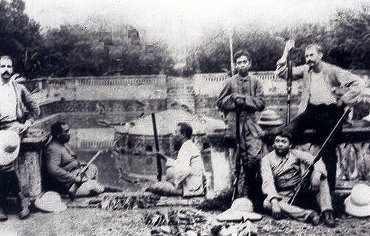
The Sultan (standing 2nd from right) and
friends after a hunt (1890s).
Behind the Sultan is the pond that used to grace the
Istana Anak Bukit. In the words of Father Page who
visited the Istana in 1883 "..at the foot of the hill we
admired a magnificent pond framed in an ornamented
wall of cemented lacework. In the pond are
enormous fishes that gambol on the surface and
swallow flowers thrown to them by visitors.
I do not think there is a more delightful spot
in the Straits.."
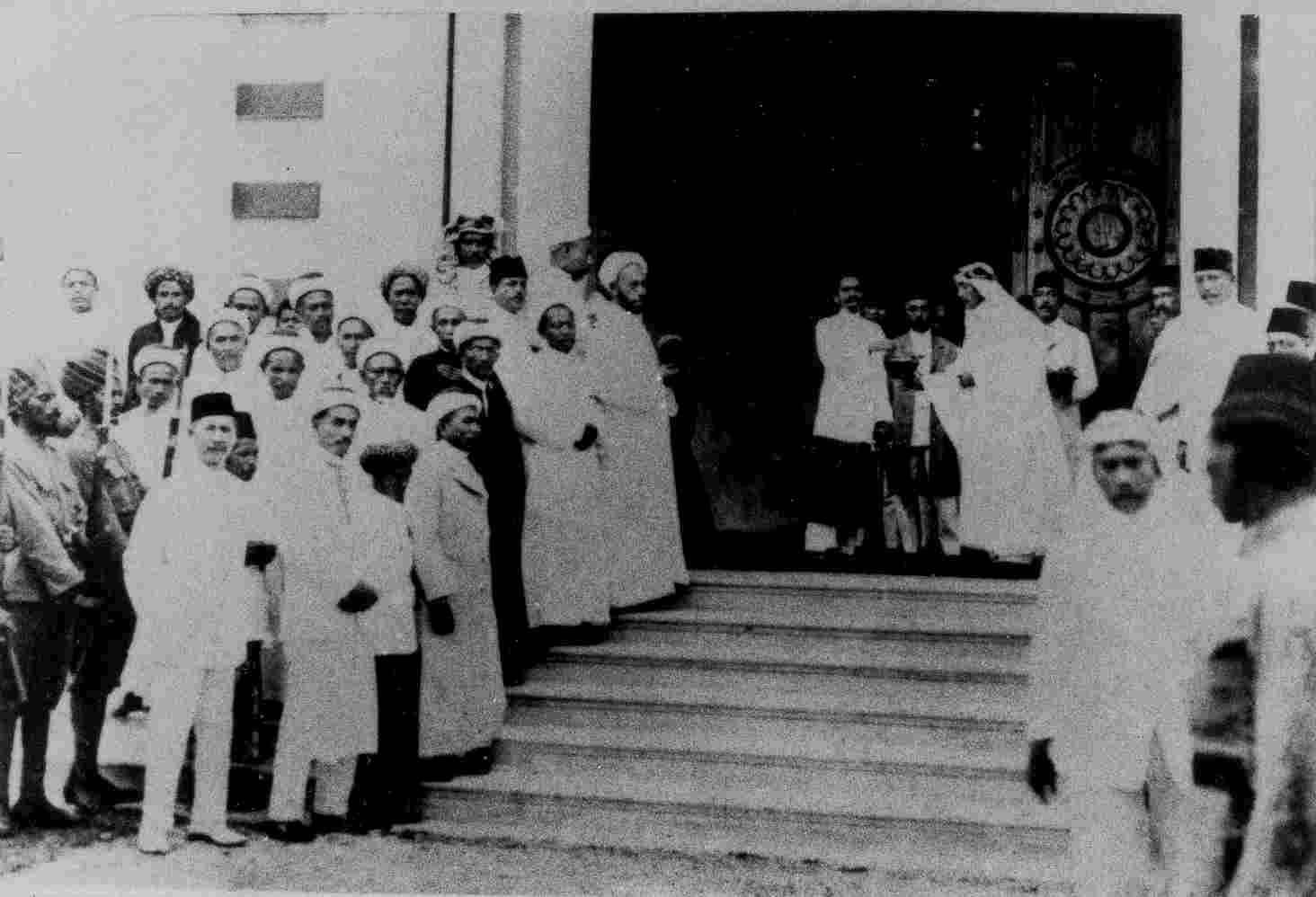
The Opening Ceremony of the Zahir Mosque, 1915.
Notice the Sultan's baju melayu and sarong and Tunku
Mahmud's Arab garb. The "Khutbah" (sermon)
was performed by Tunku Mahmud while the prayer
was lead by the Sultan himself as "Imam".
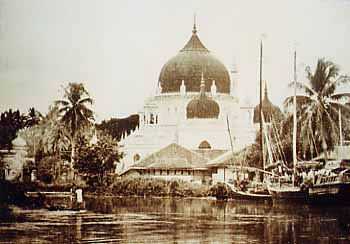
The Zahir Mosque.
Modelled on the Langkat Mosque in Sumatra by
Architect, Mr. C.G. Boutcher. Building began in
March of 1912 and completed in 1915.
|
FROM MY GRAND FATHER'S DIARY
" Ini ingatan mula sembahyang Jumaat di
Masjid Raja, Kota Setar, iaitu, sembahyang
Jumaat 6 Zulhijjah tahun 1333.
Mula ikatnya tahun 1330. "
|
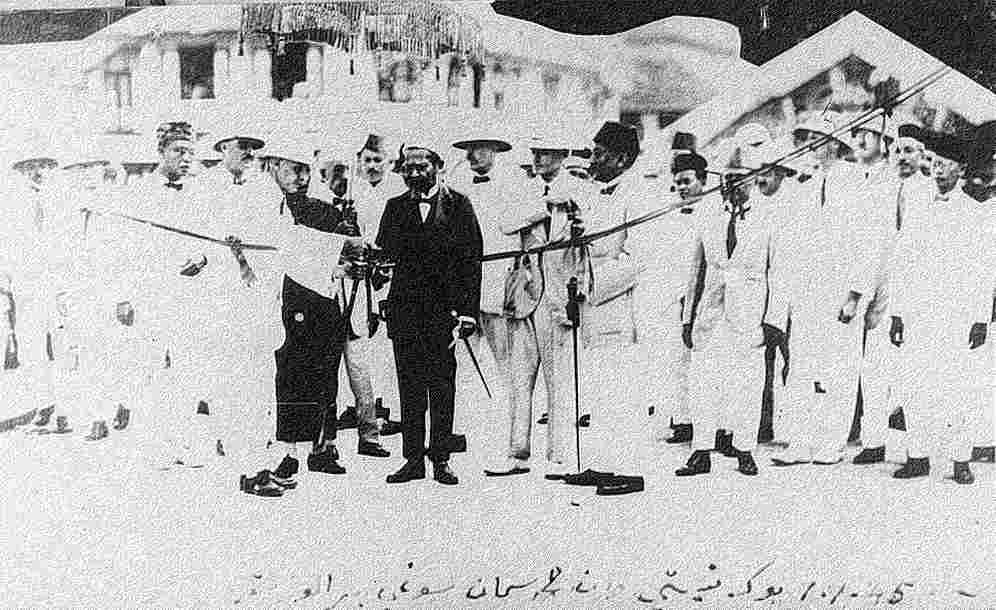
The official opening of the Wan Mat Saman bridge (1926).
The Sultan in black suit.
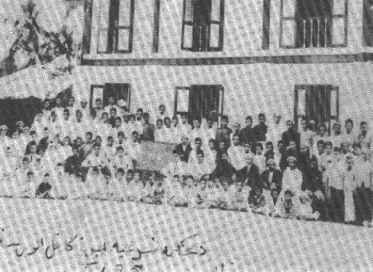
The Madrasah al-Hamidiah, Limbung Kapal.
Established by Wan Sulaiman bin Wan Sidek (affectionately called Pak
Wan Sulaiman) in 1914, this school provided
religious education. The first Headmaster was Sheikh
Abdullah Fahim (Grandfather of Abdullah Badawi,
present Prime Minister of Malaysia).
=============O=============
|
|
THE
SUFI
Datuk James F.Augustin’s foregoing narration casts some very interesting
points and I would like to pick
on these in my attempt to shed some light on the spiritual proclivities
of our Sultan. Mention has been made of the popular belief among some people
that the Sultan was indeed a spiritual person given to seclusion and meditation.
And the various supernatural acts that have been attributed to him might
have been a logical extension of such belief. However there is no extant
record that can explain in any detail the actual circumstances that lead
people to such a belief. As such we need to do some conjecture based on
the little material that we have and try to piece together a wholesome
credible theory. And in this regards, I don’t think that this has been
done before.
The Datuk was born in 1898 in Penang. In 1917 he moved over to Alor Setar
to become a Teacher at the Government English School, which was later renamed
as the Sultan Abdul Hamid College. He remained in the school till 1941
when the second World War broke out. He was therefore in Kedah during much
of the reign of the Sultan and one would naturally expect that he was an
eye witness to many events affecting the Sultan. The detailed nature of
the many essays that he wrote suggest that the information obtained was
first hand. And even if the information was borrowed from some other source,
I would expect that due to the closeness of time and space, such information
would have a quality of freshness that would make it credible. For a school
teacher I would expect no less than due scrutiny.
As such when the Datuk mentioned about the Sultan being a “recluse in the
evening of his life” and that he was “first and foremost a man of prayer”
who “all the while fingered his prayer-beads in prayer”, I would propose
that this was a first hand personal observation. This is interesting because
many writers on Kedah history tend to scoff the idea of the Sultan being
a very religious person and would prefer to mention Tunku Mahmud, the brother
of the Sultan, instead of having such a quality. Citing that the Sultan
did not make any outward presentation, these writers point to Tunku Mahmud’s
work with the Sheikhul Islam, Wan Sulaiman bin Wan Sidek in setting up
the two religious schools, Madrasah Al Hamidiah and the Al-Mahaadil Mahmud.
Not discounting Tunku Mahmud’s own religious bent, for indeed he was, I
would propose that the writers failed to consider the probability that
the Sultan could have been practicing a form of “Inner Islam” – that of
Tasawwuf or Sufism.
For a start let’s look back and ponder on the point about the Sultan being
a recluse. Some relate this cloistered existence to the bouts of illness
that the Sultan experienced which rendered him incapable of running the
daily affairs of government. There is some element of truth in this and
the Sultan did in fact fell ill in the early years of his reign and again
in 1915. However, temporary withdrawal from outer activity in order to
concentrate on spiritual exertions is also a hallmark of Sufism. It is
highly probable that the Sultan was a recluse for this purpose at other
times when he was not ill, particularly “in the evening of his life”. This
assertion is supported by claims made by some members of his family
but much ignored by the Historians. This writer visited the Istana Pelamin
in 2002 and among the many interesting discoveries made was a small room
that was the private prayer chamber of Sultan Abdul Hamid. It was a most
befitting room for a solitary withdrawal for prayer.
The Sultan’s penchant for telling his beads (the “Tasbeh”) must have left
quite an impression on Datuk James F. Augustin for him to state boldly
that the Sultan was “first and foremost a man of prayer”. The use of beads
for the purpose of recollection (Arabic “Zikr”) was of course a common
practice among the Malays of yore (and even today) and one need not be
a practicing Sufi of a particular school to be doing so. However, the fervor
shown by the Sultan leaves me with little doubt that the Sultan was under
some kind of spiritual discipline. Anyone familiar with Islamic Sufism
would know that the repetition of certain formulae is central to Sufi practices.
NEXT HOME |